
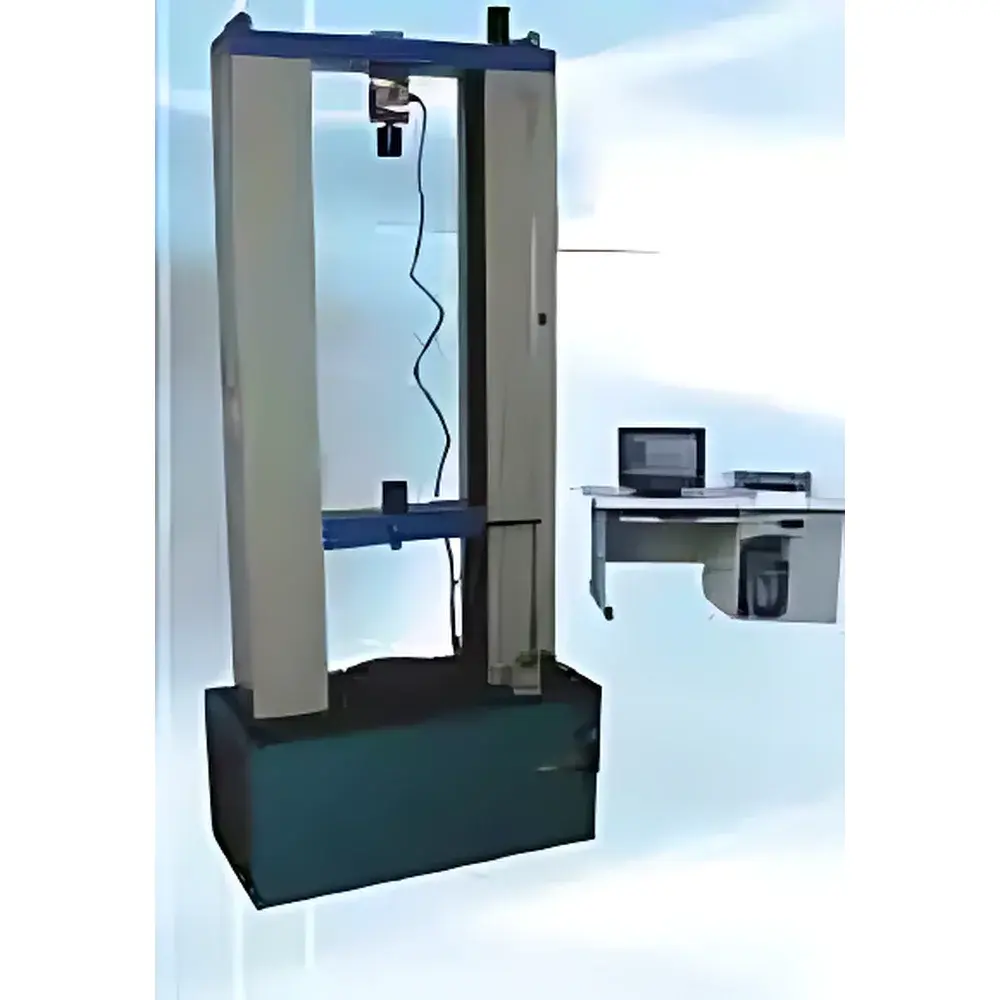
Brookfield JB-124A Universal Tensile and Compression Testing Machine
| Brand | Jiubin Instruments |
|---|---|
| Origin | Taiwan |
| Model | JB-124A |
| Load Capacity | 0–5 kN (user-selectable) |
| Test Speed Range | 0.001–500 mm/min (infinitely variable) |
| Effective Test Width | 380 mm |
| Max. Traverse Distance | 1000 mm |
| Load Cell Accuracy | ±0.5% of full scale |
| Displacement Resolution | 1/200,000 |
| Positioning Accuracy | ±0.005% of full stroke |
| Safety Features | Upper/lower mechanical limits, emergency stop button |
| Power Supply | 220 V / 380 V, 50 Hz |
| Net Weight | 1080–1180 kg |
| Dimensions (W×D×H) | 1280 × 950 × 1800 mm |
| Control System | Servo motor (Japan-made), AC motor (Taiwan-made) |
| Mechanical Drive | High-precision ball screw (Taiwan-made), zero-backlash lead screw (Korea-made) |
| Data Interface | PC + microcomputer dual-display |
| Optional Accessories | PC workstation, thermal/inkjet printer, extensometer, compliant test software |
Overview
The Brookfield JB-124A Universal Tensile and Compression Testing Machine is an electromechanically integrated materials testing system engineered for precision mechanical property evaluation across R&D laboratories, QC departments, and manufacturing process validation environments. It operates on the fundamental principle of controlled uniaxial force application—applying calibrated tensile, compressive, flexural (three-point bending), or shear loads to standardized or custom specimens while simultaneously measuring load, displacement, and strain-derived parameters in real time. The system conforms to core mechanical testing methodologies defined in ASTM E4, ASTM E8/E8M (tension), ASTM E9 (compression), ASTM D790 (flexure), and ISO 6892-1, enabling traceable, repeatable quantification of yield strength, ultimate tensile strength, modulus of elasticity, elongation at break, and compressive yield stress.
Key Features
- Modular dual-control architecture: Synchronized operation via embedded microcomputer controller and external Windows-based PC interface for redundancy and operational flexibility.
- High-fidelity load measurement: U.S.-sourced high-accuracy load cell with ≤±0.5% full-scale linearity error and 200,000-count internal resolution ensures metrological integrity across the 0–5 kN range.
- Precision motion control: Japanese servo motor coupled with Taiwanese high-precision ball screws and Korean zero-backlash lead screws delivers smooth, vibration-damped actuation across the full speed range (0.001–500 mm/min).
- Robust mechanical frame: Floor-standing rigid steel structure (1080–1180 kg mass) minimizes deflection under load; optimized ergonomics and industrial-grade powder-coated finish support long-term stability in ISO Class 7–8 lab environments.
- Comprehensive safety compliance: Dual mechanical end-limit switches, certified emergency stop circuitry (EN ISO 13850), and overload protection safeguard operators and equipment during routine and failure-mode testing.
- Configurable data acquisition: Real-time dual-channel display (load vs. displacement, stress vs. strain) with user-definable sampling rates up to 1 kHz; supports GLP/GMP-compliant audit trails when paired with validated software.
Sample Compatibility & Compliance
The JB-124A accommodates a broad spectrum of specimen geometries and material classes—including metallic alloys, polymer films, elastomeric compounds, textile yarns, leather substrates, composite laminates, and electrical insulation materials—via interchangeable fixture sets (e.g., wedge-action grips, compression platens, three-point bend fixtures, peel test clamps). All mechanical configurations adhere to dimensional tolerances specified in ASTM E1012 (alignment verification) and ISO 7500-1 (static calibration of force-proving instruments). When operated with optional extensometers and validated software modules, the system satisfies data integrity requirements under FDA 21 CFR Part 11 for electronic records and signatures in regulated pharmaceutical and medical device manufacturing settings.
Software & Data Management
Built-in test software provides ISO 17025-aligned workflow management: pre-configured test methods (ASTM/ISO templates), automated pass/fail logic based on user-defined acceptance criteria, and export-ready reporting in PDF, Excel, and XML formats. Raw data files retain full metadata (operator ID, timestamp, environmental conditions, calibration certificate IDs). Audit trail functionality logs all parameter modifications, result deletions, and report revisions with immutable timestamps—critical for regulatory submissions and internal quality audits. Optional integration with LIMS platforms via OPC UA or RESTful API enables seamless data flow into enterprise quality management systems (QMS).
Applications
- Tensile characterization of metal strips, fasteners, and wire harnesses per ASTM B557 and ISO 6892-1.
- Compression testing of foams, gaskets, and biomedical hydrogels under ISO 844 and ASTM D3574.
- Three-point flexural analysis of PCB substrates, thermoset composites, and ceramic tiles per ASTM D790 and ISO 178.
- Peel and tear resistance evaluation of adhesive tapes, laminated packaging, and medical device pouches (ASTM D903, ASTM F904).
- Shear strength determination of bonded joints, riveted assemblies, and structural adhesives (ASTM D1002, ISO 4587).
- Process validation support for extrusion, injection molding, and heat treatment through comparative mechanical property trending across production lots.
FAQ
What standards does the JB-124A comply with for calibration and verification?
The system meets ISO 7500-1 Class 1 accuracy requirements for static force calibration and supports periodic verification per ASTM E4 using certified reference load cells.
Can the machine perform cyclic or fatigue testing?
No—the JB-124A is designed exclusively for quasi-static monotonic loading. For dynamic or high-cycle fatigue applications, a dedicated electrodynamic or servo-hydraulic testing system is required.
Is the software compliant with FDA 21 CFR Part 11?
Yes, when deployed with enabled electronic signature modules, audit trail logging, and secure user role management—subject to site-specific validation protocols.
What is the recommended maintenance interval?
Preventive maintenance—including ball screw lubrication, load cell zero-check, and mechanical alignment verification—is advised every 500 operational hours or semiannually, whichever occurs first.
Does the system support third-party transducers (e.g., extensometers)?
Yes—via standard analog voltage input (±10 V) and digital encoder interfaces compatible with major OEM extensometers meeting ASTM E83 Class B-1 specifications.



