
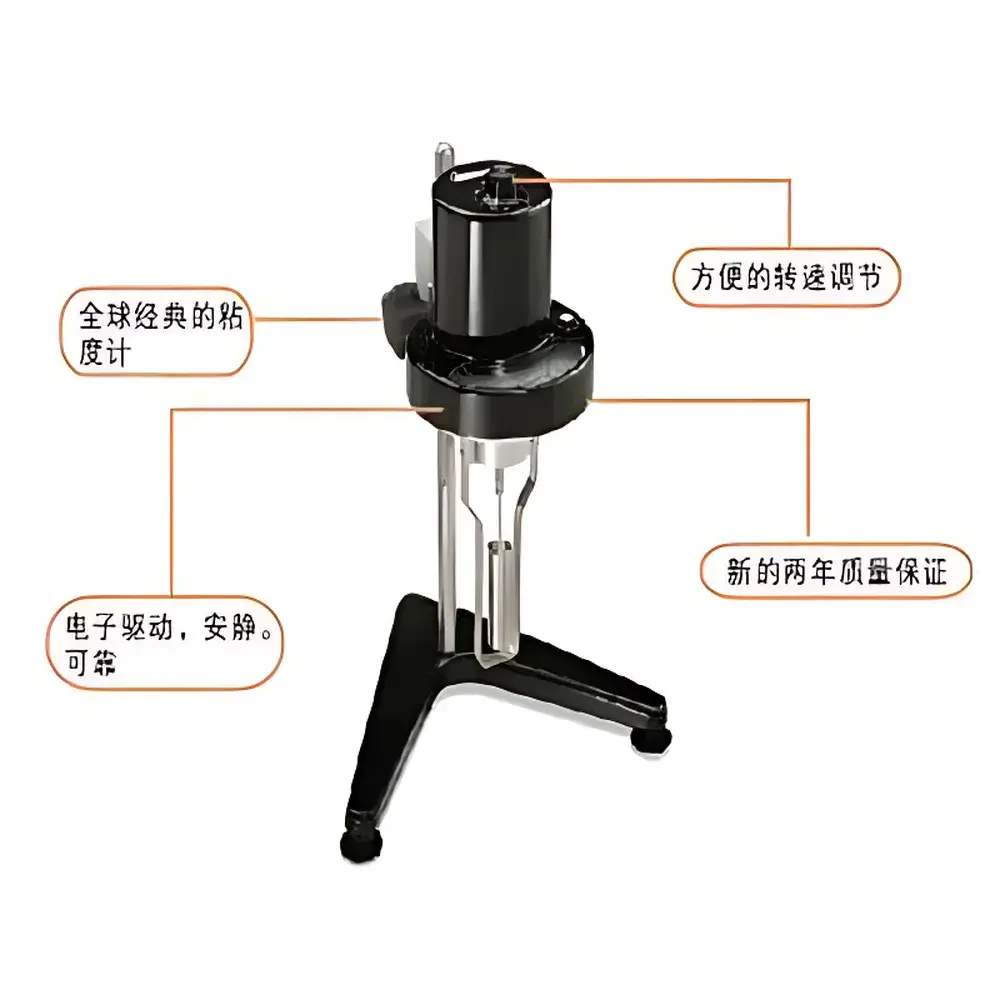
Brookfield LVT/RVT Dial Viscometer
| Brand | Brookfield |
|---|---|
| Origin | USA |
| Model | LVT/RVT |
| Type | Analog Dial Viscometer |
| Standard Spindles | LVT includes LV#1–LV#4 |
| Motor | Multi-speed, low-noise synchronous motor |
| Compliance | Designed to support ASTM D2196, ISO 2555, and USP <911> viscosity testing protocols |
Overview
The Brookfield LVT/RVT Dial Viscometer is a precision-engineered analog rotational viscometer designed for routine viscosity measurement of Newtonian and mildly non-Newtonian fluids in QC laboratories, production floors, and field service environments. Operating on the principle of spring-deflection torque measurement—where fluid resistance to spindle rotation deflects a calibrated helical spring—the instrument delivers direct, real-time viscosity readings in centipoise (cP) or millipascal-seconds (mPa·s) via a robust mechanical dial display. Unlike digital instruments requiring power sources or software interfaces, the LVT/RVT functions entirely passively, ensuring operational continuity during power outages, in remote locations, or within intrinsically safe zones where electronic instrumentation is restricted. Its proven mechanical architecture has remained unchanged for over five decades, reflecting a design philosophy prioritizing long-term reliability, minimal maintenance, and operator independence from calibration software or firmware updates.
Key Features
- True analog operation: No batteries, no firmware, no connectivity dependencies—ideal for GLP-compliant manual recordkeeping and environments with electromagnetic interference.
- Dual-model platform: The LVT variant supports low-viscosity applications (1–1 million cP) using LV spindles #1–#4; the RVT variant extends range to medium-to-high viscosities (100–2 million cP) with RV spindles #2–#7.
- Multi-speed synchronous motor: Offers 18 fixed speeds (0.3–100 rpm) with enhanced acoustic damping for quieter operation and improved thermal stability during extended runs.
- Intrinsically safe configuration: Optional explosion-proof housing (Class I, Division 1, Groups C & D) certified per UL 60079-0 and CSA C22.2 No. 60079-0, enabling use in solvent-based coating, petrochemical, and pharmaceutical manufacturing areas.
- Modular accessory compatibility: Fully interoperable with Brookfield’s full suite of accessories—including small sample adapters, thermosel heating baths, ultra-low volume spindles, and automatic lift stands—without recalibration.
Sample Compatibility & Compliance
The LVT/RVT accommodates a wide range of industrial and research-grade samples, including paints, inks, adhesives, food emulsions, polymer solutions, lubricants, and cosmetic gels. Its spindle geometry and speed selection enable compliance with standardized test methods such as ASTM D2196 (non-Newtonian fluids), ISO 2555 (resin solutions), and USP (pharmaceutical viscosity). While the instrument itself does not generate electronic audit trails, its mechanical readout supports handwritten SOP execution and manual data transcription into validated LIMS or ELN systems under FDA 21 CFR Part 11–aligned documentation practices. Calibration verification is performed using NIST-traceable silicone oil standards (e.g., Brookfield STD series), with certificate-of-calibration available upon request.
Software & Data Management
As a purely analog instrument, the LVT/RVT does not integrate with proprietary software or require drivers, eliminating cybersecurity vulnerabilities, license management, or OS compatibility constraints. All measurements are recorded manually—supporting paper-based or hybrid digital workflows where operators transcribe dial readings into validated spreadsheets or laboratory information management systems. For labs requiring traceability, Brookfield provides optional calibration log templates aligned with ISO/IEC 17025 documentation requirements. Users may pair the viscometer with optional analog-to-digital converters (e.g., Brookfield DV-DAQ) for semi-automated data capture—though such configurations fall outside the base instrument’s qualification scope and require separate validation per GMP Annex 11 guidelines.
Applications
- Quality control of solvent-borne and water-based coatings: Monitoring batch-to-batch consistency prior to filtration and packaging.
- Adhesive formulation development: Screening shear-thinning behavior of acrylic and epoxy systems at low shear rates.
- Food processing: Verifying viscosity of ketchup, salad dressings, and dairy-based sauces against sensory and pumping specifications.
- Pharmaceutical excipient testing: Assessing viscosity of carbomer gels and methylcellulose suspensions per USP monographs.
- Education and training: Teaching fundamental rheological concepts—such as shear rate dependence and spindle geometry effects—without abstraction layers introduced by digital interfaces.
FAQ
Is the LVT/RVT suitable for non-Newtonian fluid characterization?
Yes—when used with appropriate spindle/speed combinations and interpreted alongside shear rate estimates (calculated from spindle geometry and rotational speed), it supports qualitative assessment of shear-thinning or thixotropic trends, though quantitative rheological modeling requires a controlled-stress rheometer.
Can I upgrade my analog LVT/RVT to a digital model later?
No—LVT/RVT units are mechanically distinct from digital DV series instruments. However, all standard spindles, stands, and accessories are cross-compatible across both platforms.
What calibration standards are recommended?
NIST-traceable Brookfield Standard Viscosity Oils (STD-010 through STD-10M) are recommended for periodic verification; annual calibration by an ISO/IEC 17025-accredited lab is advised for regulated environments.
Does the instrument meet FDA or EU regulatory requirements?
The device itself is not “FDA-approved,” but its design, documentation support, and traceable calibration path enable compliance with FDA 21 CFR Part 11 (when paired with validated manual procedures) and EU GMP Annex 11 for paper-based viscosity testing workflows.



