
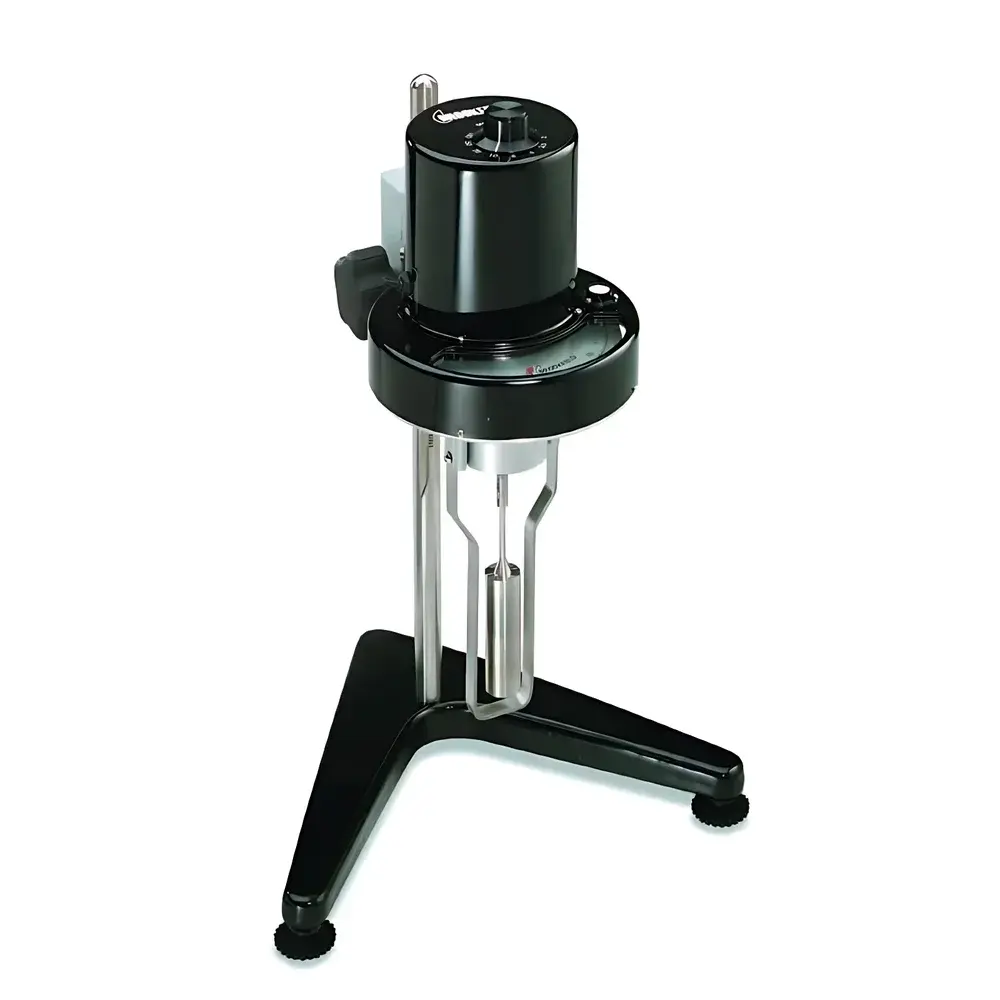
Brookfield LVT/RVT/HAT/HBT Series Dial-Reading Rotational Viscometers
| Brand | Brookfield |
|---|---|
| Origin | USA |
| Manufacturer Type | Original Equipment Manufacturer (OEM) |
| Product Category | Imported Instrument |
| Model Variants | LVT, RVT, HAT, HBT |
| Instrument Type | Benchtop Fixed-Base Rotational Viscometer |
| Operating Environment | Ambient Temperature (15–30°C) |
| Viscosity Range | 1 – 64,000,000 mPa·s (cP) |
| Accuracy | ±1.0% of full-scale reading |
| Repeatability | ±0.2% |
| Speed Control | Stepped Motor-Driven (8–10 RPM increments, model-dependent) |
| Display | Analog Dial Gauge (Torque %) |
| Calibration Compliance | Traceable to NIST standards |
| Warranty | 12 months limited parts and labor |
Overview
The Brookfield LVT/RVT/HAT/HBT Series dial-reading rotational viscometers represent the foundational instrumentation in laboratory and industrial viscosity measurement. Engineered for precision, reliability, and long-term stability, these analog viscometers operate on the principle of Couette flow—measuring the torque required to rotate a spindle at a defined speed within a fluid sample. The resulting deflection of the mechanical dial indicates percent torque, which—when multiplied by the instrument-specific calibration factor—yields dynamic viscosity in centipoise (cP) or millipascal-seconds (mPa·s). As the original standard-setters in rotational rheometry since the 1930s, these instruments remain widely referenced in ASTM D2196, ISO 2555, and USP for routine quality control and process validation across pharmaceutical, paint, food, polymer, and adhesive manufacturing environments.
Key Features
- Robust analog architecture with no dependency on software, firmware, or external power supplies beyond basic AC input—ensuring operational continuity during IT infrastructure outages or regulatory audit periods.
- Dial-based torque readout provides immediate visual feedback without interpretation latency; ideal for training, rapid pass/fail screening, and environments where digital displays are restricted (e.g., explosion-proof zones).
- Motor-driven stepped-speed control delivers consistent, vibration-minimized rotation across discrete RPM increments—LVT offers 8 speeds (0.3–60 rpm), while RVT, HAT, and HBT models provide 10 speeds (0.5–100 rpm).
- Interchangeable spindle sets optimized per model: LV variants include four spindles (LV-1 to LV-4); RV/HA/HB configurations ship with six spindles (RV-1 to RV-6), each calibrated to extend measurable range and improve low-shear sensitivity.
- Integrated protective guard leg minimizes edge effects and enhances reproducibility for Newtonian and mildly non-Newtonian fluids—standard on LV and RV models, excluded from high-torque HA/HB configurations due to mechanical clearance constraints.
- Benchtop G-series stand ensures vertical alignment and sample container stability; all units ship in durable molded carrying cases compliant with IATA transport guidelines for lab equipment.
Sample Compatibility & Compliance
These viscometers accommodate standard 600-mL Griffin beakers or optional cylindrical sample containers (e.g., 250-mL jacketed vessels for temperature-controlled testing). With appropriate accessories—including the Small Sample Adapter (SSA), Ultra-Low Viscosity Adapter (ULA), and Thermosel heated bath—the effective sample volume can be reduced to as little as 2 mL while maintaining ASTM D1200-compliant geometry. All models meet CE marking requirements for electromagnetic compatibility (EN 61326-1) and safety (EN 61010-1). Calibration documentation is supplied with NIST-traceable certificates, supporting GLP/GMP compliance when integrated into controlled document management systems. While not inherently 21 CFR Part 11–compliant (due to analog data capture), audit trails may be established via manual logbooks validated under internal SOPs.
Software & Data Management
As fully analog instruments, the LVT/RVT/HAT/HBT series do not incorporate embedded microprocessors or digital output interfaces. Data recording follows traditional manual transcription protocols: operators record dial readings, selected RPM, spindle ID, and environmental conditions (temperature, time) directly into bound laboratory notebooks or validated electronic lab notebooks (ELNs). For laboratories requiring digitized workflows, Brookfield’s optional DV2T Viscometer (digital successor) supports USB/RS-232 output and PC-based Rheo3000 software with automated calculation, statistical analysis, and export to CSV/PDF formats—enabling seamless integration with LIMS and ERP platforms under FDA 21 CFR Part 11 controls.
Applications
- Pharmaceutical suspensions and ointments (USP consistency testing)
- Paint and coating formulations (ASTM D1200 efflux cup correlation)
- Food emulsions (mayonnaise, dressings) and starch pastes (ISO 6379)
- Adhesives and sealants (shear-thinning behavior assessment at fixed shear rates)
- Polymer melts and resins (preliminary screening prior to capillary or rotational rheometry)
- Industrial lubricants and greases (NLGI consistency classification support)
FAQ
What is the minimum detectable viscosity for the LVT model?
With standard LV-1 spindle and full immersion in a 600-mL beaker, the lower limit is 1 cP (1 mPa·s); using the optional ULA adapter reduces this to 0.1 cP under controlled conditions.
Can these viscometers measure non-Newtonian fluids?
Yes—by conducting multi-speed tests and plotting apparent viscosity vs. shear rate (RPM × geometric constant), users can identify shear-thinning, shear-thickening, or yield-stress behavior—though yield point quantification requires additional analysis tools.
Is calibration verification required before each use?
Per ISO/IEC 17025 and internal QC protocols, daily verification with certified viscosity standards (e.g., silicone oils traceable to NIST SRM 2490 series) is recommended for regulated environments.
Are replacement spindles and calibration certificates available separately?
Yes—Brookfield supplies individually serialized spindles with factory calibration reports (part numbers ending in -CAL); recalibration services are offered globally through authorized service centers with ISO/IEC 17025 accreditation.
Does the guard leg affect measurement accuracy for thixotropic samples?
The guard leg stabilizes flow geometry but may suppress transient structural breakdown; for thixotropy assessment, remove the guard leg and use standardized rest/shear/recovery timing protocols per ASTM D7483.



