
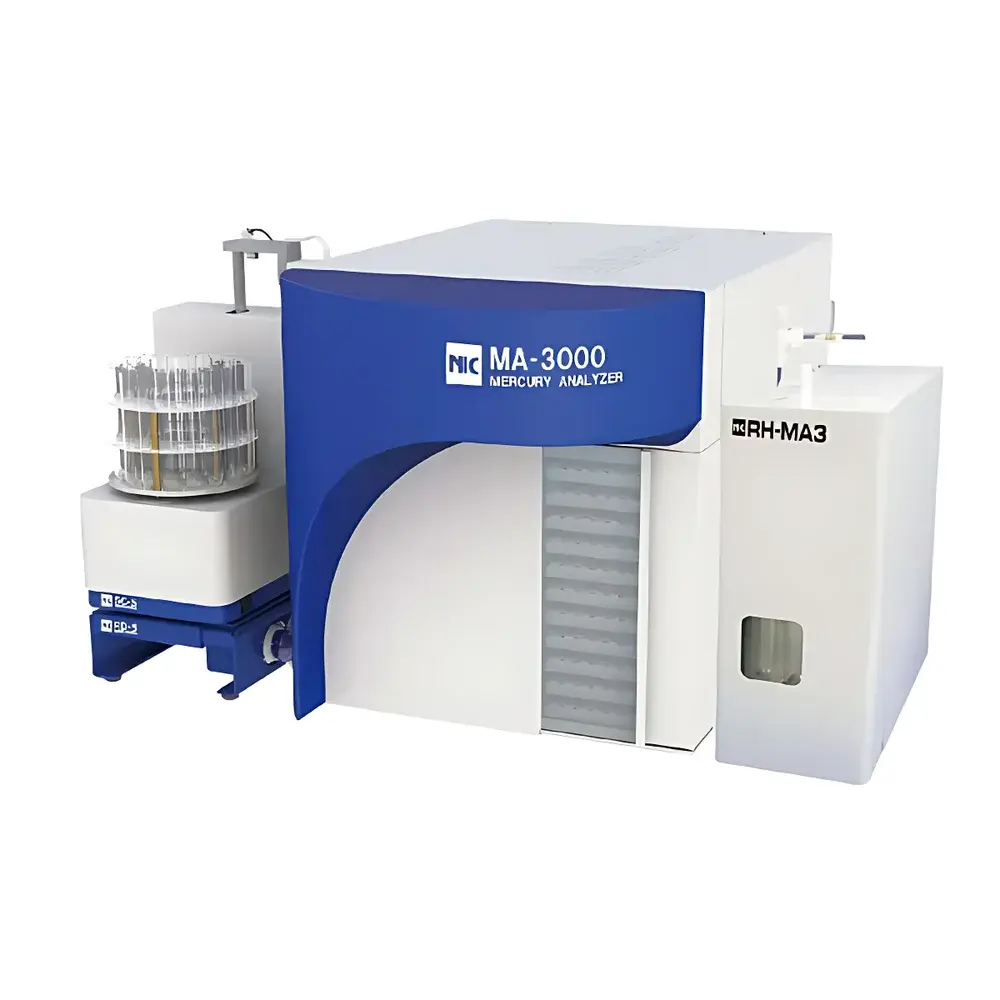
Brookfield MA-3000 Direct Mercury Analyzer
| Brand | Brookfield |
|---|---|
| Origin | Beijing, China |
| Manufacturer Type | Manufacturer |
| Regional Category | Domestic (China) |
| Model | MA-3000 |
| Instrument Type | Benchtop Laboratory Analyzer |
| Measurement Principle | Cold Vapor Atomic Absorption Spectrometry (CVAAS) with Thermal Decomposition and Gold Amalgamation |
| Detection Limit | < 0.001 ng Hg |
| Dynamic Range | 0.001–70,000 ng Hg |
| Sample Throughput | 100-position Autosampler |
| Regulatory Compliance | ASTM D6722-19, ASTM D7623-20, UOP 1009-15, ISO 15411, US EPA Method 7473 |
| Patented Technology | JP No. 5596995 (Dual-cell, Triple-beam CVAAS Detector), JP No. 5001419 (Catalyzed Thermal Decomposition Tube) |
Overview
The Brookfield MA-3000 Direct Mercury Analyzer is a benchtop laboratory instrument engineered for precise, interference-resistant total mercury quantification across solid, liquid, and gas-phase matrices. It employs thermal decomposition coupled with gold amalgamation and cold vapor atomic absorption spectrometry (CVAAS) at the resonance wavelength of 253.7 nm. Unlike traditional wet-chemistry or hydride generation approaches, the MA-3000 eliminates sample digestion, chemical reagents, and manual pretreatment—enabling direct analysis of heterogeneous samples such as soil, sediment, coal, biological tissues, petroleum products, and air filters. Its core architecture integrates a high-efficiency catalytic decomposition furnace, temperature-controlled mercury transport path, and a patented dual-cell triple-beam optical detection system (JP No. 5596995), which actively compensates for lamp drift and background absorption—ensuring long-term signal stability and metrological rigor under routine laboratory operation.
Key Features
- Patented dual-cell triple-beam CVAAS detector (JP No. 5596995) delivering sub-0.001 ng method detection limit (MDL) and linear dynamic range spanning five orders of magnitude (0.001–70,000 ng Hg)
- Catalyzed thermal decomposition tube incorporating NIC’s proprietary catalyst formulation (JP No. 5001419), enhancing resistance to halogen and selenium interferences during high-temperature sample pyrolysis
- Integrated 100-position autosampler enabling unattended batch analysis of heterogeneous sample types—including solids, liquids, and adsorbent-trapped gases
- Active thermal management system minimizing mercury memory effect through precise zone-specific temperature control of the furnace, transfer lines, and amalgamation trap
- Modular configuration support: standard MA-3000 can be upgraded to SCRD & RH-MA3 configuration, enabling three orthogonal mercury analysis modes on a single platform—direct thermal decomposition (solids/liquids), reduction vaporization (trace aqueous Hg), and thermal desorption (gas-phase Hg captured on sorbents)
Sample Compatibility & Compliance
The MA-3000 accommodates diverse sample forms without matrix-specific method development: intact soils, sludge, fly ash, blood, urine, hair digests, crude oil, lubricants, and activated carbon traps. Its analytical performance meets or exceeds requirements specified in internationally recognized standards including ASTM D6722-19 (mercury in coal and coke), ASTM D7623-20 (mercury in natural gas condensates), UOP 1009-15 (mercury in hydrocarbon streams), ISO 15411 (mercury in water by CVAAS), and US EPA Method 7473 (total mercury in solids and liquids by thermal decomposition). The instrument supports GLP/GMP-aligned workflows through audit-trail-capable software, electronic signature compatibility, and full traceability of calibration history, sample metadata, and raw absorbance data—facilitating regulatory submissions and third-party laboratory accreditation.
Software & Data Management
The MA-3000 operates via dedicated Windows-based control software compliant with FDA 21 CFR Part 11 requirements. It provides real-time spectral visualization, automated peak integration, multi-point calibration curve generation with weighting options, and customizable reporting templates aligned with ISO/IEC 17025 documentation standards. All measurement parameters—including furnace ramp profiles, amalgamation trap dwell time, purge gas flow rates, and lamp current—are fully programmable and stored with each run. Raw absorbance vs. time traces, baseline correction logs, and diagnostic flags (e.g., incomplete decomposition, trap saturation, lamp instability) are embedded in the data file structure. Export formats include CSV, PDF, and XML for LIMS integration and external statistical analysis.
Applications
The MA-3000 serves environmental monitoring laboratories conducting EPA-compliant site assessments; petrochemical QA/QC labs verifying mercury speciation limits in feedstocks and refined products; clinical toxicology units quantifying biomonitoring markers in human biofluids; and research institutions studying mercury biogeochemical cycling in aquatic sediments or atmospheric deposition. Its ability to analyze undiluted, high-matrix samples—such as 500 mg soil or 1 mL whole blood—without acid digestion or distillation reduces procedural blank contributions and improves accuracy at ultra-trace levels. Applications validated by NIC include mercury speciation screening in fish tissue homogenates, rapid screening of catalyst poisoning in syngas streams, and compliance testing of mercury emissions from municipal waste incinerators per EU Directive 2010/75/EU.
FAQ
Does the MA-3000 require sample digestion prior to analysis?
No. The instrument performs direct thermal decomposition, eliminating the need for acid digestion, distillation, or chemical reduction steps.
Can the same instrument analyze both solid and liquid samples without hardware modification?
Yes. The MA-3000’s universal sample boat design and programmable thermal protocol accommodate solids (e.g., soil, tissue) and liquids (e.g., water, serum) using identical hardware—only the heating program and sample mass/volume differ.
How does the dual-cell triple-beam detector improve measurement robustness?
It uses one reference beam for lamp intensity normalization, one sample beam for analyte absorption, and a third beam for real-time background correction—reducing sensitivity to lamp aging, window fouling, and gas-phase interferences.
Is the MA-3000 compatible with laboratory information management systems (LIMS)?
Yes. The software supports ASTM E1384-compliant data export and offers ODBC connectivity for direct LIMS integration.
What maintenance intervals are recommended for the catalytic decomposition tube?
Under typical usage (≤ 500 analyses/month), the tube maintains performance for ≥ 2,000 runs; replacement is indicated when observed signal drift exceeds ±3% over 10 consecutive calibrations or when decomposition efficiency falls below 98% for certified reference materials.





