
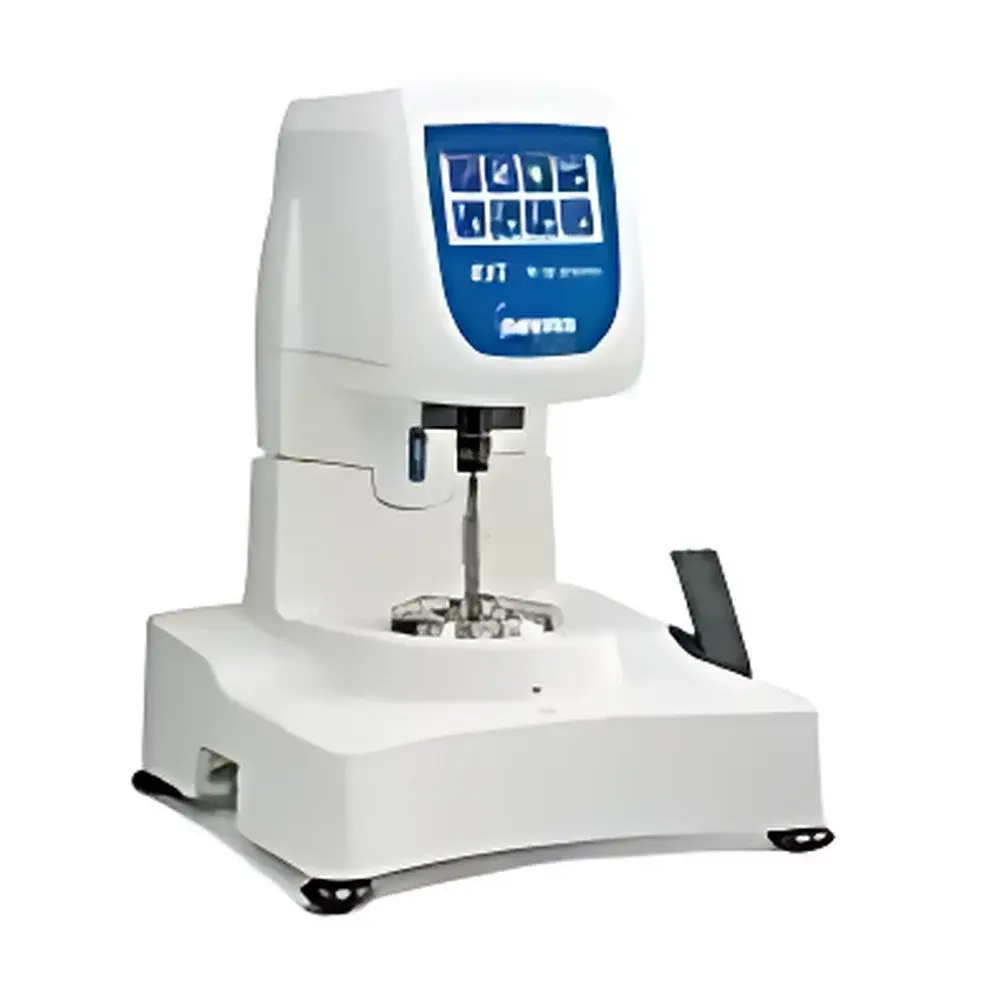
Brookfield RST Series Touchscreen Rotational Rheometers
| Brand | Brookfield |
|---|---|
| Origin | USA |
| Instrument Type | Rotational Rheometer |
| Sample State | Liquid or Soft Solid |
| Bearing Type | Mechanical Bearing |
| Minimum Speed | 0.01 rpm |
| Maximum Speed | 1300 rpm |
| Frequency Range | 0.7–800 rad/s |
| Maximum Torque | 100 mN·m |
| Torque Resolution | 0.01 mN·m / 0.015 mrad |
| Geometry Options | Cone/Plate (RST-CPS), Coaxial Cylinder (RST-CC), Vane/Paddle (RST-SST) |
| Temperature Control Options | Circulating Bath (−20 °C to 200 °C), Peltier Air (20–180 °C), Peltier Oil (0–180 °C), Electric Heater (40–250 °C) |
Overview
The Brookfield RST Series is a family of modular, touchscreen-enabled rotational rheometers engineered for precision rheological characterization across diverse material classes—from low-viscosity Newtonian fluids to structured soft solids and highly filled suspensions. Based on the Couette flow principle in coaxial cylinder (RST-CC), controlled-gap cone-and-plate (RST-CPS), and vane/paddle geometries (RST-SST), the platform delivers traceable shear stress, shear rate, and normal force measurements under programmable control. Each variant is designed to meet distinct metrological requirements: RST-CPS excels in rapid, small-volume screening with high shear-rate resolution; RST-CC provides absolute viscosity calibration traceability per ASTM D2196 and ISO 3219; RST-SST implements structural yield and viscoelastic recovery analysis compliant with ASTM D7478 and USP for semi-solids. All models operate natively via integrated touchscreen interface—enabling standalone QC execution—and support full PC-based method development and data governance through Rheo3000 software.
Key Features
- Intuitive 7-inch capacitive touchscreen interface with real-time graphing and on-device method storage—no external PC required for routine QC testing.
- Modular geometry architecture: Interchangeable transducer heads accommodate cone/plate (1°, 2°, 4°), parallel-plate (25 mm, 50 mm), coaxial cylinder (various bob/cup combinations), and vane/paddle spindles—all calibrated to NIST-traceable standards.
- High-fidelity torque sensing with 0.01 mN·m resolution and <0.1% linearity over full range, enabling accurate yield stress determination down to 0.2 Pa (RST-SST) and complex modulus quantification at low frequencies.
- Multi-mode temperature control: Integrated Peltier systems (air- or oil-cooled) deliver ±0.1 °C stability from 0 °C to 180 °C; circulating bath compatibility extends operational range to −20 °C or 200 °C; electric heating modules support up to 250 °C for high-temperature polymer melt studies.
- Dual-control operation: Independent selection of shear rate (0.001–1300 s⁻¹), shear stress (0.01–218 kPa), or rotational speed (0.01–1300 rpm) with closed-loop feedback—ensuring reproducible transient and steady-state protocols.
Sample Compatibility & Compliance
The RST Series supports liquid, paste, gel, and particulate-laden samples without pre-dilution or homogenization. RST-CPS accommodates as little as 0.02 mL for high-value formulations (e.g., biopharmaceuticals, cosmetic actives); RST-CC maintains laminar flow integrity for ISO 16520-compliant viscosity certification; RST-SST preserves microstructure during vane insertion—critical for sediment-stabilized slurries, toothpaste, or battery electrode pastes. All configurations comply with GLP/GMP documentation requirements when used with Rheo3000 software’s 21 CFR Part 11–enabled audit trail, electronic signatures, and user-access controls. Test methods align with ASTM D4402 (asphalt), ISO 14470 (yield stress), and USP (rheology of semisolids), supporting regulatory submissions and internal quality agreements.
Software & Data Management
Rheo3000 software provides full instrument control, method automation, and advanced data processing—including time sweeps, frequency sweeps, creep-recovery modeling, and Herschel-Bulkley fitting. Raw torque vs. time, G′/G″ vs. ω, and flow curve overlays are exportable in CSV, Excel, or PDF formats with embedded metadata (operator ID, timestamp, calibration certificate ID). The software enforces version-controlled SOPs, supports IQ/OQ validation templates, and logs all parameter changes with operator attribution—meeting FDA and EMA data integrity expectations. Optional add-ons include automated yield point detection algorithms, batch comparison dashboards, and LIMS integration via ASTM E1384-compliant HL7 messaging.
Applications
- Pharmaceuticals: Gel strength profiling of topical formulations, syringeability assessment of injectables, and thermal stability mapping of thermosensitive hydrogels.
- Food & Beverage: Yield stress quantification of yogurts and sauces, thixotropic recovery kinetics in dressings, and particle suspension stability in plant-based milks.
- Coatings & Inks: Shear-thinning behavior of UV-curable resins, sag resistance evaluation of architectural paints, and pigment dispersion stability in lithographic inks.
- Polymers & Composites: Melt elasticity of polyolefins, filler network breakdown in conductive pastes, and crosslink density evolution during epoxy cure monitoring.
- Energy Materials: Rheological fingerprinting of lithium-ion battery cathode slurries, anti-settling performance of drilling muds, and pumpability of asphalt binders at service temperatures.
FAQ
What distinguishes RST-CPS from RST-CC in terms of measurement accuracy?
RST-CPS uses defined-gap cone/plate geometry for absolute shear rate control—ideal for non-Newtonian fluid characterization where local shear rate must be known precisely. RST-CC employs coaxial cylinder geometry with calculable shear rate profiles, providing higher absolute viscosity accuracy per ISO 3219 and better suitability for QC viscosity certification.
Can the same instrument switch between liquid and soft-solid testing?
Yes—via hardware module exchange. RST-SST requires the optional Soft Solids Test Kit (including vane spindle, adjustable base, and dedicated firmware), while RST-CPS and RST-CC share the same motor/transducer assembly and touchscreen controller.
Is temperature calibration traceable to national standards?
All Peltier and bath temperature sensors are factory-calibrated against NIST-traceable reference probes; optional PT100 immersion sensors (PT-E) provide in-situ verification with ±0.1 °C uncertainty.
How does the system ensure data integrity for regulated environments?
Rheo3000 software implements role-based access, immutable audit trails, electronic signatures, and automatic backup—fully compliant with 21 CFR Part 11, EU Annex 11, and ISO/IEC 17025 documentation requirements.
What maintenance is required for mechanical bearing systems?
The sealed mechanical bearing assembly requires no periodic lubrication or alignment; routine verification includes torque zero-check and geometry gap calibration using supplied gauge blocks—recommended annually or after 500 hours of operation.



