
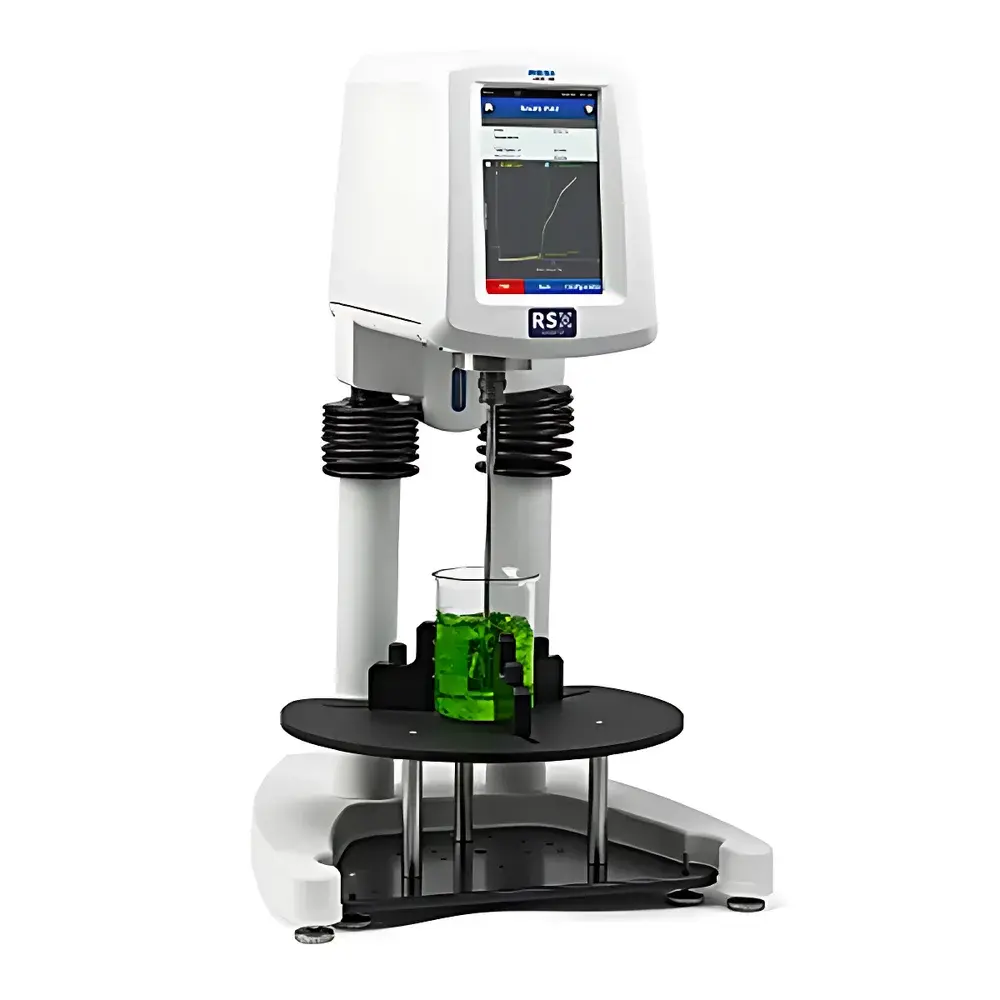
Brookfield RSX-CC Coaxial Cylinder Rheometer
| Brand | Brookfield |
|---|---|
| Origin | USA |
| Manufacturer Type | Authorized Distributor |
| Origin Category | Imported |
| Model | RSX-CC |
| Pricing | Available Upon Request |
Overview
The Brookfield RSX-CC Coaxial Cylinder Rheometer is a high-performance, motorized rotational rheometer engineered for precision-controlled shear stress and shear rate measurements across a broad spectrum of complex fluids and soft solids. Based on the Couette flow principle—where torque is measured as a sample shears between a rotating outer cylinder (cup) and a stationary inner cylinder (bob)—the RSX-CC delivers high reproducibility in viscosity, yield stress, thixotropy, viscoelastic moduli (G′, G″), and flow curve characterization. Designed for both R&D laboratories and quality control environments, it supports ISO 16520, ASTM D2196, and ASTM D445-compliant testing protocols, and its architecture meets fundamental requirements for GLP-compliant data integrity when integrated with validated software workflows.
Key Features
- Advanced dual-mode control: Independent regulation of shear stress (0.001–139.37 Pa) and shear rate (0.013–4344 s⁻¹), enabling full flow curve construction and yield point determination via controlled-stress ramping.
- Integrated high-torque motor system: Delivers up to 139.37 mN·m maximum torque—optimized for structured gels, pastes, polymer melts, and filled composites requiring robust mechanical response.
- Intelligent transducer recognition: Each coaxial cylinder (CCT) rotor features embedded RFID or barcode encoding; the instrument auto-detects geometry, applies correct calibration coefficients, and validates measurement validity in real time.
- Minimal sample volume operation: As low as 13.4 mL (CCT-8 geometry) to 16.8 mL (CCT-25), reducing material consumption and accelerating cleaning cycles—critical for high-throughput screening and expensive formulations.
- Motorized vertical positioning: Precision stepper-driven lift mechanism enables repeatable gap setting (±1 µm resolution) and accommodates thermal expansion during temperature sweeps.
- Modular temperature control: Compatible with direct immersion in standard water baths or external recirculating chillers (e.g., FTKY3 jacketed system); operational range spans −20 °C to +180 °C with ±0.1 °C stability under steady-state conditions.
Sample Compatibility & Compliance
The RSX-CC accommodates non-Newtonian liquids, suspensions, emulsions, thermosetting resins, food pastes, pharmaceutical gels, and elastomeric compounds. Its coaxial cylinder geometries—including CCT-DG, CCT-40, CCT-25, CCT-14, and CCT-8—provide optimized surface area-to-gap ratios for accurate shear field homogeneity and reduced end effects. All geometries comply with ISO 3219 Annex A for rotational viscometry and are traceable to NIST-certified reference oils. The system supports audit-ready documentation per FDA 21 CFR Part 11 when used with Brookfield Rheo3000 software configured for electronic signatures, user access levels, and immutable audit trails.
Software & Data Management
Controlled via Brookfield’s Rheo3000 v4.x platform, the RSX-CC offers intuitive touchscreen navigation, real-time rheogram plotting (τ vs. γ̇, G′/G″ vs. ω), and automated test sequencing (e.g., step-shear, oscillatory frequency sweeps, time sweeps). Data export formats include CSV, Excel (.xlsx), and universal .rhe files containing metadata (geometry ID, temperature, calibration date, operator ID). Software validation packages—including IQ/OQ documentation, UAT scripts, and change control logs—are available for regulated industries operating under GMP or ISO 17025 frameworks.
Applications
- Quality assurance of coatings and inks: Yield stress mapping to prevent sagging; thixotropic recovery analysis for spray application consistency.
- Pharmaceutical formulation development: Gelation kinetics of thermoresponsive hydrogels; viscosity profiling of ophthalmic suspensions under physiological shear rates.
- Food texture engineering: Structural breakdown of dairy gels during mouthfeel simulation; cold-set gel strength evaluation at refrigerated temperatures.
- Adhesives and sealants: Creep compliance testing under sustained load; melt viscosity of hot-melt adhesives prior to extrusion.
- Academic rheology research: Linear viscoelastic region (LVR) identification; Cox-Merz superposition validation for polymer solutions.
FAQ
What coaxial cylinder geometries are included with the RSX-CC system?
The base configuration includes CCT-DG, CCT-40, CCT-25, CCT-14, and CCT-8—each calibrated and supplied with individual geometry ID tags.
Does the RSX-CC support oscillatory testing?
Yes, it performs controlled-strain and controlled-stress oscillatory measurements (amplitude sweeps, frequency sweeps, time sweeps) to determine storage and loss moduli.
Is temperature calibration traceable to national standards?
Temperature sensors are factory-calibrated against NIST-traceable references; optional on-site calibration certificates (ISO/IEC 17025 accredited) are available.
Can the RSX-CC be integrated into an automated lab environment?
It supports Ethernet (TCP/IP) and RS-232 communication protocols, enabling integration with LIMS, MES, or PLC-based production monitoring systems.
What maintenance intervals are recommended for long-term accuracy?
Annual verification of torque sensor linearity and geometry alignment is advised; quarterly verification of temperature uniformity within the cup is recommended for regulated applications.
Related Products



