
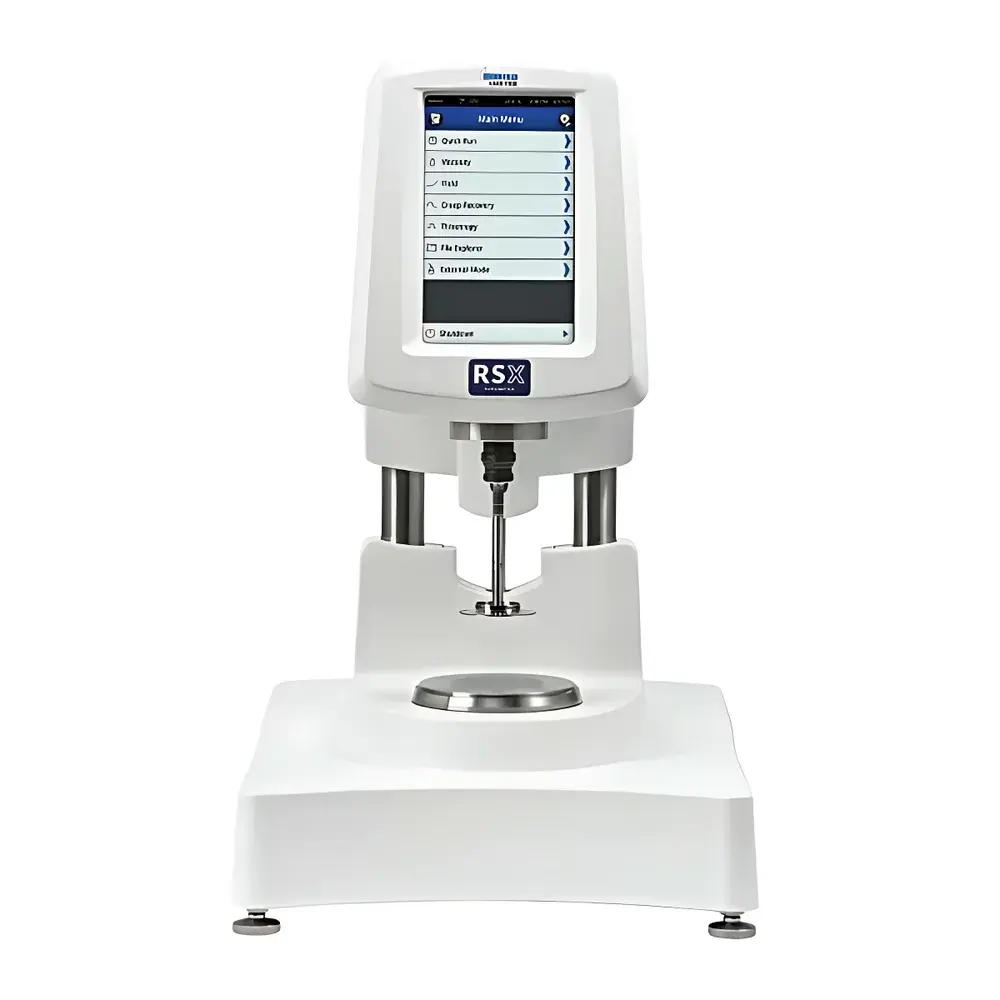
Brookfield RSX Cone-Plate Rheometer
| Brand | Brookfield |
|---|---|
| Origin | USA |
| Model | RSX |
| Type | Advanced Controlled-Stress/Controlled-Rate Cone-Plate Rheometer |
| Sample Volume | As low as 0.1 mL (depending on cone geometry) |
| Shear Rate Range | 0.001–6,000 s⁻¹ |
| Shear Stress Range | 0.0038–204 kPa |
| Torque Range | 0.01–100 mN·m |
| Temperature Control Options | Peltier (±0.1 °C) or Circulating Water Bath |
| Compliance | ASTM D2196, ISO 3219, ISO 6721-10, USP <911>, FDA 21 CFR Part 11 ready (with optional software module) |
Overview
The Brookfield RSX Cone-Plate Rheometer is an advanced, microprocessor-controlled rotational rheometer engineered for precision characterization of complex fluid behavior under controlled shear stress and shear rate conditions. Utilizing the well-established cone-and-plate geometry—where a precisely angled conical rotor rotates above a flat stationary plate—it delivers uniform shear rate distribution across the entire sample gap, enabling highly reproducible measurements of viscosity, yield stress, thixotropy, viscoelastic moduli (G′, G″), and flow curves. Designed for laboratories requiring regulatory-compliant rheological data in QC, R&D, and process development environments, the RSX operates on Couette flow principles with direct torque measurement via a high-resolution electromagnetic torque transducer. Its modular architecture supports both steady-state and dynamic oscillatory testing protocols, making it suitable for non-Newtonian fluids including polymer melts, pharmaceutical suspensions, food emulsions, coatings, and battery slurries.
Key Features
- True dual-mode operation: simultaneous controlled-stress (CS) and controlled-rate (CR) testing with automatic mode switching during a single experiment.
- Integrated 7-inch capacitive touch display with intuitive icon-driven interface; no external PC required for basic operation.
- Quick-connect rotor system with magnetic alignment and auto-sensing RFID/QR-coded rotors—eliminates manual calibration entry and reduces setup errors.
- Ultra-low sample volume capability: as little as 0.1 mL for standard 25 mm cones, minimizing material consumption and waste—critical for high-value or hazardous samples.
- High-torque motor (up to 100 mN·m) with enhanced thermal stability, enabling reliable measurement of stiff gels, pastes, and semi-solid formulations without slippage or overload.
- Modular temperature control: interchangeable Peltier-based stage (–10 to 150 °C, ±0.1 °C accuracy) or external water bath coupling for extended thermal range and stability.
- Ruggedized industrial-grade chassis with IP54-rated enclosure, vibration-dampened base, and reinforced bearing assembly—validated for continuous use in production-floor environments.
Sample Compatibility & Compliance
The RSX accommodates a wide range of sample types—from low-viscosity solvents to highly structured yield-stress fluids—using interchangeable cone geometries (25 mm, 50 mm, 75 mm) and matching plates. Optional solvent trap and environmental hood accessories enable volatile sample handling. All hardware and firmware comply with international standards governing rheological instrumentation, including ISO 3219 (cone-plate geometry tolerances), ASTM D2196 (non-Newtonian viscosity measurement), ISO 6721-10 (dynamic mechanical analysis), and USP (rheology of pharmaceutical dosage forms). When configured with Rheo3000 v4.2 software and audit trail module, the system meets FDA 21 CFR Part 11 requirements for electronic records and signatures, supporting GLP and GMP workflows with full user access control, event logging, and data integrity validation.
Software & Data Management
The RSX is fully compatible with Brookfield’s Rheo3000 v4.2 software suite, a Windows-based platform offering real-time graphing, multi-step test programming, and automated report generation in PDF, CSV, and XML formats. The software includes built-in models for Herschel-Bulkley, Casson, and Cross fitting; time-sweep thixotropy analysis; and frequency sweep storage/loss modulus calculation. Raw torque and angular displacement data are recorded at up to 100 Hz sampling rate. Data files include embedded metadata (operator ID, timestamp, instrument serial number, rotor ID, temperature, and environmental conditions), ensuring traceability. Optional cloud synchronization and LIMS integration modules support centralized data governance across multi-site laboratory networks.
Applications
- Pharmaceuticals: Gel strength profiling of topical formulations, injectable suspension stability assessment, and excipient screening per ICH Q5C guidelines.
- Food Science: Yield stress determination of yogurts and sauces; temperature-dependent viscosity mapping of chocolate and dairy products.
- Coatings & Inks: Thixotropic recovery evaluation for spray- and brush-applied systems; sag resistance modeling using creep-recovery tests.
- Electrochemical Materials: Rheological fingerprinting of cathode/anode slurries for lithium-ion battery manufacturing—correlating viscosity hysteresis with particle dispersion quality.
- Personal Care: Structuring agent efficacy testing in shampoos and conditioners; sensory attribute prediction via flow curve parameters.
- Polymer Processing: Melt elasticity and extensional viscosity estimation using LAOS (Large Amplitude Oscillatory Shear) protocols.
FAQ
What cone geometries are available for the RSX, and how do they affect measurement sensitivity?
The RSX supports three standard cone diameters: 25 mm, 50 mm, and 75 mm, each with single- or dual-angle variants (e.g., RCTO-25-1, RCTO-75-2). Smaller cones provide higher shear stress sensitivity and lower minimum viscosity detection limits; larger cones improve signal-to-noise ratio for low-stress measurements and accommodate particulates up to 100 µm.
Can the RSX perform oscillatory tests, and what frequency range is supported?
Yes—the RSX performs both amplitude sweeps (0.01–100% strain) and frequency sweeps (0.01–100 Hz) with phase angle resolution ≤0.1°, enabling accurate determination of linear viscoelastic region (LVR) and time-temperature superposition (TTS) analysis.
Is the RSX compatible with third-party temperature baths or environmental chambers?
Yes—via standardized flange mounting and analog/digital I/O ports, the RSX integrates with external circulating baths (e.g., Julabo, Huber) and humidity-controlled enclosures using Brookfield’s External Device Interface (EDI) protocol.
How does the auto-rotor recognition system function, and what data is stored?
Each rotor contains a passive NFC tag encoding geometry type, cone angle, truncation gap, calibration date, and torque offset. Upon insertion, the RSX reads this information and loads corresponding correction factors into the active test method—no manual input required.
What maintenance is recommended for long-term torque accuracy?
Annual verification using Brookfield’s NIST-traceable torque calibration kit (part # CAL-KIT-RSX) is recommended. Routine cleaning of cone surfaces with lint-free wipes and isopropanol, plus quarterly bearing lubrication check, ensures >10,000-hour operational reliability.



