
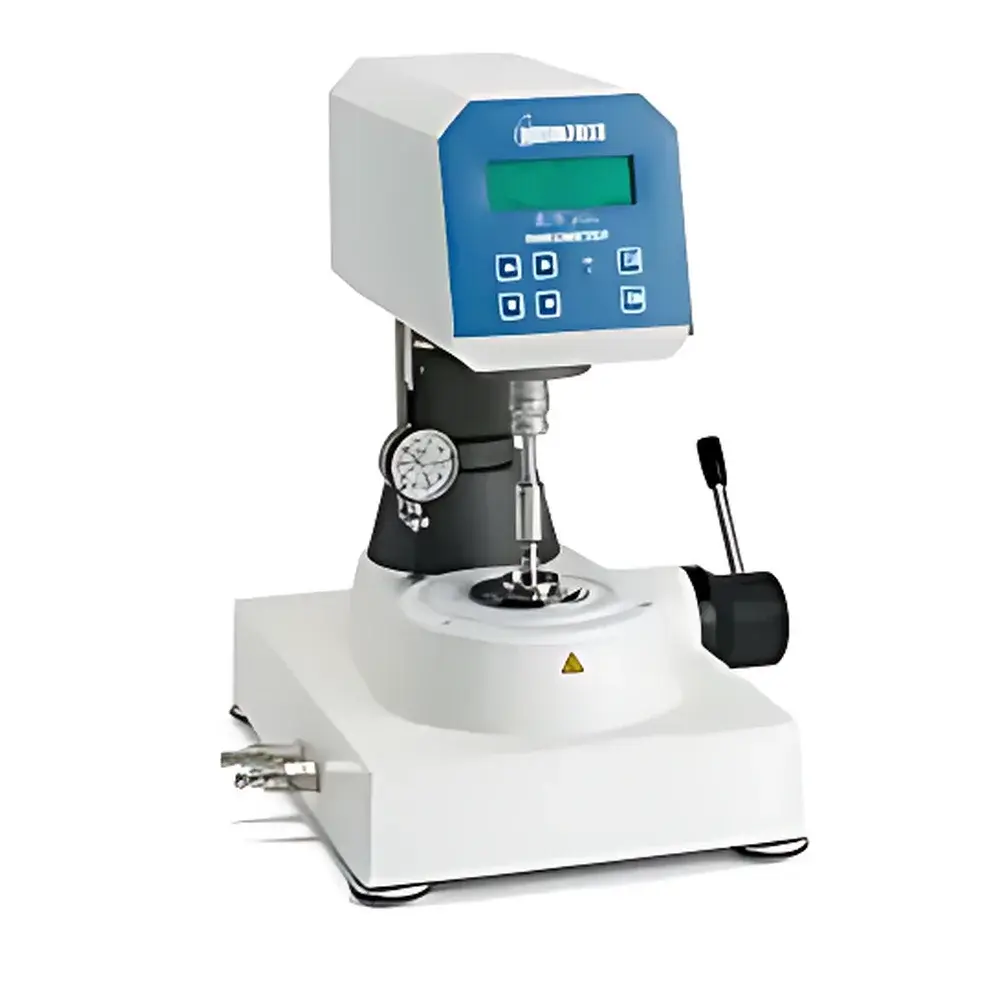
Brookfield R/S Plus Series Rotational Rheometer
| Brand | Brookfield |
|---|---|
| Origin | USA |
| Instrument Type | Rotational Rheometer |
| Model | R/S Plus |
| Minimum Speed | 0.01 rpm |
| Maximum Speed | 1000 rpm |
| Maximum Torque | 50 mN·m |
| Torque Resolution | 0.01 mN·m |
Overview
The Brookfield R/S Plus Series Rotational Rheometer is a high-precision, modular torque-controlled rheological measurement system engineered for fundamental and applied research in material science, quality control, and process development. Based on Couette flow principles, it applies controlled rotational motion between parallel-plate, cone-and-plate, or concentric-cylinder geometries to quantify the relationship between applied shear stress (τ) and resulting shear rate (γ̇), enabling full viscoelastic characterization of complex fluids and soft solids. Unlike simple viscometers, the R/S Plus operates across three distinct operational modes—stress-controlled, rate-controlled, and oscillatory—supporting yield stress determination, time-dependent thixotropy analysis, temperature-dependent viscosity profiling, and linear viscoelastic region (LVR) mapping. Its robust architecture integrates a high-resolution torque transducer (0.01 mN·m) with a low-inertia motor capable of precise speed control from 0.01 to 1000 rpm, making it suitable for both ultra-slow creep recovery studies and rapid ramp tests under ISO 6721-1, ASTM D4402, and USP compliant protocols.
Key Features
- Modular design supporting interchangeable measurement systems: Parallel-plate (PP), cone-and-plate (CP), concentric-cylinder (CC), and soft-solid testing (SST) configurations
- True dual-mode operation: simultaneous stress- and rate-control with real-time feedback loop correction
- Integrated temperature control options: recirculating bath (–20 °C to 250 °C), Peltier stage (0–135 °C or 20–180 °C), or electronic heater (50–250 °C)
- Minimal sample requirement (as low as 0.5 mL for CP geometry), reducing material cost and cross-contamination risk
- Standalone operation via built-in LCD interface with programmable test sequences—no PC required for routine QC checks
- Comprehensive test method library including yield stress ramp, hysteresis loops, time sweeps, temperature ramps, and oscillatory amplitude/frequency sweeps
Sample Compatibility & Compliance
The R/S Plus accommodates an exceptionally broad range of sample classes—from low-viscosity Newtonian liquids (e.g., solvents, polymer solutions) to highly structured pastes, gels, and thermosetting resins. Its SST module enables reliable measurement of yield stress and structural recovery in semi-solids such as toothpaste, sealants, and ceramic slurries without structural disruption during rotor insertion. The CC geometry delivers traceable absolute viscosity values per ASTM D2196 and ISO 3219, while PP/CP configurations support non-Newtonian behavior quantification—including pseudoplasticity, thixotropy, and viscoelastic relaxation—under GLP/GMP-aligned workflows. All firmware and data handling comply with FDA 21 CFR Part 11 requirements when used with validated Rheo3000 software, including electronic signatures, audit trails, and secure user access levels.
Software & Data Management
Rheo3000 software provides full instrument control, real-time data visualization, and advanced post-processing capabilities—including master curve generation, Cox-Merz validation, and Williams-Landel-Ferry (WLF) modeling. Raw torque and angular displacement data are logged at ≥100 Hz with timestamped metadata (operator ID, calibration status, environmental conditions). Export formats include CSV, Excel, and universal .rhe files compatible with third-party analysis tools (e.g., MATLAB, OriginLab). Audit trail logs record all parameter changes, test executions, and report generations, ensuring full traceability for regulatory submissions. Optional IQ/OQ documentation packages support installation and operational qualification in pharmaceutical and medical device manufacturing environments.
Applications
- Quality assurance of coatings, inks, adhesives, and personal care formulations using single-point viscosity and yield stress thresholds
- Rheological fingerprinting of polymer melts and composites during extrusion and injection molding process optimization
- Temperature-dependent flow behavior analysis of bitumen, asphalt binders, and thermal interface materials per AASHTO T315
- Structural breakdown/recovery kinetics in food products (e.g., chocolate, peanut butter) and pharmaceutical suspensions
- Yield stress and elastic modulus determination for cementitious grouts, battery electrode slurries, and 3D-printing pastes
- Regulatory-compliant viscosity profiling for ophthalmic solutions and parenteral suspensions under USP
FAQ
What distinguishes the R/S Plus from basic viscometers?
Unlike rotational viscometers that assume steady-state Newtonian behavior, the R/S Plus performs dynamic, transient, and oscillatory measurements to resolve both viscous and elastic components of complex fluids.
Can the R/S Plus measure yield stress accurately?
Yes—using controlled-stress ramp tests with automatic yield point detection algorithms based on critical stress threshold and strain deviation criteria.
Is temperature control mandatory for reproducible results?
While ambient-temperature testing is possible, temperature stabilization is strongly recommended for any application where thermal history or phase transitions affect structure—especially for polymers, waxes, and thermoreversible gels.
How does the SST module differ from standard geometries?
The SST uses a paddle-style rotor that minimizes sample disturbance during immersion, enabling direct measurement of structural integrity and creep compliance in fragile or heterogeneous soft solids.
Does the system support automated calibration verification?
Yes—Rheo3000 includes built-in calibration routines using NIST-traceable standard oils and torque verification standards, with results stored in the audit trail.



