
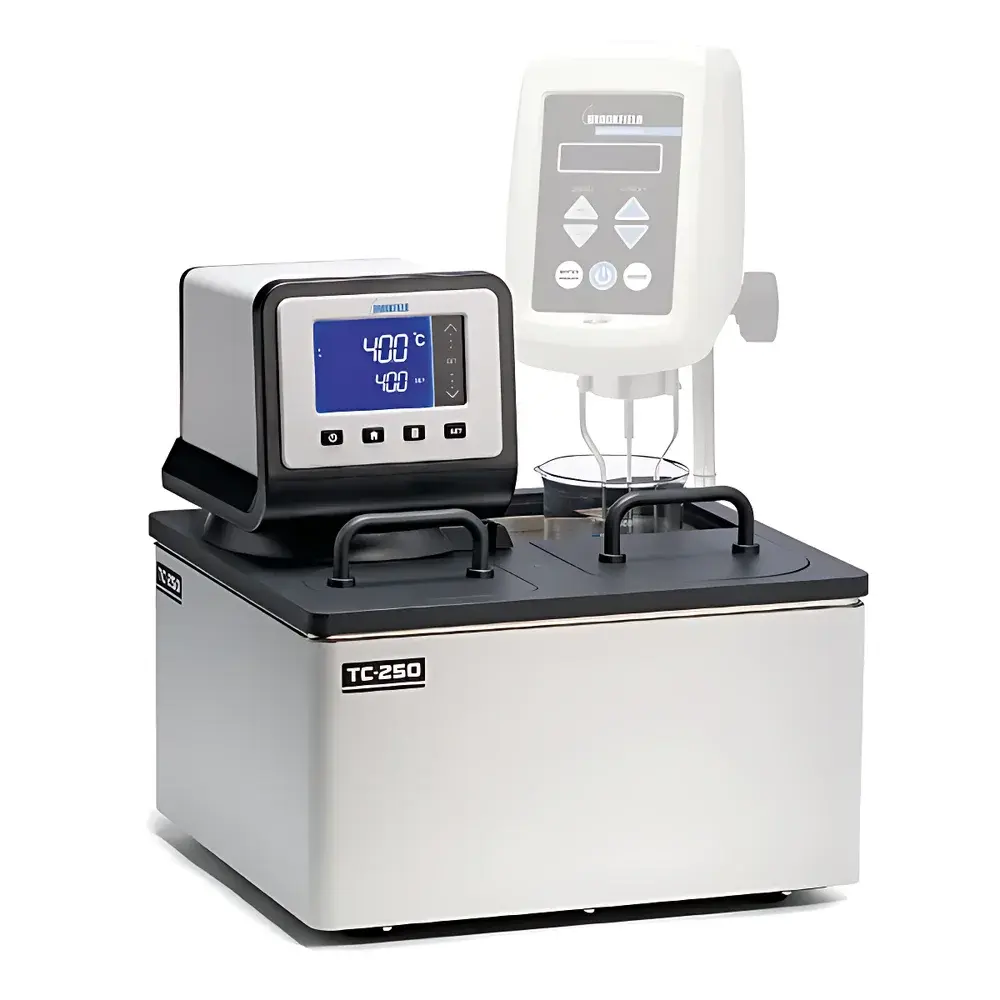
Brookfield TC-250 Precision Temperature-Controlled Circulating Water Bath
| Brand | Brookfield |
|---|---|
| Origin | USA |
| Model | TC-250 |
| Temperature Range | –20 °C to +150 °C (depending on controller variant) |
| Temperature Stability | ±0.01 °C (AP), ±0.04 °C (SD), ±0.07 °C (MX) |
| Controller Options | AP (touchscreen, programmable, multi-language), SD (dual-speed pump, Rheocalc-compatible), MX (basic digital display, single-speed pump) |
| Pump Type | Variable-speed (AP), dual-speed (SD), fixed-speed (MX) |
| Software Integration | Compatible with Brookfield Rheocalc v3.0+ for remote programming and data logging |
Overview
The Brookfield TC-250 is a high-stability, precision circulating water bath engineered for rigorous laboratory environments requiring accurate, repeatable thermal control across extended operating ranges. Designed as a modular platform, the TC-250 supports three distinct controller configurations—AP, SD, and MX—to accommodate varying levels of automation, software integration, and operational complexity. Its core function is to maintain uniform temperature distribution in external circulation loops or internal baths via a thermostatically regulated heating/cooling system, utilizing a refrigerated compressor and resistive heating elements. The unit achieves thermal equilibrium through forced convection, with fluid circulation driven by integrated pumps whose speed profiles are optimized per controller tier. This architecture enables stable operation from –20 °C to +150 °C, making it suitable for applications demanding cryogenic conditioning, accelerated stability testing, viscosity calibration, and material property evaluation under controlled thermal stress.
Key Features
- Precision temperature control with stability down to ±0.01 °C (AP model), verified per ASTM E1137/E1142 protocols for liquid-bath thermometry.
- Three controller variants: AP (capacitive touchscreen interface, 8-language support, embedded help system, and independent programmable ramp/soak profiles); SD (dual-speed circulation pump, fast thermal response in standalone mode, full compatibility with Rheocalc v3.0+ for PC-based scheduling and real-time monitoring); MX (cost-optimized digital controller with LED display and fixed-speed pump, ideal for routine static-temperature applications).
- Refrigeration-compressor cooling combined with PID-controlled resistive heating ensures seamless transition across the full –20 °C to +150 °C range without external chiller dependency.
- Stainless steel reservoir and circulation manifold resist corrosion from aqueous, glycol, or silicone oil-based heat transfer fluids.
- Over-temperature, low-fluid-level, and dry-run protection circuits comply with IEC 61010-1 safety requirements for laboratory equipment.
- Front-panel USB port (AP/SD) and RS-232 interface (all models) enable firmware updates and serial communication with LIMS or QC systems.
Sample Compatibility & Compliance
The TC-250 supports open-loop circulation to external jackets, viscometers, spectrophotometer cells, and reaction blocks, accommodating flow rates up to 12 L/min (AP) or 8 L/min (SD/MX). It is compatible with water, 50/50 ethylene glycol–water mixtures, and low-volatility silicone oils (e.g., Dow Corning 200 Fluid), subject to flash point and viscosity constraints. All TC-250 variants are CE-marked and conform to ISO/IEC 17025-relevant environmental control specifications when used in accredited testing laboratories. The AP and SD controllers support audit-trail-enabled operation per FDA 21 CFR Part 11 requirements when paired with validated Rheocalc configurations, including user access logs, parameter change history, and electronic signature capture.
Software & Data Management
Rheocalc v3.0+ serves as the primary software interface for the TC-250 AP and SD models, enabling multi-device synchronization, automated temperature profiling, and export of time-stamped temperature datasets in CSV or XML formats. The software supports GLP-compliant reporting templates and integrates with common laboratory informatics platforms via OPC UA or Modbus TCP gateways. Local data storage on the AP controller retains ≥10,000 timestamped readings (1-second resolution), while SD and MX models rely on host-PC logging. All firmware versions undergo quarterly security patching aligned with NIST SP 800-161 guidelines for lab instrument cybersecurity.
Applications
- Viscosity calibration of rotational rheometers (e.g., DVNext, RST series) using NIST-traceable reference oils at defined shear temperatures.
- Accelerated stability studies per ICH Q1A(R3), where samples are held at elevated temperatures (40 °C, 50 °C, 60 °C) for predefined durations to assess degradation kinetics.
- Thermal preconditioning of polymer melts prior to capillary or rotational rheological testing.
- Controlled-temperature enzymatic assays in biochemistry labs requiring precise thermal management between 4 °C and 45 °C.
- Calibration of platinum resistance thermometers (PRTs) and thermocouples against fixed-point references in metrology labs.
FAQ
What is the maximum allowable working temperature for each TC-250 controller variant?
The AP and SD models support up to +150 °C; the MX variant is rated to +135 °C due to thermal derating of its basic control electronics.
Can the TC-250 operate continuously at –20 °C?
Yes—provided the heat transfer fluid has a pour point below –25 °C and sufficient thermal conductivity at low temperatures (e.g., specialized low-temp glycol blends). Compressor duty cycle increases significantly below –10 °C.
Is Rheocalc software included with purchase?
Rheocalc v3.0+ is supplied free of charge with AP and SD models; MX models do not support software connectivity and ship without installation media.
Does the TC-250 meet GMP documentation requirements for pharmaceutical QC labs?
When configured with AP controller, validated Rheocalc settings, and enabled audit trail, the system satisfies ALCOA+ data integrity principles and supports 21 CFR Part 11 compliance for electronic records.
What maintenance intervals are recommended for optimal long-term stability?
Annual verification of temperature uniformity (per ASTM D1549) and calibration of the internal PRT sensor against a certified reference thermometer is advised. Pump impeller inspection and fluid replacement should occur every 12 months or after 2,000 operational hours, whichever comes first.
Related Products



