
Brookhaven ACOS Real-Time In-Line Particle Size Analyzer
| Brand | Brookhaven |
|---|---|
| Origin | USA |
| Manufacturer Type | Authorized Distributor |
| Origin Category | Imported |
| Model | ACOS |
| Pricing | Upon Request |
| Dispersion Method | Dry & Wet Dispersion |
| Instrument Type | In-Line Laser Particle Size Analyzer |
| Measurement Range | Particle Size: 0.6 nm – 3 µm |
| Dynamic Concentration Range | 0.1 ppm – 40% (w/v) |
| Repeatability | Configurable per application protocol |
| Measurement Duration | User-Defined |
Overview
The Brookhaven ACOS Real-Time In-Line Particle Size Analyzer is an engineered solution for continuous, non-invasive characterization of colloidal and nanoscale systems under dynamic process conditions. Based on the physical principle of Dynamic Light Scattering (DLS), the ACOS system enables real-time monitoring of hydrodynamic diameter distributions in flowing streams—without offline sampling, dilution, or interruption of reaction kinetics. Unlike conventional benchtop DLS instruments, the ACOS integrates a pressure-rated optical detection cell, precision fluidic control, and high-fidelity correlation electronics into a purpose-built in-line architecture. It is designed for deployment directly in process lines—such as reactor effluent streams, crystallization loops, or nanoparticle synthesis conduits—where maintaining sample integrity, pressure stability, and temporal resolution is critical. The system operates across a broad physicochemical envelope: from dilute protein solutions (<0.1 ppm) to highly concentrated polymer dispersions (up to 40% w/v), while preserving measurement fidelity under pressures up to 2000 psi and temperatures from 5 °C to 90 °C (±0.1 °C stability).
Key Features
- Patented Microvolume Flow Cell: 2.5 µL optical path volume with sapphire windows and hermetic sealing—enabling true in-situ measurement without air exposure, oxidation, or aggregation artifacts.
- High-Pressure Compatibility: Optical detection module rated to 2000 psi (138 bar), allowing integration into pressurized reactors, extrusion lines, and supercritical fluid processes.
- Dynamic Concentration Resilience: Adaptive signal processing and TurboCorr research-grade digital correlator enable robust autocorrelation analysis across six orders of magnitude in mass concentration (0.1 ppm–40% w/v).
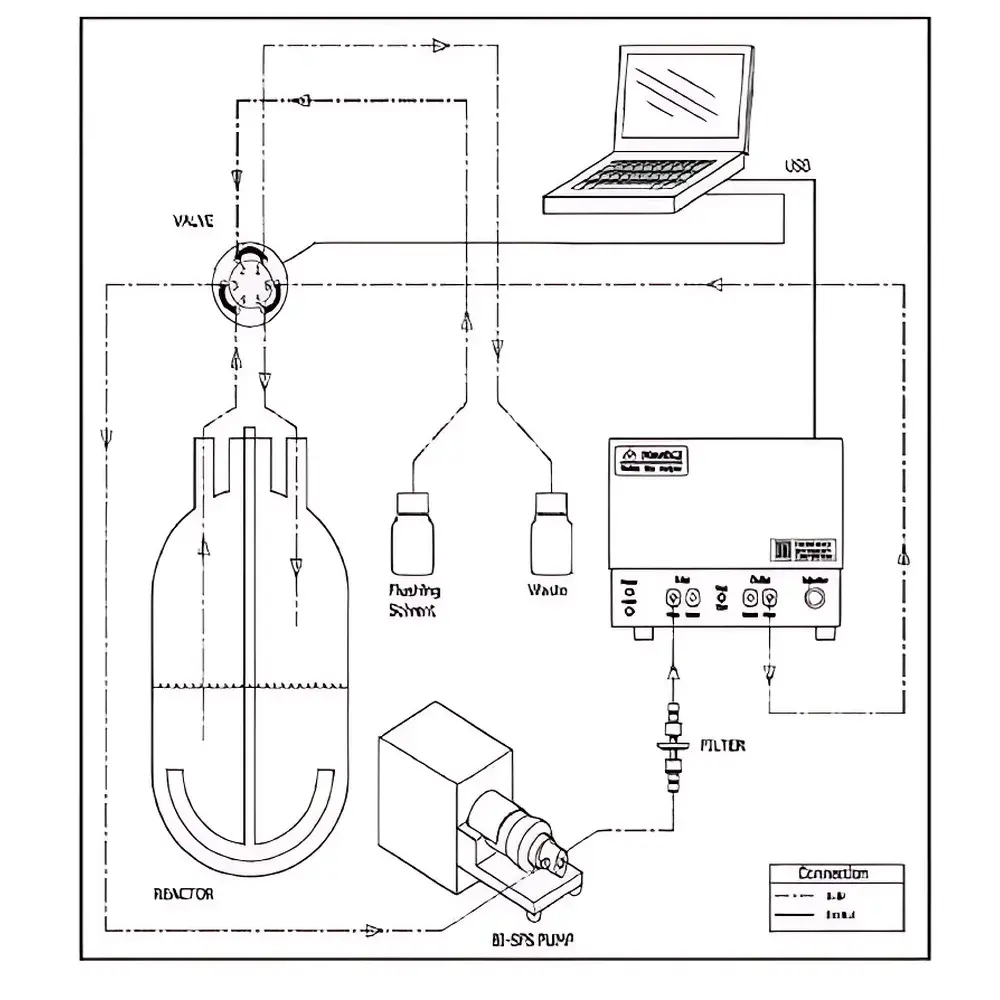
- Configurable Fluidics: Interchangeable capillary tubing (0.25 mm or 0.5 mm ID), programmable peristaltic pump, and automated three-way control valves support custom flow-path design for diverse reactor geometries (e.g., CSTR, PFR, microreactors).
- Real-Time Temporal Resolution: Measurement interval fully user-defined—from sub-second single acquisitions to continuous multi-hour monitoring—with synchronized timestamping and metadata logging.
- Laser Power Modulation: Adjustable 0–35 mW diode laser output ensures optimal signal-to-noise ratio across low-scattering (e.g., small proteins) and high-scattering (e.g., metal oxide nanoparticles) samples.
Sample Compatibility & Compliance
The ACOS system supports aqueous, organic, and mixed-solvent systems—including biological macromolecules (monoclonal antibodies, viral vectors), synthetic polymers (PLGA, PEG-PLA), inorganic nanomaterials (Au, Ag, Fe3O4), surfactant micelles, and contrast agent emulsions. Its sealed, inert fluid path minimizes adsorption, shear-induced degradation, and interfacial denaturation. For regulated environments, raw data files include full audit trails (user ID, timestamp, instrument configuration, calibration history) compliant with FDA 21 CFR Part 11 requirements when deployed with validated software configurations. The system adheres to ISO 22412:2017 (DLS methodology) and supports GLP/GMP-aligned documentation workflows through exportable .csv and .txt report formats.
Software & Data Management
ACOS Control Suite provides intuitive graphical interface for method setup, real-time scatter plot visualization, and batch-wise size distribution trending. All measurements are stored in a hierarchical database with embedded metadata (temperature, pressure, flow rate, laser power). Export options include ASCII-compatible time-series datasets compatible with MATLAB, Python (Pandas), and industry-standard statistical process control (SPC) platforms. Optional integration with DeltaV™, Emerson DCS, or Siemens PCS7 enables closed-loop feedback to reactor controllers—supporting PAT (Process Analytical Technology) initiatives per ICH Q8/Q9 guidelines.
Applications
- Monitoring protein aggregation kinetics during thermal stress or pH titration in bioreactor harvest streams
- Tracking nucleation and growth phases in nanoprecipitation synthesis of contrast agents (e.g., iodinated or gadolinium-based particles)
- Quantifying micelle size transitions during temperature- or concentration-triggered CMC shifts
- Validating inline homogenization efficiency in high-shear wet milling of drug nanosuspensions
- Characterizing real-time particle coalescence in emulsion polymerization reactors
- Supporting Quality-by-Design (QbD) development of lipid nanoparticles (LNPs) for mRNA delivery
FAQ
Can the ACOS system be integrated into existing stainless-steel process piping?
Yes—the ACOS flow cell and associated fittings are available with 1/4″ VCR or Swagelok® compression connections, and can be mounted directly onto sanitary tri-clamp or threaded process lines with appropriate isolation valves.
Does the system require periodic recalibration with NIST-traceable standards?
While no routine recalibration is required for DLS-based sizing, annual verification using certified polystyrene latex standards (e.g., NIST SRM 1963, 1964) is recommended for regulatory submissions and long-term trend consistency.
Is it possible to re-inject measured sample back into the reactor?
Yes—by configuring the valve manifold for recirculation mode, the system maintains mass balance and avoids sample loss, critical for small-volume or high-value formulations.
What level of IT infrastructure is needed for remote monitoring?
The ACOS Control Suite supports standard Ethernet TCP/IP communication; remote access is enabled via secure VPN or TLS-encrypted web dashboard—no proprietary cloud service is required.
How does the system handle air bubbles or particulate contamination in the flow stream?
Integrated bubble detection algorithms monitor intensity variance in real time; optional in-line filtration (0.2 µm PTFE) and degassing modules are available as accessories to maintain optical path clarity.



