
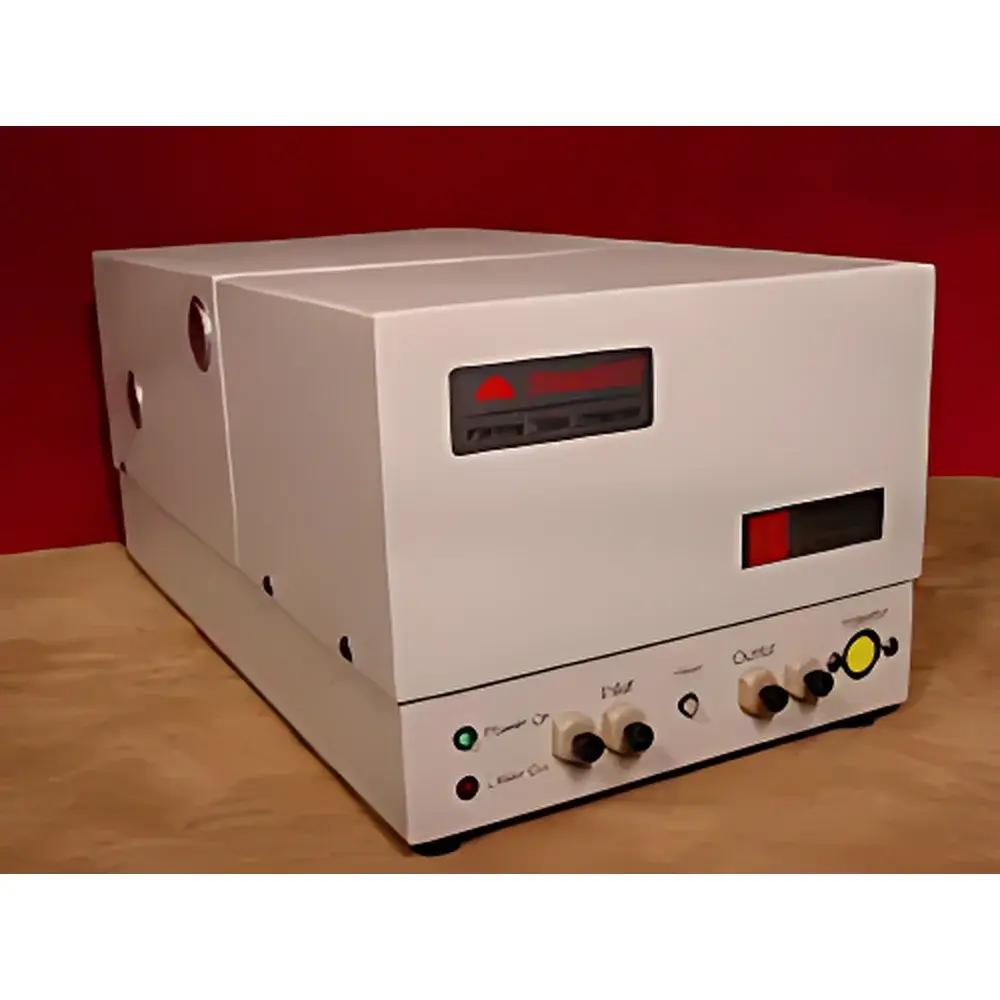
Brookhaven NanoDLS High-Sensitivity Online Dynamic Light Scattering Particle Size Analyzer
| Brand | Brookhaven Instruments |
|---|---|
| Origin | USA |
| Manufacturer Type | Authorized Distributor |
| Origin Category | Imported |
| Model | NanoDLS |
| Dispersion Method | Wet & Dry Dispersion |
| Instrument Type | Online Laser Particle Size Analyzer |
| Measurement Range | 0.5 nm – 3 µm (refractive index dependent) |
| Repeatability | ≤1% (typical) |
| Measurement Time | <10 s per acquisition (configurable) |
| Sample Volume | 2.5 µL |
| Max Operating Pressure | 400 bar (5,880 psi) |
| Concentration Range | 0.1–100 mg/mL |
| Temperature Control Range | 25–80 °C |
| Laser Source | 35 mW, 638 nm solid-state laser |
| Detector | Avalanche Photodiode (APD) |
| Scattering Angle | 90° |
| Interface | USB 2.0 & 1.1 |
| Data Output | Hydrodynamic diameter distribution (intensity-, number-, and volume-weighted), Gaussian & multimodal fitting, real-time aggregation kinetics plots |
| Operation Mode | Auto-sampling or manual injection |
| Optional Integration | BI-MwA multi-angle static light scattering module for SEC-MALS coupling |
Overview
The Brookhaven NanoDLS High-Sensitivity Online Dynamic Light Scattering Particle Size Analyzer is an engineered solution for real-time, in-line characterization of nanoparticle hydrodynamic size and size distribution under flow conditions. It operates on the fundamental principle of dynamic light scattering (DLS), where Brownian motion of particles in suspension induces time-dependent fluctuations in scattered light intensity. These fluctuations are captured by a high-gain avalanche photodiode (APD) detector at a fixed 90° scattering angle and processed via digital autocorrelation to extract the intensity autocorrelation function (ACF). Using the Stokes–Einstein equation—relating diffusion coefficient to hydrodynamic diameter—the system computes particle size distributions with sub-nanometer resolution. Designed for integration into process streams or chromatographic workflows, the NanoDLS delivers continuous, non-invasive monitoring of colloidal stability, aggregation onset, and conformational changes—critical for biopharmaceutical formulation development, nanomaterial synthesis control, and quality-by-design (QbD) implementation.
Key Features
- Real-time online DLS capability with <10-second acquisition time per measurement, enabling kinetic tracking of aggregation, dissolution, or structural transitions
- Ultra-low sample consumption: only 2.5 µL required per analysis, minimizing material waste and supporting precious-sample applications
- Patented high-pressure flow cell rated to 400 bar (5,880 psi), compatible with UHPLC, FPLC, and high-pressure extrusion systems
- Broad sizing range from 0.5 nm to 3 µm (dependent on refractive index contrast), validated across proteins, liposomes, polymeric nanoparticles, and virus-like particles
- Integrated Peltier temperature control (25–80 °C) with ±0.1 °C stability for thermally sensitive samples and accelerated stability studies
- 35 mW, 638 nm solid-state laser source providing stable, low-noise illumination with extended operational lifetime and minimal photodamage risk
- Modular architecture supporting optional BI-MwA multi-angle static light scattering (MALS) upgrade for simultaneous determination of weight-average molar mass (Mw) and radius of gyration (Rg) in SEC-MALS configurations
Sample Compatibility & Compliance
The NanoDLS accommodates aqueous and organic solvent-based dispersions, including buffers, surfactant solutions, and low-viscosity polymer melts. Its chemically inert flow path—constructed from fused silica, stainless steel, and PEEK—is compatible with biological macromolecules, monoclonal antibodies, mRNA-LNPs, and peptide therapeutics. The system meets key regulatory expectations for analytical instrumentation used in GMP environments: full audit trail support (user login, parameter change logging, data modification history), electronic signature readiness, and alignment with FDA 21 CFR Part 11 requirements when operated with compliant software configuration. It supports ISO 22412:2017 and ASTM E2490-20 standards for DLS-based particle sizing, and its calibration traceability follows NIST-traceable polystyrene and silica nanoparticle reference materials.
Software & Data Management
Controlled via Brookhaven’s proprietary DYNAMICS™ software, the NanoDLS provides intuitive workflow management—from method setup and instrument calibration to real-time plotting and batch reporting. The software implements advanced algorithms for regularization (CONTIN, NNLS), baseline correction, and noise suppression to enhance resolution of polydisperse systems. All raw correlation data, processed distributions (intensity-, number-, and volume-weighted), and kinetic trend overlays are stored in vendor-neutral HDF5 format, ensuring long-term accessibility and third-party interoperability. Export options include CSV, PDF, and image formats (PNG, TIFF) suitable for inclusion in regulatory submissions. For enterprise deployment, the software supports network licensing, centralized database archiving, and integration with LIMS via ODBC-compliant drivers.
Applications
- Continuous monitoring of protein aggregation during thermal stress or pH titration in bioprocess development
- In-line QC of lipid nanoparticle (LNP) size distribution during microfluidic synthesis and post-dilution steps
- Real-time detection of micelle dissociation or vesicle fusion events in formulation screening
- SEC-MALS coupling for orthogonal characterization of polymer branching, conformation, and molar mass dispersity (Đ)
- Stability assessment of colloidal drug delivery systems under shear and pressure cycling
- Validation of nanoparticle sterilization filtration integrity through pre- and post-filtration size profiling
FAQ
Can the NanoDLS be integrated directly into a production pipeline?
Yes—its compact flow cell design, 400 bar pressure rating, and analog/digital I/O ports support direct installation in pharmaceutical manufacturing lines for PAT-compliant monitoring.
Is the system compatible with non-aqueous solvents such as THF or chloroform?
Yes, provided wetted materials are chemically compatible; users must verify seal and cell material resistance prior to use.
Does the NanoDLS require daily recalibration?
No—factory calibration using NIST-traceable standards remains valid for ≥12 months under normal operation; verification checks with standard latex beads are recommended before critical runs.
Can it resolve bimodal distributions below 10 nm separation?
Resolution depends on signal-to-noise ratio and polydispersity; typical resolution limit is ~20% Δd/d for monomodal systems, with improved resolution achievable via multi-angle or MALS-enhanced configurations.
What level of IT infrastructure is needed for GMP data integrity compliance?
A validated Windows Server environment with role-based access control, encrypted storage, and periodic backup protocols fulfills core 21 CFR Part 11 requirements when paired with DYNAMICS™ audit trail settings enabled.



