
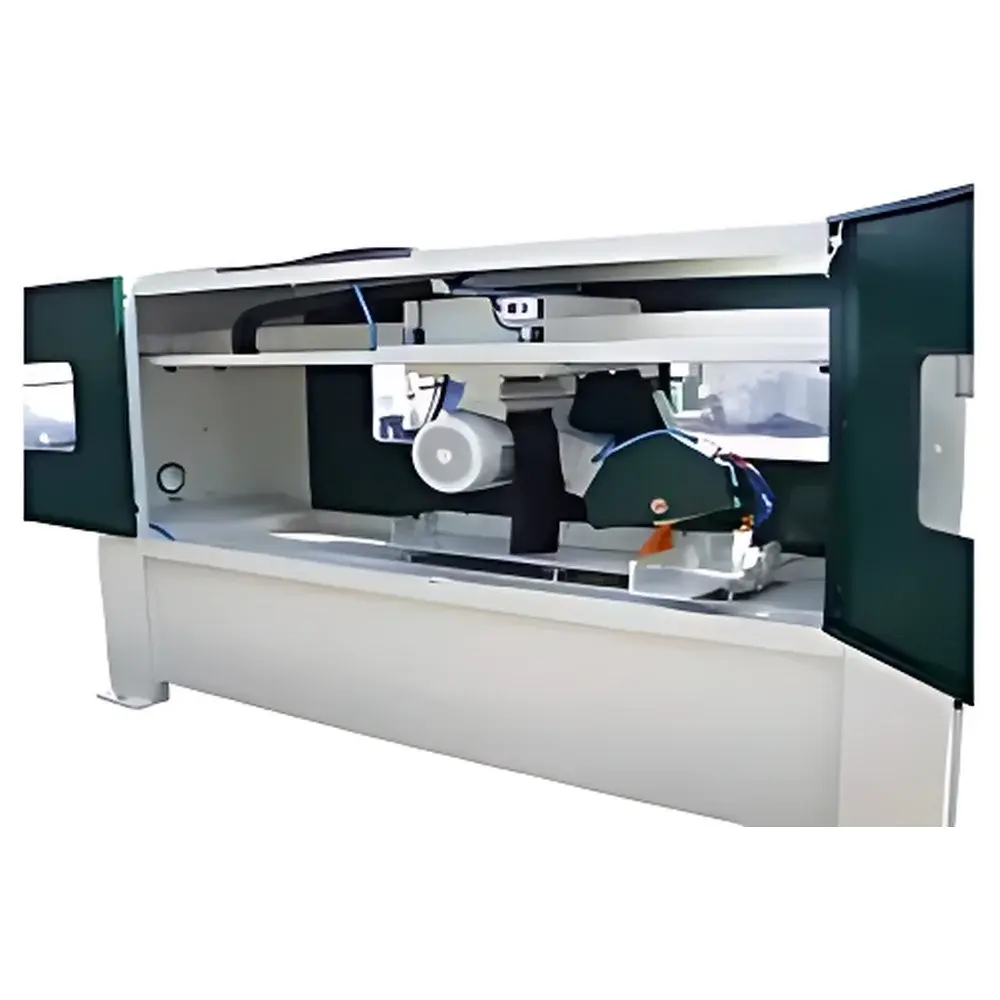
BROT-LAB 1 02 08 Large-Sample Core Cutting System
| Brand | French BROT-LAB |
|---|---|
| Origin | France |
| Model | 1 02 08 |
| Motor Power | 7.5 kW spindle motor, 0.37 kW feed motor, 0.25 kW pump motor |
| Diamond Blade Diameter Options | Ø300–Ø400 mm (standard) |
| Spindle Speed | 1440–2160 rpm |
| Max Core Length | 1000–1500 mm |
| Positioning Accuracy | ±0.01 mm |
| Core Diameter Range | Ø80–Ø134 mm |
| Cut Configurations | 1/2, 1/3, or 1/4 diameter sections |
| Worktable Dimensions | 500 × 680 × 480 mm |
| Cooling Options | Water, oil, or user-supplied coolant with external recirculation unit |
| Frame | Welded steel construction with anti-vibration base and corrosion-resistant polypropylene splash guard & waste collection sump |
| Safety | Dual interlocked doors with electrical cutoff, IP65-rated control cabinet, insulated wiring, and splash-proof circuit protection |
Overview
The BROT-LAB 1 02 08 Large-Sample Core Cutting System is an industrial-grade, precision-engineered rock core preparation instrument designed for geoscience laboratories, petroleum core analysis facilities, and geological survey institutions requiring high-fidelity, non-destructive sectioning of cylindrical geological specimens. Based on a fixed-sample, moving-disk architecture—where the core remains stationary while the diamond-impregnated blade traverses axially—the system eliminates lateral stress, torsional loading, and sample slippage during cutting. This kinematic configuration ensures mechanical integrity of fragile or laminated formations (e.g., shale, chalk, or weathered sandstone) and preserves stratigraphic orientation for subsequent petrophysical, mineralogical, or geochemical analysis. The machine complies with EN 60204-1 (electrical safety), ISO 12100 (risk assessment for machinery), and incorporates structural damping elements to meet laboratory vibration isolation standards (ISO 2631-2). Its rigid welded frame, reinforced base plate, and integrated anti-splash containment system enable stable operation in shared analytical environments without cross-contamination risk.
Key Features
- Fixed-core kinematics with linearly actuated diamond blade carriage—minimizes specimen deformation and microfracturing
- High-torque 7.5 kW spindle motor delivering consistent rotational force across full speed range (1440–2160 rpm), optimized for both soft and ultra-hard lithologies
- Adjustable automatic feed rate with real-time pressure regulation: maintains constant blade load during cut progression, preventing thermal cracking and kerf widening
- Precision-ground linear guides and servo-controlled positioning system achieving ±0.01 mm repeatability over 1.5 m travel length
- Modular diamond blade compatibility: accepts Ø300 mm to Ø500 mm segments with selectable bond hardness (general-purpose, hard-rock, or ultra-hard matrix formulations)
- Integrated polypropylene fluid containment sump with sediment retention basin and external coolant loop interface for closed-loop temperature management
- Dual interlocked access doors meeting Category 3 / PL e (ISO 13857) requirements; door-open condition disables all drive circuits instantaneously
- IP65-rated centralized control cabinet housing PLC-based motion logic, emergency stop circuitry, and isolated I/O modules
Sample Compatibility & Compliance
The 1 02 08 accommodates intact cylindrical cores ranging from Ø80 mm to Ø134 mm in diameter and up to 1500 mm in length—covering standard API RP 44, ASTM D4543, and ISO 14688-1 specimen dimensions. It supports quarter-, third-, and half-diameter sectioning protocols required for routine thin-section preparation, plug extraction (per ASTM D2938), and multi-sensor logging calibration. All wet-cutting operations conform to OSHA 1910.1050 (crystalline silica exposure control) when used with water-based coolant and integrated mist suppression. The system’s electrical architecture satisfies CE marking requirements under the Machinery Directive 2006/42/EC and Low Voltage Directive 2014/35/EU. Optional documentation packages include Factory Acceptance Test (FAT) reports, traceable calibration certificates for positioning encoders, and GLP-compliant installation qualification (IQ) templates.
Software & Data Management
While the 1 02 08 operates via dedicated HMI panel with tactile push-button interface, its embedded controller logs all operational parameters—including feed velocity, spindle current draw, coolant flow status, and door interlock state—to internal non-volatile memory. Data export is supported via USB 2.0 port in CSV format for integration into LIMS environments (e.g., LabWare, STARLIMS). Optional Ethernet/IP connectivity enables remote monitoring of machine health metrics (motor temperature, hydraulic pressure, blade wear index) through OPC UA servers. Audit trails comply with FDA 21 CFR Part 11 requirements when paired with validated electronic signature modules and time-stamped event logging. No proprietary cloud platform is involved; data sovereignty remains fully under end-user control.
Applications
- Petrophysical core analysis labs performing routine permeability and porosity plug extraction
- National geological surveys preparing archival core sections for digital imaging and spectral scanning
- Academic sedimentology programs conducting bedding-plane oriented sampling for anisotropy studies
- Geotechnical engineering firms generating standardized test specimens per ASTM D4767 (consolidated-undrained triaxial testing)
- Carbon capture and storage (CCS) research centers sectioning caprock and reservoir analogs for pore-network characterization
- Mineral exploration labs preparing polished sections for SEM-EDS and QEMSCAN® mineral liberation analysis
FAQ
What core diameters and lengths does the 1 02 08 support?
It accepts cores from Ø80 mm to Ø134 mm in diameter and up to 1500 mm in length. For larger diameters (up to Ø200 mm), the 1 02 08G variant is recommended.
Is coolant circulation mandatory?
Yes—continuous coolant delivery is required for diamond blade longevity and thermal management. The system supports water, oil, or synthetic coolants via externally plumbed recirculation units.
Can the machine perform angled or bevel cuts?
No—the 1 02 08 is configured exclusively for orthogonal, transverse sectioning. Bevel or oblique cuts require post-processing on a separate precision saw.
How is blade wear monitored?
Spindle current profiling and feed resistance trends are logged and can be correlated with manufacturer-recommended blade life cycles (typically 200–400 linear meters per Ø400 mm segment, depending on rock hardness).
Does the system meet GMP or GLP documentation requirements?
Yes—when supplied with optional validation documentation package (IQ/OQ/PQ protocols, calibration records, and electronic audit trail configuration), it supports regulated environments under ISO/IEC 17025 and USP .



