
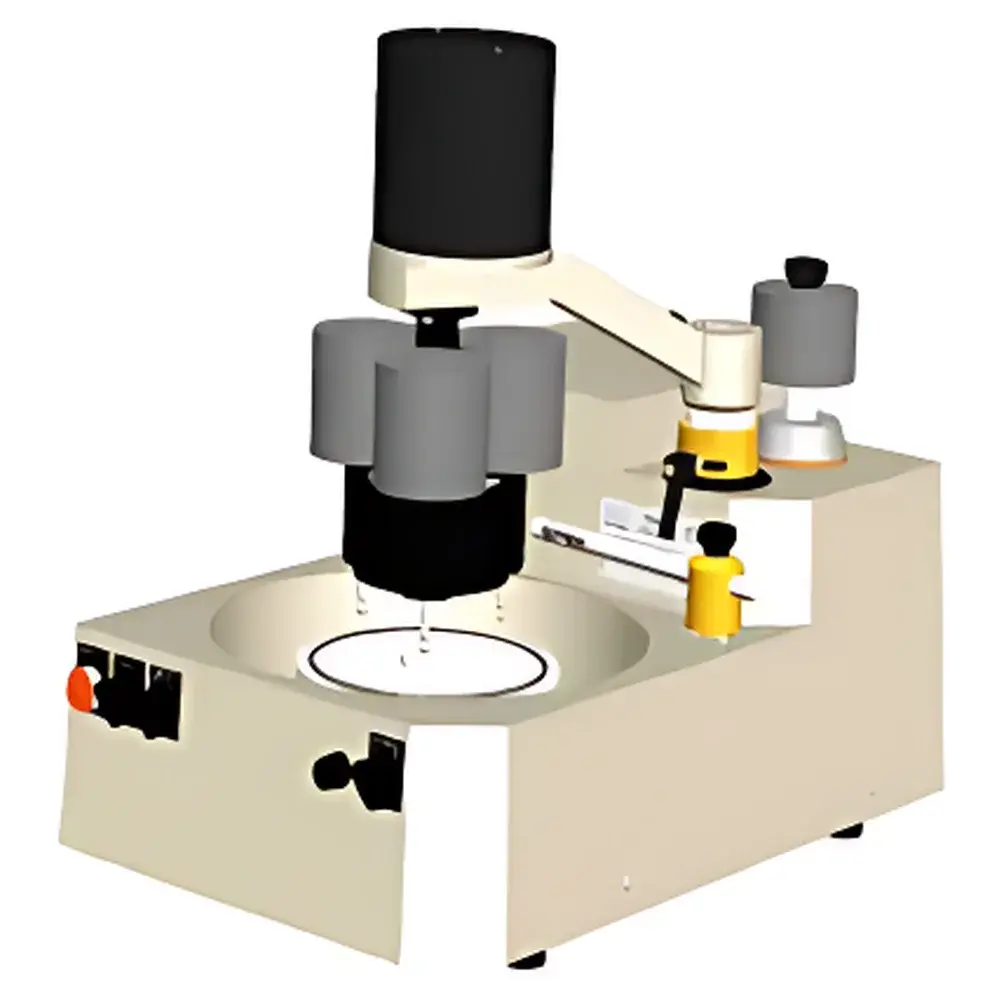
BROT-LAB 10317-3 Automated Thin-Section Polishing System
| Brand | French BROT-LAB |
|---|---|
| Origin | France |
| Model | 10317-3 |
| Sample Capacity | 1–5 thin sections |
| Polishing Plate Diameter | 200 mm |
| Rotational Speed | 25–200 rpm |
| Timer Range | 1–60 min |
| Compatible Polishing Disc Sizes | Ø150–Ø250 mm |
| Standard Sample Dimensions | 30×45 mm, 45×60 mm, Ø25–Ø40 mm |
| Abrasive Granularity Options | 15 µm, 6 µm, 3 µm, 1 µm, 0.5 µm |
| Polishing Cloth Set | 50 pcs (Ø200 mm) |
Overview
The BROT-LAB 10317-3 Automated Thin-Section Polishing System is an engineered solution for precision mechanical polishing of geological thin sections—specifically designed for heterogeneous, impurity-rich rock and mineral specimens where conventional polishing protocols yield inconsistent surface finish or thickness control. Unlike general-purpose grinding-polishing units, this system implements a dual-rotation kinematic architecture: the main polishing plate rotates at user-defined speeds (25–200 rpm), while each individual sample holder independently rotates about its own axis. This coaxial motion minimizes edge rounding, suppresses differential wear across heterogeneous phases (e.g., quartz vs. clay matrix), and ensures uniform material removal rate across the entire specimen surface. The system operates under fully programmable time-controlled cycles (1–60 minutes), eliminating manual intervention and external mechanical perturbations that compromise reproducibility in petrographic preparation.
Key Features
- Dual-axis rotational mechanism: independent rotation of both polishing platen and sample carriers ensures isotropic material removal and superior flatness retention.
- Precise thickness control via individually adjustable load application per sample—each of up to five holders features calibrated pressure settings corresponding to target final thickness (e.g., 30 µm standard for optical microscopy).
- Modular disc compatibility: accepts polishing plates from Ø150 mm to Ø250 mm, enabling seamless integration with existing consumables and process workflows.
- Programmable timer with ±5-second resolution supports repeatable endpoint determination—critical for inter-laboratory comparability and GLP-compliant thin-section production.
- Stable low-vibration chassis with damped base isolates rotational forces, preventing micro-slip or lateral displacement during extended polishing cycles.
- Tool-free sample mounting system accommodates standard petrographic formats including 30×45 mm, 45×60 mm, and circular specimens (Ø25–Ø40 mm) without adapter kits.
Sample Compatibility & Compliance
The 10317-3 system is validated for use with silicate-rich igneous and metamorphic rocks, carbonate sequences, ore-bearing lithologies, and synthetic ceramic composites. Its mechanical design conforms to ISO 9001-certified manufacturing practices; all electrical components meet CE and RoHS directives. While not inherently certified to ASTM D7582 or ISO 14488 (which govern automated hardness testing), the system’s output—thin sections meeting ASTM D5776 (Standard Practice for Preparation of Thin Sections of Rock and Soil Specimens)—is routinely accepted by accredited geological laboratories for quantitative petrography, cathodoluminescence mapping, and electron microprobe analysis. Optional documentation packages support audit readiness for GLP environments requiring traceable equipment qualification (IQ/OQ/PQ).
Software & Data Management
This is a hardware-controlled, non-computerized system: operation relies on embedded digital timer logic and analog speed regulation—eliminating software dependencies, cybersecurity vulnerabilities, or validation overhead associated with FDA 21 CFR Part 11–compliant platforms. All operational parameters (duration, speed, pressure setting per station) are recorded manually in laboratory notebooks or integrated LIMS systems. For labs requiring electronic data capture, optional external logging modules (e.g., USB-connected RPM and timer signal monitors) can be interfaced via 0–10 V analog outputs—a configuration compatible with LabVIEW, MATLAB, or custom SCADA architectures.
Applications
- Preparation of geologically representative thin sections for transmitted-light optical microscopy (TLM), polarized light microscopy (PLM), and interference contrast imaging.
- Surface planarization prior to ion-beam milling for SEM-EBSD orientation mapping and FIB-SEM lamella extraction.
- Controlled thickness reduction of mineral separates (e.g., zircon, monazite) for LA-ICP-MS ablation studies requiring sub-30 µm uniformity.
- Routine quality assurance in commercial core-logging facilities processing >500 samples/week under ISO/IEC 17025-accredited workflows.
- Research-grade thin-section fabrication for hyperspectral imaging (SWIR/MWIR) where spectral fidelity depends on consistent path-length and minimal subsurface scattering.
FAQ
What is the maximum recommended operating duration per cycle?
The system supports continuous operation up to 60 minutes per cycle; however, for optimal surface integrity in coarse-grained or fractured samples, cycles exceeding 25 minutes should employ intermediate rinsing and abrasive replenishment.
Can the unit accommodate non-standard sample geometries such as irregularly shaped drill-core chips?
Yes—custom-machined clamping fixtures (available as OEM accessories) allow secure fixation of irregular fragments up to 5 mm thickness, provided the contact footprint remains within the effective polishing zone (Ø180 mm inner diameter).
Is calibration of rotational speed traceable to national standards?
Each unit ships with factory calibration certificate referencing EN ISO/IEC 17025-accredited tachometric verification; recalibration intervals are recommended every 12 months or after 500 operational hours.
Does the system support wet or dry polishing modes?
It is engineered exclusively for wet polishing using aqueous or ethanol-based suspensions; dry operation is prohibited due to thermal loading risks on the motor and bearing assembly.
Are replacement polishing cloths supplied pre-cut and pre-impregnated?
Standard cloth sets include 50 pieces of non-woven polyester substrate (Ø200 mm), supplied uncoated; users apply diamond or alumina suspensions according to protocol requirements—ensuring full control over abrasive concentration and particle dispersion kinetics.



