
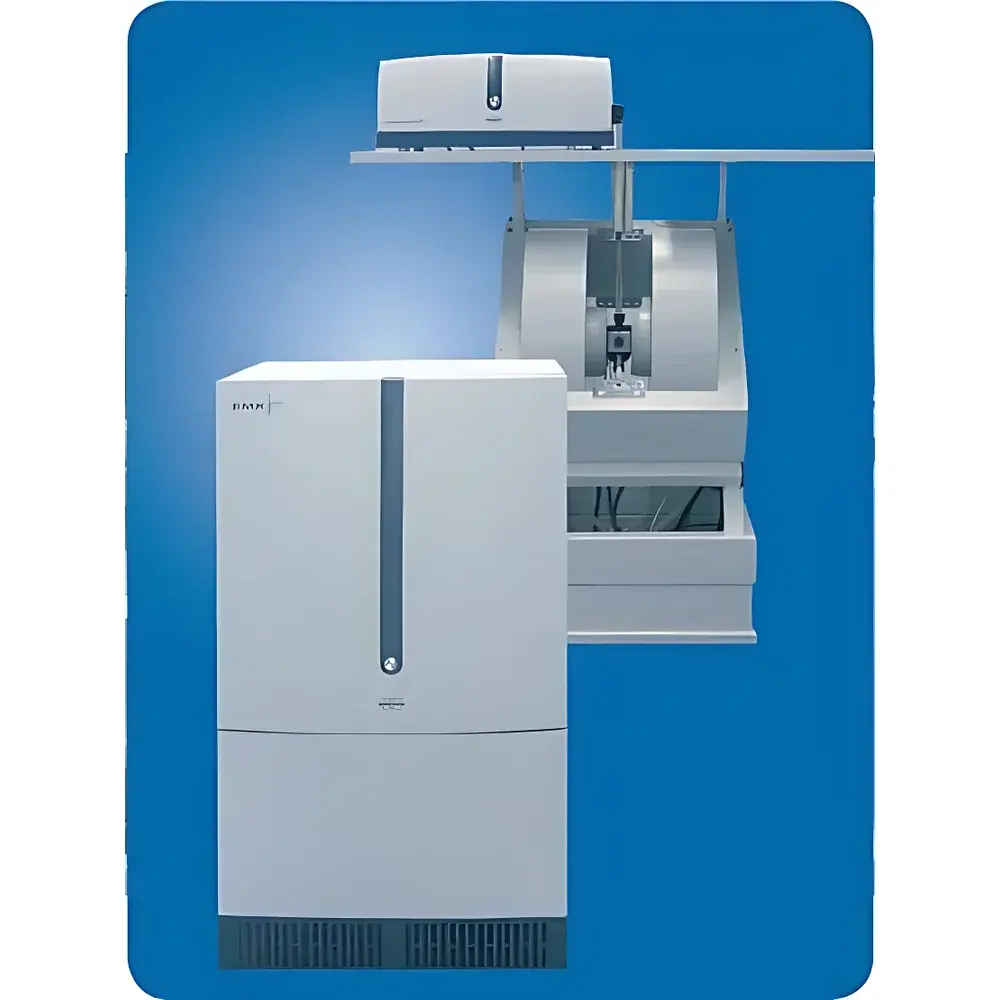
Bruker EMXplus and EMXmicro Continuous-Wave Electron Paramagnetic Resonance (EPR) Spectrometers
| Brand | Bruker |
|---|---|
| Origin | Germany |
| Model | EMXplus, EMXmicro |
| Instrument Type | Continuous-Wave (CW) EPR |
| Configuration | Benchtop, Integrated Digital Architecture |
| Control Interface | Ethernet-connected, WinEPR Software Platform |
| Magnetic Field Resolution | 18-bit digital |
| Signal Digitization | 18-bit ADC |
| Microwave Bridge | Next-generation EMXplusX™ |
| Detection Modes | Simultaneous dual-phase (0° & 90° modulation), 1st- and 2nd-harmonic detection |
Overview
The Bruker EMXplus and EMXmicro are benchtop continuous-wave electron paramagnetic resonance (CW-EPR) spectrometers engineered for high-fidelity detection and quantification of paramagnetic species—including transition metal ions, organic radicals, and defect centers—in solid, liquid, and frozen solution states. Based on the well-established cavity-based microwave absorption principle, these instruments operate at X-band (~9.7 GHz) and employ a lock-in detection scheme synchronized with magnetic field modulation to resolve narrow linewidths (< 0.1 G) and low-concentration spin systems (down to sub-nanomolar sensitivity under optimized conditions). The EMXplus represents an evolutionary advancement over the legacy EMX platform, integrating a fully digital signal path, enhanced field homogeneity control, and modular hardware architecture. The EMXmicro is the most compact fully integrated CW-EPR system in the Bruker portfolio—designed for laboratories with space constraints without compromising spectral fidelity or operational robustness.
Key Features
- Dual-channel digital signal acquisition: First-generation implementation enabling simultaneous detection at 0° and 90° modulation phases for comprehensive lineshape analysis and artifact suppression.
- 18-bit digital resolution in both magnetic field control and signal digitization: Enables high dynamic range (> 100 dB) and stable baseline performance across wide sweep widths (up to ±1500 G).
- EMXplusX™ microwave bridge: Optimized for minimal phase noise and thermal drift, delivering improved signal-to-noise ratio (SNR) and long-term amplitude stability.
- Fully integrated temperature control: EMXmicro embeds a compact cryogenic or variable-temperature unit within its computer-sized chassis, supporting operation from 100 K to 400 K with < ±0.1 K stability.
- Ethernet-based real-time instrument control: Allows remote operation, centralized lab management, and seamless integration into automated workflows via TCP/IP protocols.
- Self-calibrating startup sequence: Automatic validation of microwave power, field homogeneity, and detector linearity prior to data acquisition ensures measurement traceability and reproducibility.
Sample Compatibility & Compliance
The EMXplus and EMXmicro accommodate standard EPR quartz tubes (3 mm and 4 mm OD), flat cells, and custom holders for heterogeneous or air-sensitive samples. Both systems support routine analysis of biological macromolecules (e.g., spin-labeled proteins), catalytic materials (e.g., supported Cu²⁺ or Mn²⁺), radiation-damaged pharmaceuticals, and semiconductor defects. Hardware and firmware comply with IEC 61000-6-3 (EMC emissions) and IEC 61010-1 (electrical safety). Data integrity features—including audit-trail-enabled user logins, timestamped parameter logging, and immutable raw-data storage—align with GLP and GMP documentation requirements. While not FDA 21 CFR Part 11–certified out-of-the-box, the WinEPR software platform supports configuration for Part 11 compliance through optional electronic signature modules and secure database backends.
Software & Data Management
Operation is managed exclusively through WinEPR—Bruker’s industry-standard EPR acquisition and processing suite. Version 3.0+ provides intuitive experiment setup wizards, real-time spectral preview, automated g-factor calibration using reference standards (e.g., DPPH, Cr³⁺), and batch processing for kinetic or temperature-dependent datasets. All raw data are stored in Bruker’s proprietary BES3T format, ensuring backward compatibility and metadata-rich archiving (including instrument configuration, field sweep parameters, modulation amplitude, and receiver gain). Export options include ASCII, CSV, and JCAMP-DX formats for third-party analysis (e.g., EasySpin, MATLAB, Python SciPy). Network-deployable license models enable concurrent access across departmental workstations, and API hooks allow integration with LIMS environments via RESTful endpoints.
Applications
- Structural biology: Distance measurements via double electron-electron resonance (DEER/PELDOR) when coupled with pulsed accessories.
- Materials science: Characterization of oxygen vacancies in metal oxides, carbon-centered radicals in polymers, and dopant distribution in perovskites.
- Pharmaceutical QA/QC: Identification and quantification of radical impurities induced during gamma sterilization or photolytic degradation.
- Environmental chemistry: Detection of reactive oxygen species (ROS) in aqueous suspensions and soil extracts using spin trapping agents (e.g., DMPO, TEMPO).
- Catalysis research: In situ monitoring of paramagnetic intermediates during heterogeneous catalytic cycles under controlled gas atmospheres.
- Archaeometry & geochronology: Dating of quartz and feldspar via natural EPR signal accumulation over geological timescales.
FAQ
What is the difference between EMXplus and EMXmicro?
The EMXplus is a modular, expandable CW-EPR platform designed for multi-user labs requiring flexibility in resonator selection, accessory integration (e.g., gas handling, light irradiation), and high-throughput operation. The EMXmicro is a fixed-configuration, space-optimized system targeting single-investigator use cases where footprint, ease of installation, and rapid startup are prioritized.
Does the system support pulsed EPR experiments?
No—both EMXplus and EMXmicro are dedicated continuous-wave platforms. Pulsed EPR capabilities require the separate Bruker ELEXSYS or EMXplus-Pulse upgrade packages, which include high-power amplifiers, fast switching units, and time-domain digitizers.
Can I perform quantitative spin concentration analysis?
Yes—using calibrated standards (e.g., Cu(II)-EDTA solutions) and identical acquisition parameters, absolute spin counts can be determined with typical uncertainties of ±5–8% under controlled temperature and cavity Q conditions.
Is remote operation supported?
Yes—WinEPR supports full remote desktop control and script-driven automation via Ethernet. No local display or keyboard is required after initial setup.
What maintenance is required?
Annual calibration of the field controller and microwave bridge is recommended. Cryogenic systems require periodic helium refills (for liquid He dewars) or compressor service (for closed-cycle coolers); no routine vacuum pump servicing is needed as the EMXmicro uses sealed permanent magnet technology.





