
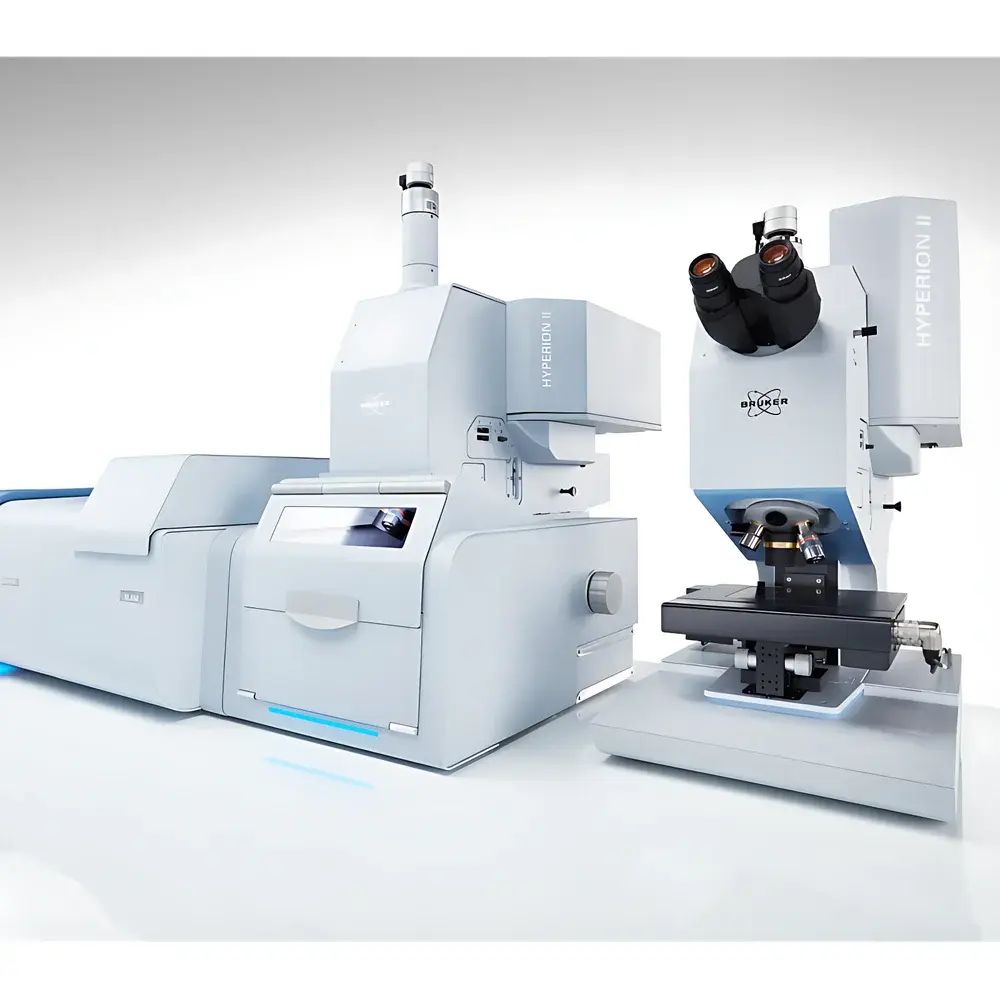
Bruker HYPERION II Research-Grade FT-IR and QCL Laser Infrared Microscope
| Brand | Bruker |
|---|---|
| Origin | Germany |
| Model | HYPERION II |
| Detection Principle | Fourier Transform Infrared Spectroscopy (FT-IR) and Quantum Cascade Laser (QCL) Infrared Imaging |
| Detector Options | Liquid Nitrogen-Cooled MCT, Thermoelectrically Cooled MCT, Focal Plane Array (FPA) |
| Measurement Modes | Transmission, Reflection, ATR |
| Spatial Resolution | Diffraction-Limited (≤ 3–5 µm typical in mid-IR) |
| Objective Compatibility | Wide Range of Reflective and Refractive IR Objectives (e.g., 15×, 36×, 74×, ATR objectives with integrated pressure sensor) |
| Software Platform | OPUS 8.x with IR Image Analysis Suite, ILIM Control Module |
| Compliance | Fully Compatible with GLP/GMP Data Integrity Requirements, Supports Audit Trail & Electronic Signatures per FDA 21 CFR Part 11 |
Overview
The Bruker HYPERION II is the world’s first research-grade infrared microscope to integrate dual-source spectroscopic imaging—combining conventional Fourier Transform Infrared (FT-IR) microscopy with tunable Quantum Cascade Laser (QCL) infrared illumination—in a single, unified optical platform. Engineered for precision and flexibility, the HYPERION II leverages the broad spectral coverage and quantitative fidelity of FT-IR alongside the high-brightness, narrow-linewidth, and rapid-tuning capabilities of QCL sources. This hybrid architecture enables simultaneous or sequential acquisition of chemically specific images across the mid-infrared range (typically 750–4000 cm⁻¹), with spatial resolution governed by diffraction limits (~3–5 µm at 1500 cm⁻¹). Unlike conventional single-source systems, the HYPERION II supports real-time visual monitoring during data collection, facilitating dynamic sample interrogation—including thermal response, hydration kinetics, or chemical reaction progression—without interrupting measurement continuity.
Key Features
- Integrated dual-source optical path: Co-aligned FT-IR interferometer and QCL laser module sharing identical microscope optics and detector interface.
- Focal Plane Array (FPA) detection support: Enables true chemical imaging at up to 128 × 128 or 64 × 64 pixel formats, delivering high-fidelity hyperspectral data cubes (x, y, wavenumber) with full spectral resolution (≤ 4 cm⁻¹).
- Multi-mode measurement capability: Seamless switching between transmission, reflection, and Attenuated Total Reflection (ATR) configurations using motorized beam path selection and auto-calibrated stage positioning.
- Dedicated ATR objective with integrated force-sensing transducer: Ensures reproducible contact pressure during micro-ATR mapping—critical for quantitative analysis of heterogeneous or soft samples (e.g., polymers, biological tissues, pharmaceutical tablets).
- Thermoelectrically cooled (TE-MCT) and liquid nitrogen-cooled (LN₂-MCT) detector options: Optimized for signal-to-noise ratio across diverse experimental timeframes—from rapid QCL snapshot imaging (<1 s/frame) to high-SNR FT-IR mapping (minutes per mosaic).
- Real-time visible/IR overlay imaging: Synchronized CCD camera and IR detector output allow precise correlation of morphological features with molecular distribution maps.
Sample Compatibility & Compliance
The HYPERION II accommodates a broad spectrum of solid, semi-solid, and thin-film specimens without requiring extensive preparation. Its modular stage design supports standard microscope slides, wafer carriers (up to 200 mm), and custom sample holders for in situ cells (e.g., heating/cooling stages, humidity chambers). The system meets essential regulatory expectations for analytical instrumentation used in quality control and R&D environments: full traceability of instrument parameters, user access controls, electronic signature support, and audit trail generation—all compliant with FDA 21 CFR Part 11 and aligned with ISO/IEC 17025 and ASTM E1252 guidelines for vibrational spectroscopic data reporting. All calibration routines (wavenumber, intensity, spatial) are documented and repeatable under GLP/GMP frameworks.
Software & Data Management
Controlled via Bruker’s OPUS 8.x software suite, the HYPERION II provides unified workflow management for both FT-IR and QCL acquisitions. The IR Image Analysis module enables advanced multivariate processing—including hierarchical cluster analysis (HCA), principal component analysis (PCA), and classical least-squares (CLS) fitting—directly on hyperspectral datasets. Data export adheres to open formats (e.g., HDF5, ENVI, CSV) ensuring interoperability with third-party chemometric tools (e.g., MATLAB, Python scikit-learn). Raw interferograms and QCL scan logs are stored with metadata tags (user, timestamp, instrument configuration, environmental conditions), supporting retrospective reprocessing and long-term data integrity.
Applications
The HYPERION II serves as a primary analytical tool in multiple high-impact domains: failure analysis of microelectronic packaging (delamination, residue identification); forensic trace evidence characterization (fiber, paint chip, adhesive layer differentiation); pharmaceutical solid-state analysis (polymorph distribution, API-excipient interaction, coating uniformity); life science tissue phenotyping (lipid/protein/carbohydrate mapping in FFPE sections); and materials science investigations (carbon nanotube dispersion, polymer blend morphology, corrosion product stratification). Its ability to switch between wide-field overview (low-magnification objectives) and sub-cellular detail (high-magnification ATR or reflective objectives) ensures method scalability from screening to validation.
FAQ
Can the HYPERION II perform both FT-IR and QCL measurements on the same sample location without realignment?
Yes—the co-registered optical design ensures sub-micron spatial overlap between FT-IR and QCL focal spots, enabling direct pixel-wise comparison of spectra acquired from identical coordinates.
Is FPA imaging supported in ATR mode?
Yes—FPA detectors operate natively in ATR geometry when paired with the dedicated ATR objective; spatial resolution remains consistent with transmission mode within the constraints of evanescent field penetration depth (~0.5–2 µm).
Does the system support automated spectral library searching during mapping?
Yes—OPUS includes integrated spectral search engines (e.g., KnowItAll, Bruker’s own reference libraries) that can be applied in batch mode across mapped regions for rapid component identification.
What level of spectral resolution is achievable in QCL mode?
QCL tuning resolution is ≤ 0.5 cm⁻¹ (instrument-limited), with typical acquisition resolution set between 1–4 cm⁻¹ depending on signal averaging requirements and measurement speed targets.
Are external environmental chambers compatible with the HYPERION II stage?
Yes—the motorized XYZ stage features standardized mounting interfaces and cable routing provisions for integration with commercial heating/cooling, gas-controlled, or electrochemical cells.




