
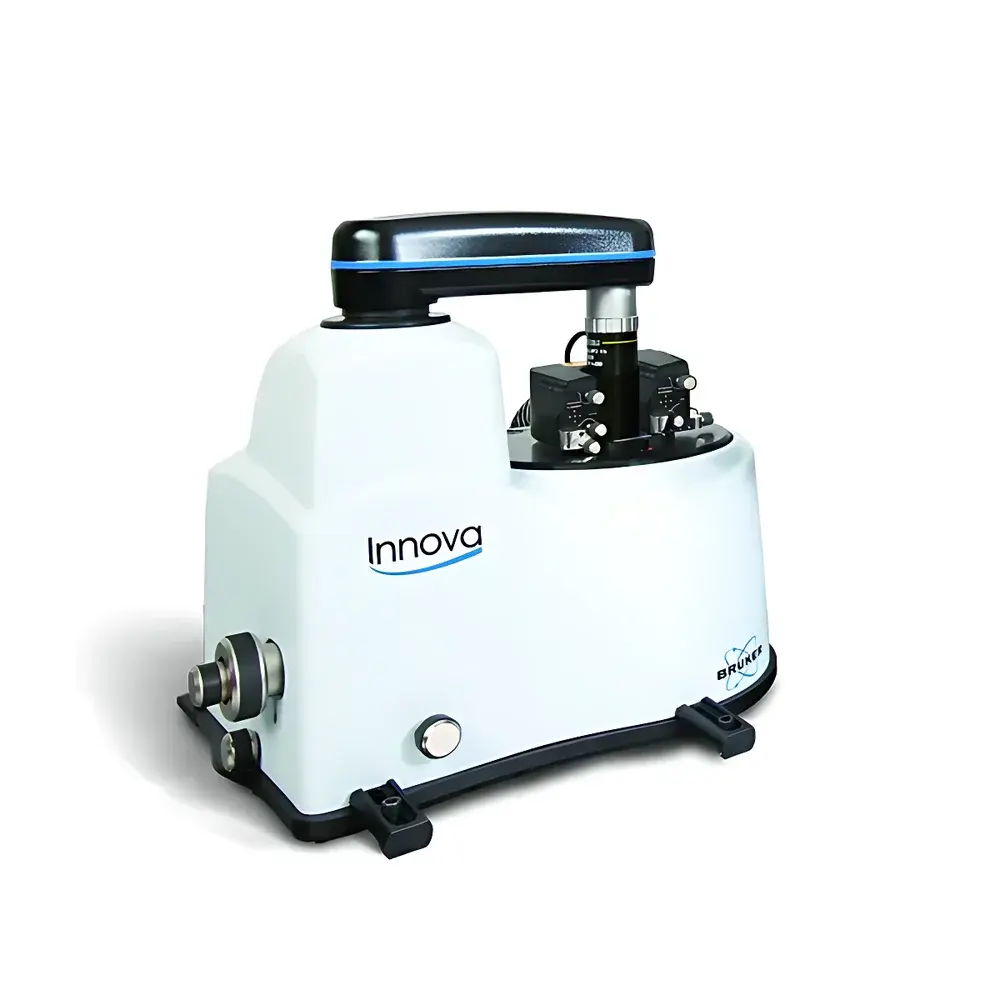
Bruker Innova SPM Scanning Probe Microscope
| Brand | Bruker |
|---|---|
| Origin | Germany |
| Model | Innova SPM |
| Instrument Type | Scanning Tunneling Microscope (STM) & Atomic Force Microscope (AFM) |
| Sample Stage Dimensions | X-45 mm × Y-45 mm × Z-18 mm |
| Scan Range | 90 µm (max) down to sub-micron resolution |
| Control Architecture | Closed-loop piezoelectric positioning |
| Optical System | Upright, motorized zoom and intensity-controlled illumination |
| Compatible Modes | Contact Mode, TappingMode™, STM, Phase Imaging™, MFM, EFM, C-AFM, SCM, KPFM, Force-Distance Spectroscopy, I-V Spectroscopy, Nanoindentation, Nanolithography |
Overview
The Bruker Innova SPM is a high-performance, modular scanning probe microscope engineered for rigorous nanoscale characterization across physics, materials science, and life science laboratories. Operating on the fundamental principles of atomic force microscopy (AFM) and scanning tunneling microscopy (STM), the Innova delivers quantitative topographic, mechanical, electrical, magnetic, and electrostatic property mapping at sub-nanometer resolution. Its closed-loop piezoelectric scanner architecture ensures true dimensional fidelity—eliminating image distortion inherent in open-loop systems—while maintaining low thermal and electronic noise levels comparable to high-end open-loop configurations. The system integrates a precision upright optical microscope with motorized zoom, software-controlled LED illumination, and real-time optical navigation, enabling rapid sample location, probe alignment, and correlative analysis. Designed for operational flexibility and long-term stability, the Innova SPM supports vacuum, ambient, and liquid environments (with optional enclosures), making it suitable for both fundamental research and applied R&D workflows requiring traceable, reproducible nanoscale data.
Key Features
- Closed-loop XYZ piezoelectric scanner with active position feedback for distortion-free imaging across full 90 µm lateral range and 18 mm vertical travel
- Upright optical microscope with high-resolution color CCD camera, motorized zoom (0.7×–4.5×), and programmable LED illumination intensity control
- Integrated probe alignment station with pre-aligned cantilevers and automated laser steering for rapid setup and consistent optical lever sensitivity
- Modular controller architecture supporting simultaneous multi-channel signal acquisition (topography, phase, current, voltage, force, capacitance, surface potential)
- Ergonomic, open-stage design accommodating samples up to 45 mm × 45 mm × 18 mm with easy access for in-situ modifications or environmental cell integration
- Real-time scan parameter optimization and adaptive feedback tuning via NanoScope software platform
Sample Compatibility & Compliance
The Innova SPM accommodates a broad spectrum of conductive and non-conductive specimens—including thin films, 2D materials, polymers, biological membranes, semiconductors, and functional oxides—without requiring conductive coating in most AFM modes. Its open-stage geometry allows direct mounting of custom substrates, electrochemical cells, heating/cooling stages, and humidity chambers. All hardware and firmware comply with CE marking requirements and meet electromagnetic compatibility (EMC) standards per EN 61326-1. Data acquisition protocols support audit-trail generation and user-access logging, facilitating alignment with GLP and GMP documentation practices. While not certified as FDA 21 CFR Part 11-compliant out-of-the-box, the NanoScope software framework provides configurable security settings (user roles, electronic signatures, immutable data archives) compatible with regulated environments upon site-specific validation.
Software & Data Management
Controlled by Bruker’s industry-standard NanoScope Analysis software suite, the Innova SPM enables seamless acquisition, processing, and reporting of multidimensional SPM datasets. The software includes built-in scripting (via Python API), batch processing tools, spectral analysis modules (FFT, cross-correlation), and quantitative roughness/statistical parameter extraction per ISO 25178 and ASTM E2927. Raw data are stored in vendor-neutral, metadata-rich .wsx format, fully compatible with third-party analysis platforms including Gwyddion, MountainsSPIP, and MATLAB. All instrument settings, calibration records, and operator annotations are embedded within each dataset file, ensuring full traceability from acquisition to publication. Export options include TIFF, PNG, CSV, and HDF5 formats, with optional DICOM export for biomedical applications.
Applications
- Atomic-resolution imaging and defect analysis of graphene, transition metal dichalcogenides (TMDs), and other van der Waals heterostructures
- Nanoscale mechanical property mapping (elastic modulus, adhesion, dissipation) of polymer blends, hydrogels, and biomaterials via force spectroscopy
- Local conductivity and carrier concentration profiling in semiconductor devices using conductive AFM (C-AFM) and scanning capacitance microscopy (SCM)
- Surface potential and work function quantification of photovoltaic absorbers and ferroelectric domains via Kelvin probe force microscopy (KPFM)
- In-situ electrochemical AFM studies of electrode/electrolyte interfaces during battery cycling or corrosion processes
- Nanoindentation-based hardness and creep measurements on thin-film coatings and MEMS structures
FAQ
What scanning modes does the Innova SPM support?
It supports Contact Mode, TappingMode™, Scanning Tunneling Microscopy (STM), Phase Imaging™, Magnetic Force Microscopy (MFM), Electrostatic Force Microscopy (EFM), Conductive AFM (C-AFM), Scanning Capacitance Microscopy (SCM), Kelvin Probe Force Microscopy (KPFM), Force-Distance Spectroscopy, Current-Voltage Spectroscopy, Nanoindentation, and Nanolithography.
Is the system compatible with environmental control?
Yes—the open-stage design permits integration of temperature-controlled stages (-150 °C to +300 °C), liquid cells, gas flow chambers, and humidity enclosures (optional accessories).
Can raw data be exported for third-party analysis?
Yes—all datasets are saved in Bruker’s .wsx format, which includes full metadata and is natively supported by Gwyddion, MountainsSPIP, and MATLAB via open-source readers.
What is the maximum sample height the stage can accommodate?
The Z-range of the sample stage is 18 mm, allowing tall or multi-layered specimens, including custom holders and in-situ cells.
Does the system meet international metrology standards?
Imaging linearity and dimensional accuracy are validated per ISO/IEC 17025-accredited calibration procedures; roughness parameters conform to ISO 25178-2 and ASTM E2927 guidelines.






