
HengaoDe H18054 Multi-Station Magnetic Hotplate Stirrer
| Brand | HengaoDe |
|---|---|
| Origin | Beijing, China |
| Manufacturer Type | Authorized Distributor |
| Country of Origin | China |
| Model | H18054 |
| Price | USD 28.50 (FOB) |
| Input Voltage | 220 V ±10%, 50 Hz |
| Stirring Power | 25 W × 4 stations |
| Heating Power | 250 W × 4 stations |
| Speed Range | 0–1600 rpm |
| Temperature Range | Ambient to 100 °C |
| Temperature Control Accuracy | ±0.5 °C |
| Control Method | Microprocessor-based digital PID control with dual LED display |
Overview
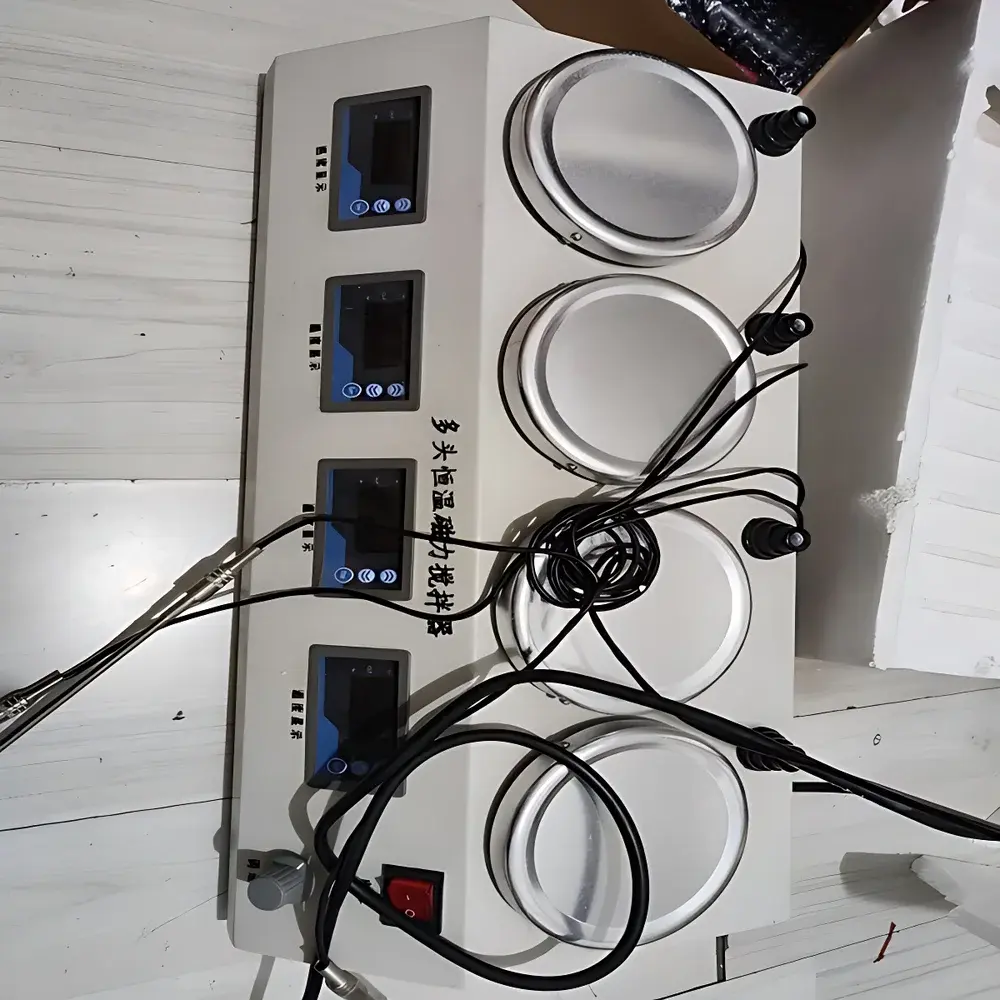
The HengaoDe H18054 Multi-Station Magnetic Hotplate Stirrer is an engineered laboratory instrument designed for simultaneous thermal regulation and precise mechanical agitation across up to four independent sample positions. Based on the principle of electromagnetic induction, it employs high-efficiency permanent magnets coupled with variable-frequency DC motors to drive magnetic stir bars within vessels placed on thermally conductive ceramic-coated stainless-steel hotplates. Its integrated heating and stirring functions operate independently per station—enabling parallel experiments under differentiated temperature and speed conditions. This architecture supports reproducible kinetic studies, dissolution testing, reagent synthesis, and buffer equilibration in compliance with GLP-aligned workflows. The unit meets fundamental electrical safety requirements per IEC 61010-1 and incorporates thermal cut-off protection to prevent uncontrolled overheating during extended operation.
Key Features
- Four-channel independent control: Each station features dedicated digital speed and temperature setpoints, eliminating cross-talk between adjacent positions.
- Microprocessor-driven PID temperature regulation: Delivers stable thermal output within ±0.5 °C over the full 0–100 °C range; real-time dual-display shows both setpoint and actual temperature.
- Low-noise, high-torque stirring mechanism: Capable of sustaining consistent rotation from 0 to 1600 rpm—even with viscous or dense media—without slippage or motor stall.
- Robust thermal platform: Ceramic-coated stainless-steel heating plates ensure uniform heat distribution, rapid thermal response, and resistance to chemical corrosion and mechanical abrasion.
- Safety-integrated design: Includes automatic over-temperature shutdown, grounded chassis construction, and IP20-rated enclosure for standard laboratory environments.
- Modular scalability: Compatible with optional accessories including PT100 probe inputs for external temperature feedback and RS232/USB interfaces for data logging (available upon request).
Sample Compatibility & Compliance
The H18054 accommodates standard laboratory glassware up to 1000 mL volume per station, including beakers, Erlenmeyer flasks, and round-bottom flasks with flat bases. It supports magnetic stir bars ranging from 10 mm to 40 mm in length and is compatible with aqueous, organic, and mildly acidic or alkaline solutions. While not certified for explosive atmospheres, its electrical design conforms to IEC 61010-1 for measurement, control, and laboratory use. The instrument does not require calibration traceability per ISO/IEC 17025 but supports user-defined verification protocols using NIST-traceable thermometers and tachometers. It is routinely deployed in academic teaching labs, QC/QA departments performing ASTM D2129 dissolution tests, and R&D units conducting method development under USP guidelines.
Software & Data Management
The H18054 operates as a standalone benchtop device without embedded software or network connectivity. All operational parameters are configured via front-panel membrane keys and displayed on dual 4-digit LED screens. For laboratories requiring audit-ready records, optional analog voltage outputs (0–5 V or 4–20 mA) can be interfaced with third-party data acquisition systems compliant with FDA 21 CFR Part 11 when paired with validated PC-based software. Time-stamped manual logs—recording start time, setpoints, duration, and observed outcomes—are recommended for GLP documentation. No firmware updates or cloud synchronization capabilities are provided; all control logic resides in hardened microcontroller firmware with write-protected memory.
Applications
This instrument serves critical roles across multiple regulated and research-intensive domains: preparation of homogeneous calibration standards in environmental testing (e.g., EPA Method 3510C); accelerated aging studies of polymer formulations under controlled thermal stress; pH adjustment and buffer equilibration in biopharmaceutical upstream processing; extraction protocol optimization in pesticide residue analysis (AOAC 2007.01); and routine maintenance of cell culture media in academic life science labs. Its multi-station capability reduces batch-to-batch variability by minimizing sequential handling artifacts—particularly valuable in comparative solubility screening and catalyst activity profiling where inter-run consistency directly impacts statistical power.
FAQ
Is the H18054 suitable for use with corrosive solvents such as concentrated HCl or NaOH?
Yes—provided appropriate stir bars (e.g., PTFE-coated or glass-coated) and chemically resistant vessels are used. The hotplate surface is inert to common lab reagents, though prolonged exposure to halogenated solvents may degrade the ceramic coating over time.
Can I operate only two stations while leaving the others inactive?
Absolutely. Each station’s heating and stirring functions are electrically isolated and may be enabled or disabled independently without affecting performance on active channels.
Does the unit support external temperature probes for jacketed reactor control?
Not natively—but analog output signals (optional) can be routed to external PID controllers that accept process inputs from PT100 or thermocouple sensors mounted inside reaction vessels.
What is the expected service life under continuous 8-hour daily operation?
Rated for ≥5 years of routine use at ≤75% of maximum power load. Bearings and thermal elements are field-replaceable; no consumables beyond stir bars are required.
Is CE or UL certification available for export to North America or the EU?
The base model carries CCC certification for domestic Chinese markets. Export configurations may be supplied with CE-marked power supplies and EMC-compliant shielding upon formal order specification—subject to additional lead time and documentation review.





