
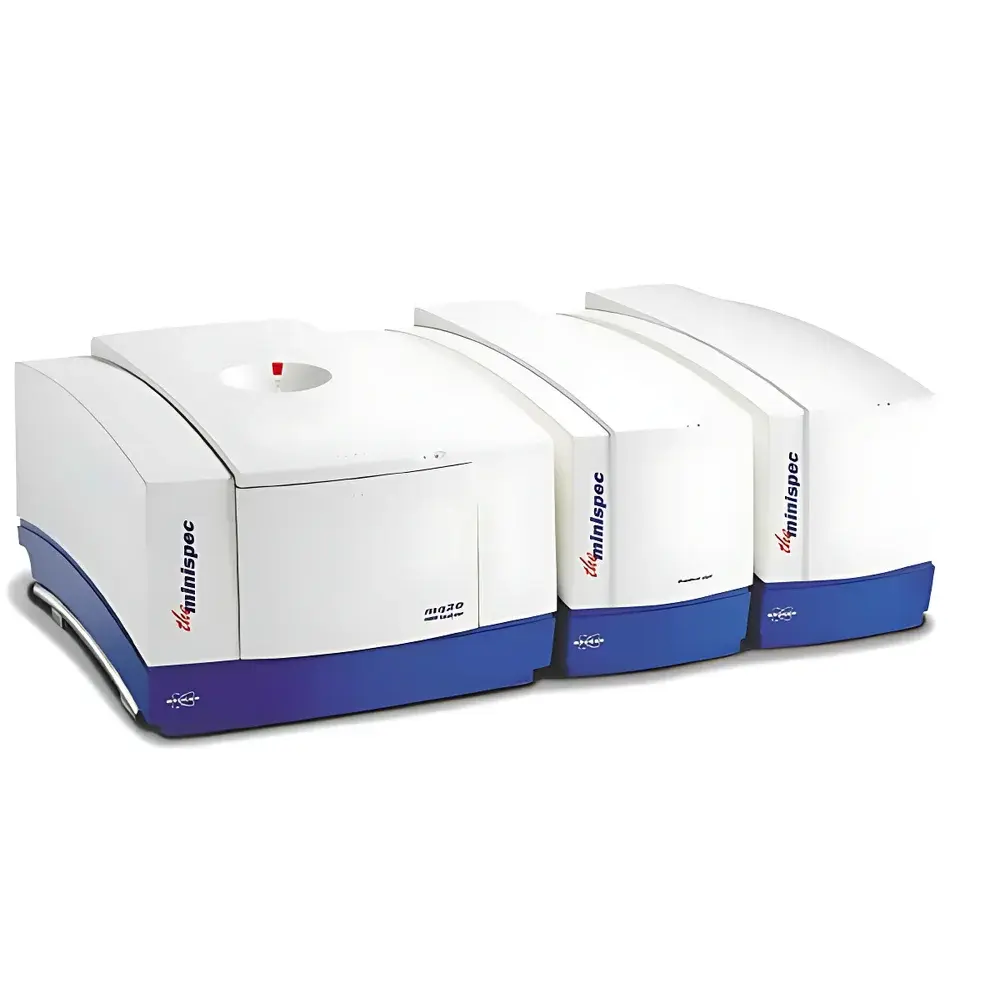
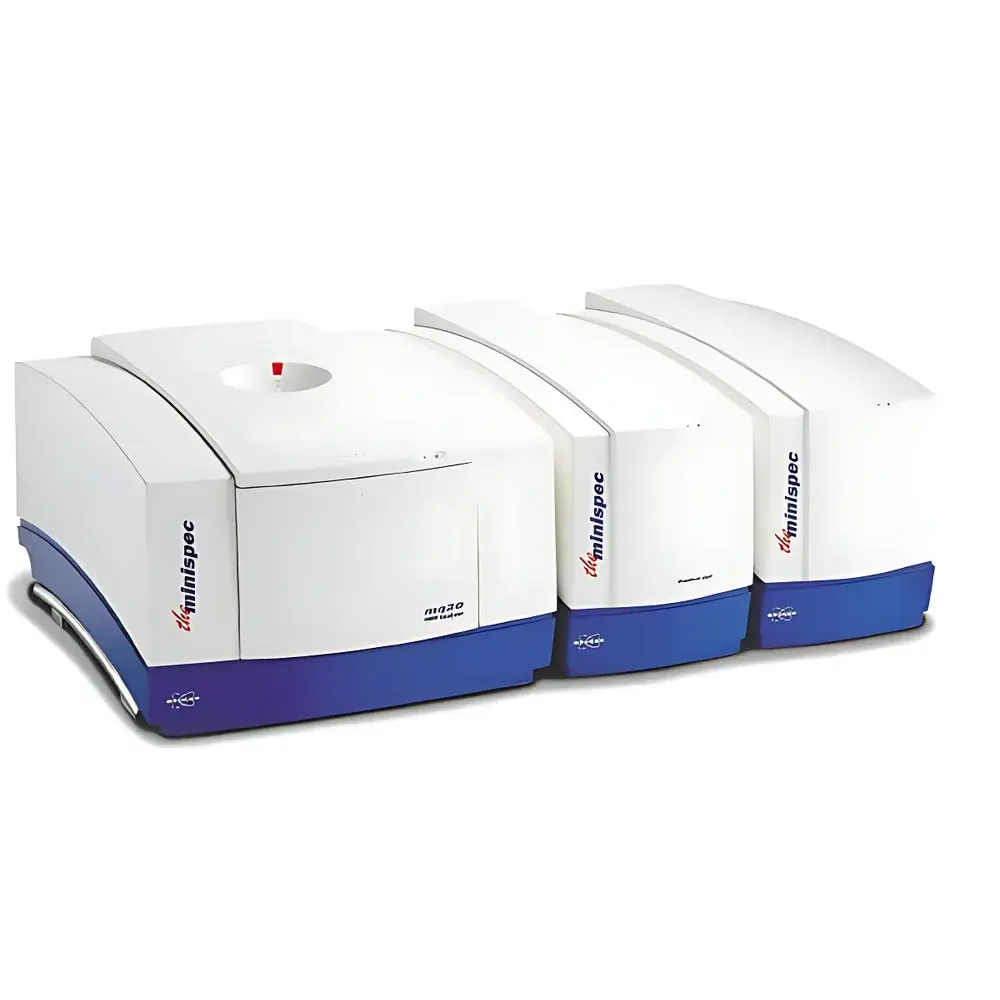
Bruker minispec Food & Beverage Droplet Size Analyzer
| Brand | Bruker |
|---|---|
| Origin | France |
| Manufacturer Type | Authorized Distributor |
| Origin Category | Imported |
| Model | minispec Food & Beverage Droplet Size Analyzer |
| Automation Level | Semi-Automatic |
| Detection Scope | Milk Composition & Emulsion Droplet Size Distribution |
| Measurement Principle | Time-Domain Nuclear Magnetic Resonance (TD-NMR) |
| Validated For | Single Emulsions (O/W and W/O) and Double Emulsions (W/O/W) |
| Droplet Size Range | 0.5–10 µm (O/W), 1–30 µm (W/O) |
| Minimum Detectable Dispersed Phase | 2% (v/v) |
| Sample Prep | Minimal — No Dilution or Modification Required |
| Regulatory Alignment | Compliant with GLP practices |
Overview
The Bruker minispec Food & Beverage Droplet Size Analyzer is a time-domain nuclear magnetic resonance (TD-NMR)-based analytical platform engineered for precise, non-invasive characterization of droplet size distributions in complex food emulsions. Unlike optical or scattering-based techniques, TD-NMR measures the transverse relaxation behavior (T2) of hydrogen nuclei in dispersed and continuous phases, enabling direct quantification of droplet dimensions based on diffusion-restricted spin–spin relaxation physics. This principle eliminates dependence on optical contrast, particle refractive index, or sample turbidity—making it uniquely robust for opaque, high-fat, or highly viscous systems such as butter, margarine, mayonnaise, salad dressings, soft cheeses, and dairy beverages. The instrument is purpose-built for quality control laboratories in dairy, infant formula, plant-based alternative, and functional food manufacturing, where emulsion stability, mouthfeel, shelf-life prediction, and controlled release performance are governed by droplet architecture.
Key Features
- TD-NMR measurement principle provides intrinsic specificity to liquid-phase droplets—not agglomerates or sediment—ensuring physicochemically relevant sizing.
- G-Var (Gradient-Variable) pulse sequence enables rapid, reproducible acquisition with minimal user intervention and no sample dilution, heating, or filtration.
- GoScan™ dedicated software interface streamlines workflow from measurement to reporting, supporting both single- and multi-modal distribution analysis under log-normal assumptions.
- Validated for single emulsions (oil-in-water and water-in-oil) and double emulsions (water-in-oil-in-water), critical for encapsulation and layered delivery systems.
- Detection limit for dispersed phase concentration as low as 2% (v/v), enabling early-stage formulation screening without signal saturation or matrix interference.
- Calibration-free operation across the full dynamic range: 0.5–10 µm for O/W systems and 1–30 µm for W/O systems—covering industry-relevant scales from micellar dispersions to coarse homogenized emulsions.
Sample Compatibility & Compliance
The minispec analyzer accommodates standard 10 mm or 18 mm NMR tubes, compatible with undiluted, ready-to-measure samples—including pasteurized milk, UHT cream, fermented dairy products, and stabilized plant milks. It requires no centrifugation, sonication, or surfactant addition—preserving native emulsion structure. Method validation aligns with ISO 11047 (determination of droplet size in emulsions by NMR), and routine use supports Good Laboratory Practice (GLP) documentation standards. When deployed with validated software configurations, the system meets data integrity requirements outlined in FDA 21 CFR Part 11 for electronic records and signatures, including full audit trails, user access controls, and immutable result archiving.
Software & Data Management
GoScan™ software delivers an intuitive, icon-driven interface optimized for food QC technicians with minimal NMR background. It automates T2 decay curve fitting using inverse Laplace transformation, generates cumulative and differential droplet size distributions, and exports standardized reports (PDF, CSV, XML) compliant with LIMS integration protocols. Batch processing, method templates, and customizable pass/fail criteria support high-throughput environments. All raw FID data, processing parameters, and metadata are stored in a relational database with timestamped version control—enabling full traceability from measurement to regulatory submission.
Applications
- Quantifying droplet coalescence kinetics during thermal abuse or long-term storage to predict creaming, phase separation, or microbial ingress risk.
- Evaluating homogenization efficiency across pressure settings and equipment generations in dairy processing lines.
- Screening emulsifier efficacy (e.g., lecithin, mono/diglycerides, polysorbates) and their impact on interfacial film rigidity and droplet resilience.
- Characterizing double emulsions for targeted nutrient delivery (e.g., omega-3 encapsulation in dairy matrices).
- Supporting shelf-life modeling by correlating initial droplet size distribution width (PDI) with accelerated stability test outcomes.
- Facilitating root-cause analysis during batch deviations—e.g., linking anomalous texture in soft cheese to bimodal droplet populations arising from incomplete homogenization.
FAQ
How does TD-NMR differ from laser diffraction or static light scattering for emulsion analysis?
TD-NMR directly probes molecular mobility constraints imposed by droplet interfaces, yielding true hydrodynamic size without optical assumptions. It performs reliably in colored, opaque, or high-viscosity samples where light-based methods fail or require extensive dilution.
Can the system distinguish between oil droplets and air bubbles in aerated dairy products?
Yes—via relaxation time discrimination: air bubbles exhibit significantly shorter T2 values ( 10 ms), enabling spectral deconvolution and selective quantification.
Is method transfer possible between different minispec instruments?
Yes—standardized pulse sequences, calibration protocols, and GoScan™ processing algorithms ensure cross-platform reproducibility within ±3% RSD for mean droplet diameter across multiple instruments and sites.
Does the system support IQ/OQ/PQ validation documentation?
Bruker provides comprehensive qualification packages—including installation qualification (IQ), operational qualification (OQ), and performance qualification (PQ) templates—aligned with ISO/IEC 17025 and pharmaceutical GMP expectations.
What sample volume is required per measurement?
Typical requirement is 0.5–1.0 mL in a standard 10 mm NMR tube, minimizing material consumption during R&D screening or high-value ingredient testing.




