
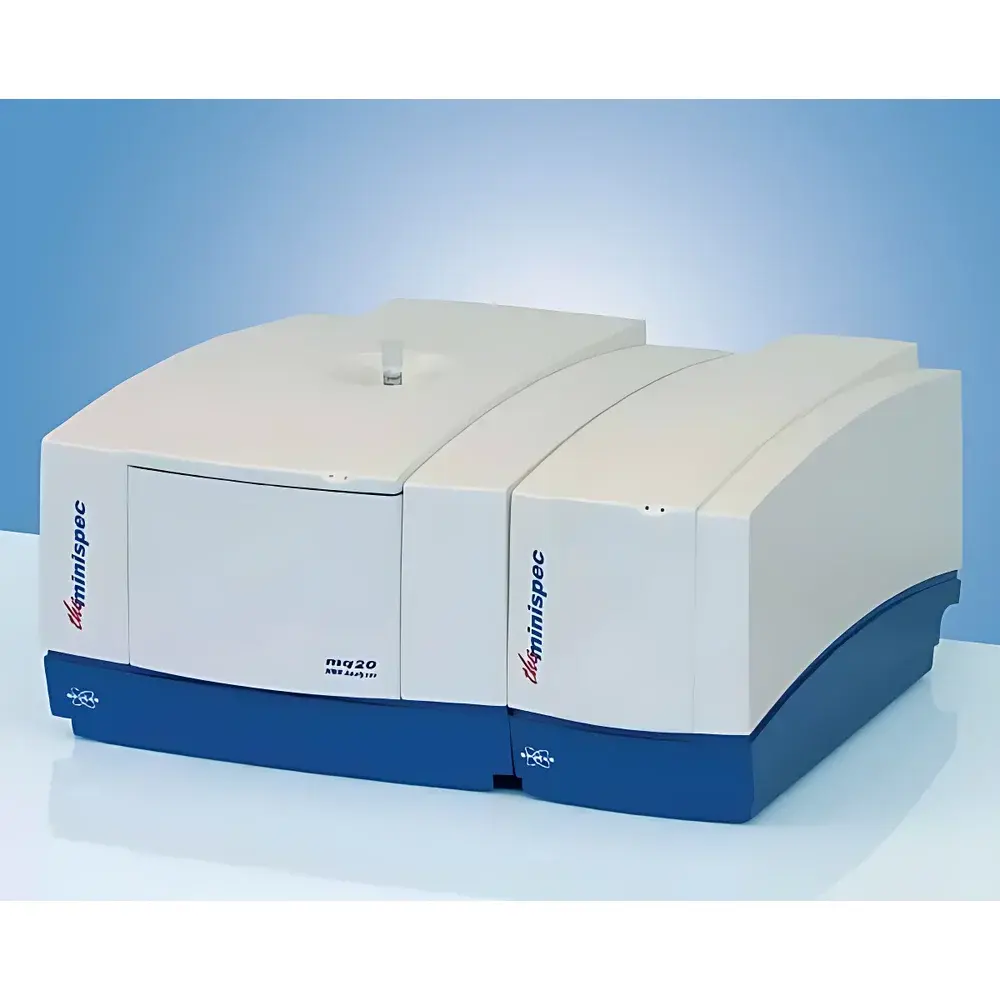
Bruker minispec mq Series Time-Domain Nuclear Magnetic Resonance (TD-NMR) Analyzer
| Brand | Bruker |
|---|---|
| Origin | France |
| Manufacturer Type | Authorized Distributor |
| Origin Category | Imported |
| Model | minispec mq |
| Instrument Type | Low-Field NMR Analyzer |
| Sample Type | Solid-Liquid Compatible |
| Operating Frequency | 20 MHz |
| Measurement Mode | Direct Analysis Without Sample Preparation |
| Temperature Range | –100 °C to +200 °C |
| Regulatory Compliance | 21 CFR Part 11, IQ/OQ/PQ Protocols, GLP-Compliant Operation |
| Calibration | Linear Calibration with ≥3 Samples, Chemometric Options Available |
Overview
The Bruker minispec mq Series is a benchtop time-domain nuclear magnetic resonance (TD-NMR) analyzer engineered for quantitative, non-invasive characterization of molecular mobility, phase composition, and physical state in heterogeneous materials. Operating at a stable 20 MHz Larmor frequency (corresponding to ~0.47 T magnetic field strength), the system exploits the intrinsic magnetic moment of 1H nuclei—primarily in hydrogen-bearing compounds—to generate relaxation and diffusion signals without ionizing radiation or chemical reagents. Unlike high-field Fourier-transform NMR spectrometers, TD-NMR focuses on the temporal evolution of spin magnetization following radiofrequency excitation, yielding robust T1 (spin-lattice) and T2 (spin-spin) relaxation times, as well as diffusion coefficients via pulsed field gradient (PFG) sequences. Its permanent magnet architecture ensures low power consumption, minimal cryogen dependency, and rapid thermal equilibration—making it suitable for routine QC environments and extended R&D workflows where reproducibility, throughput, and operational simplicity are critical.
Key Features
- 20 MHz permanent magnet system with active temperature stabilization for field homogeneity ≤0.1 ppm over 10 mm DSV
- Integrated variable-temperature probe enabling precise control from –100 °C to +200 °C (liquid nitrogen or electric heating options)
- Direct analysis capability: no grinding, dissolution, extraction, or derivatization required—preserves sample integrity and eliminates method-induced bias
- Pre-configured pulse sequences including CPMG (for T2 distribution), IR (for T1), and STE (for diffusion coefficient measurement)
- Automated calibration routines supporting linear multivariate models using ≥3 reference standards; optional chemometric modeling (PLS, PCA) via minispec LabSoftware
- Modular hardware design compliant with IQ/OQ/PQ validation protocols; full audit trail, electronic signatures, and data integrity controls aligned with FDA 21 CFR Part 11 requirements
Sample Compatibility & Compliance
The minispec mq accommodates solid, semi-solid, emulsified, and liquid samples in standard 10–18 mm OD glass or polymer tubes. Its insensitivity to optical properties—color, turbidity, opacity, or surface reflectivity—enables consistent analysis across food matrices (e.g., chocolate, margarine), agricultural products (oilseeds, meal, biomass), polymers (crosslink density, curing kinetics), pharmaceuticals (excipient hydration, tablet coating uniformity), and petrochemicals (hydrogen index in fuels, water-in-oil content). Method equivalence has been demonstrated against reference techniques per ISO 16934 (solid fat content), AOCS Cd 16b-93 (oilseed oil content), ASTM D7503 (hydrogen index in aviation turbine fuel), and IUPAC Standard Methods for Fat Analysis. All validated methods support GLP-compliant documentation and traceable calibration.
Software & Data Management
minispec LabSoftware provides a validated, Windows-based platform for instrument control, sequence editing, real-time signal processing, and report generation. Raw FID data are stored in vendor-neutral formats (e.g., ASCII, CSV) alongside metadata (operator ID, timestamp, temperature, pulse parameters). The software supports multi-user role-based access, electronic signature workflows, and encrypted database archiving. Audit trails record all parameter modifications, calibration events, and data exports. Export modules integrate with LIMS systems via ODBC or HL7 interfaces. For advanced quantification, the Chemometrics Module enables PLS regression model development, cross-validation, and external prediction—all traceable under ALCOA+ principles.
Applications
- Food Science: Solid fat content (SFC), fat crystallinity, moisture migration, emulsion stability, and shelf-life prediction
- Agriculture & Biofuels: Oil/water content in seeds, pomace, and algal biomass; protein hydration dynamics
- Polymers & Elastomers: Crosslink density mapping, solvent uptake, aging effects, and vulcanization monitoring
- Pharmaceuticals: API polymorphism screening, excipient compatibility, lyophilized cake structure, and controlled-release matrix characterization
- Petrochemicals: Hydrogen index (HI), aromaticity estimation, water-in-fuel detection, and lubricant oxidation status
FAQ
Is the minispec mq suitable for regulatory submissions in GMP environments?
Yes—when deployed with validated software configuration, documented IQ/OQ/PQ, and enabled 21 CFR Part 11 controls, it meets data integrity requirements for pharmaceutical and food-grade quality systems.
Can T2 distributions be used to distinguish between bound and free water in hydrated polymers?
Yes—multi-exponential T2 decay analysis resolves distinct proton pools based on local molecular mobility, enabling quantification of immobilized, intermediate, and bulk water fractions.
Does the system require liquid helium or cryogenic maintenance?
No—the permanent magnet operates at ambient temperature; only electrical power and optional cooling water (for high-temp operation) are required.
How is method transfer achieved between different minispec mq units?
Standardized pulse sequences, calibrated temperature profiles, and shared chemometric models ensure inter-instrument reproducibility within ±1.5% RSD for T2 mean values across identical sample sets.
What sample volume is required for reliable quantification?
Minimum fill height is 20 mm in a 10 mm tube (≈1.5 mL); optimal signal-to-noise is achieved with homogeneous packing and consistent geometry across calibration and unknowns.






