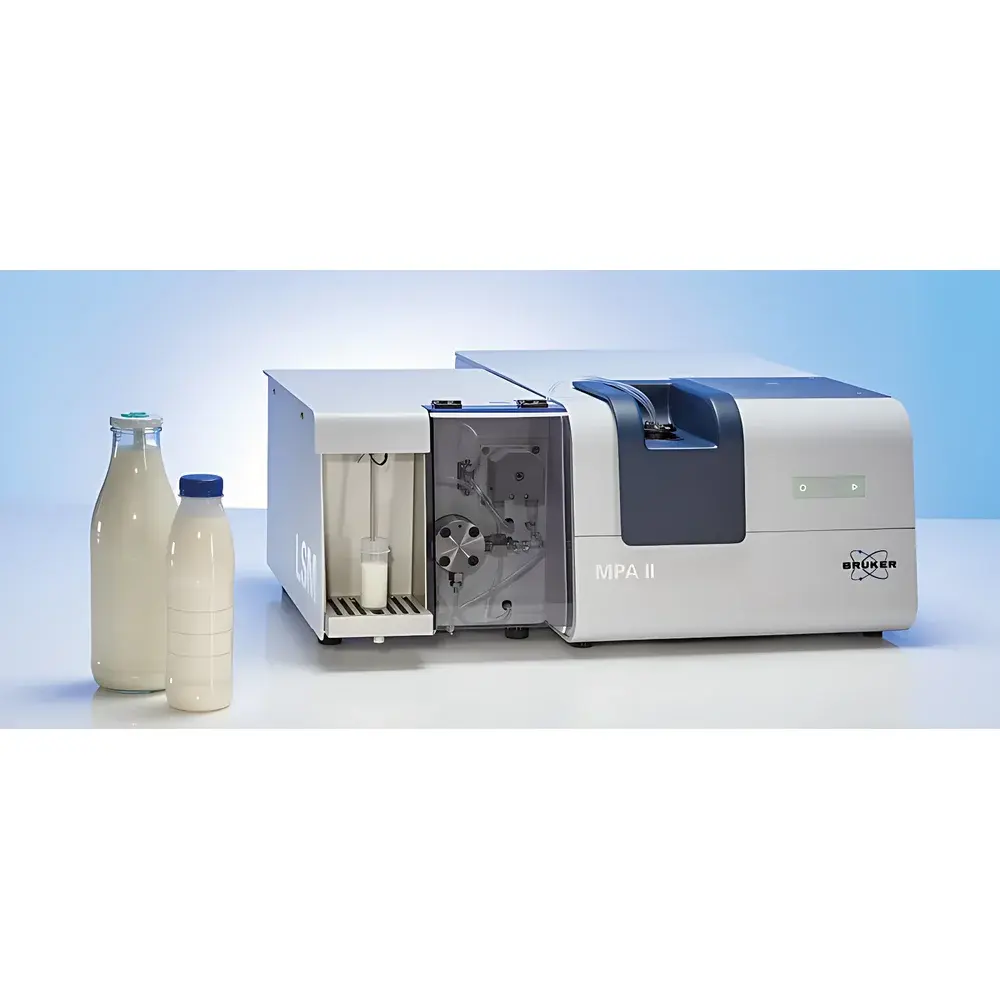
Bruker MPA II-D Fourier Transform Near-Infrared Spectrometer for Dairy Analysis
| Brand | Bruker |
|---|---|
| Origin | Germany |
| Model | MPA II-D |
| Application | Milk and dairy product composition analysis |
| Automation | Fully automated |
| Sample Types | Liquid (raw milk, UHT milk, whey), semi-solid (yogurt, cream cheese), solid (milk powder, infant formula) |
| Optical Configuration | Transmission (for liquids via 1-mm flow cell), Diffuse reflectance (for solids/semi-solids via integrating sphere) |
| Temperature Control | Heated flow cell (40 °C), programmable sample preheating (20–40 °C) |
| Fluid Handling | Dual-pump LSM module (high-pressure homogenizing pump + peristaltic pump) |
| Compliance | Designed for GLP/GMP environments |
Overview
The Bruker MPA II-D is a high-performance, research-grade Fourier Transform Near-Infrared (FT-NIR) spectrometer engineered specifically for comprehensive compositional analysis across the full spectrum of dairy products. Unlike conventional dispersive NIR systems, the MPA II-D employs interferometric optics based on Michelson interferometry, delivering superior spectral resolution (typically ≤ 4 cm⁻¹), long-term photometric stability, and inherent wavelength accuracy traceable to He–Ne laser referencing. Its core analytical capability lies in quantifying key quality parameters—including fat, protein, lactose, moisture, total solids, urea, and free fatty acids—directly from raw spectral data using chemometric models validated against reference methods (e.g., AOAC, IDF, ISO 9622). The instrument is not a generic spectrophotometer but a purpose-built platform integrating optical hardware, fluidic automation, and multivariate calibration infrastructure into a single cohesive system for dairy QC laboratories operating under ISO/IEC 17025 or GMP frameworks.
Key Features
- Fully automated Liquid Sampling Module (LSM) with dual-pump architecture: high-pressure homogenizer (for raw milk up to 30% fat) and variable-speed peristaltic pump (for viscous samples up to 60% fat or 30% total solids)
- Heated 1-mm transmission flow cell maintained at 40 °C to ensure consistent viscosity and eliminate temperature-induced spectral drift
- Integrating sphere accessory enabling diffuse reflectance measurements on powders (e.g., skim milk powder, whey protein isolate), cheeses, yogurts, and condensed milks without grinding or dilution
- No consumable optical components: gold-coated mirrors, ruggedized beam splitter, and sealed interferometer provide >10-year operational stability without recalibration or alignment
- Real-time homogenizer performance monitoring: built-in diagnostics detect valve wear or clogging before repeatability degrades
- Transparent fluidic path allows visual inspection of tubing, valves, and flow cell for contamination or air bubble formation
- Software-controlled wash cycles with configurable volume, duration, and solvent selection (water, ethanol, detergent solutions)
Sample Compatibility & Compliance
The MPA II-D accommodates heterogeneous dairy matrices that challenge conventional analyzers: raw milk with native fat globules (>5 µm), concentrated whey protein solutions (up to 45% w/w), high-calcium fortified milks containing suspended microcrystals (<0.5 mm), and viscous fermented products such as sour cream or mascarpone. All liquid analyses comply with ISO 9622:2013 (IDF 141:2013) for milk fat, protein, and lactose determination by FT-NIR. Solid and semi-solid measurements follow ISO 12099:2017 for feed and food analysis using NIR reflectance. The system supports full electronic record retention, user-level permissions, and audit-trail logging aligned with FDA 21 CFR Part 11 and EU Annex 11 requirements—enabling deployment in regulated manufacturing environments subject to regulatory inspection.
Software & Data Management
OPUS spectroscopy software (v8.5+) provides end-to-end workflow management: method development (PLS, PCR, SVM), model validation (cross-validation, external test sets), routine analysis, and reporting. Calibration models are stored with metadata including version history, training set statistics, and uncertainty estimates. Data files conform to ASTM E1783-20 standard for NIR spectral data exchange. Instrument diagnostics, maintenance logs, and calibration verification reports are exportable in PDF or CSV. Optional integration with LIMS via ASTM E2500-compliant API enables automated result transfer and chain-of-custody tracking.
Applications
- Raw milk intake testing at dairies: rapid fat/protein/lactose screening with <60-second cycle time per sample
- In-line QC of UHT milk, ESL products, and recombined milks during filling
- Batch release testing of infant formula powders for nutrient uniformity and adulterant detection (e.g., melamine, starch)
- Stability monitoring of fermented products (pH-correlated spectral shifts in yogurt fermentation)
- Verification of vitamin premixes and edible oil blends used in functional dairy formulations
- Non-destructive analysis of aged cheeses for moisture migration and proteolysis trends
FAQ
Does the MPA II-D require daily standardization or zeroing?
No. The interferometer’s laser-referenced optical path length ensures intrinsic wavelength stability; no daily standardization or zero adjustment is necessary.
Can the system analyze high-viscosity samples like condensed milk without dilution?
Yes. The peristaltic pump in the LSM module handles samples with viscosities up to 10,000 mPa·s—eliminating the need for pre-dilution or heating beyond 40 °C.
Is flow cell replacement required over time?
No. The sapphire-windowed 1-mm flow cell is chemically inert and mechanically robust; it does not degrade under normal dairy matrix exposure and requires only periodic cleaning.
How is homogenization efficiency monitored for raw milk analysis?
The LSM software calculates real-time pressure differentials across the homogenizer valve and compares them against baseline values; deviations trigger maintenance alerts before repeatability falls outside ±0.05% RSD.
What sample volume is needed for liquid analysis?
Minimum 25 mL per analysis—sufficient for duplicate measurements and system rinse—ensuring statistical confidence without excessive material consumption.