
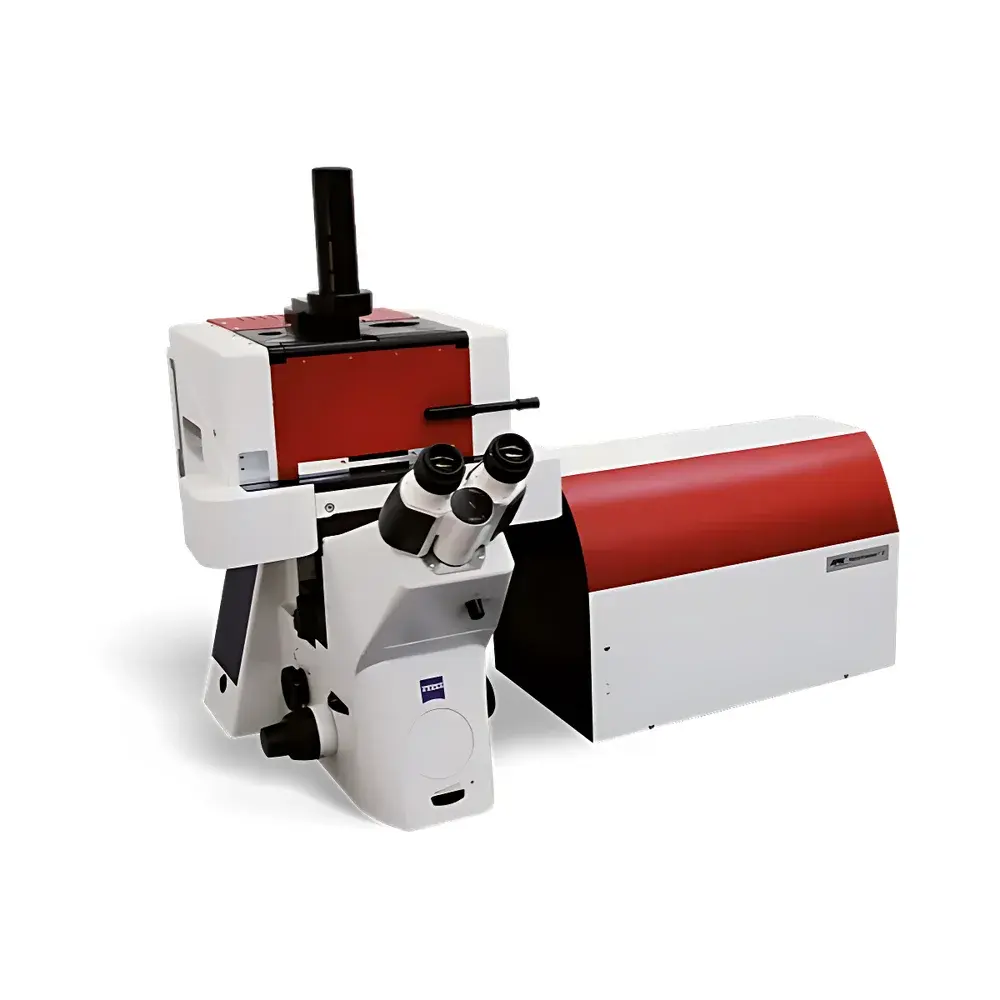
Bruker NanoTracker 2 Modular Force-Sensing Optical Tweezers and Optical Trapping Platform
| Brand | Bruker |
|---|---|
| Origin | Germany |
| Model | NanoTracker 2 |
| Laser Class | Class 1 |
| Positional Resolution | Sub-nanometer (closed-loop) |
| Force Sensitivity | < 0.1 pN/√Hz |
| Trap Stiffness Range | 0.01–100 pN/µm |
| Detection Bandwidth | Up to 100 kHz |
| Sample Stage Options | Piezo-driven XYZ stage (optional) |
| Illumination | LED-based Köhler illumination with condenser lens |
| Control Interfaces | TTL-triggered external devices (cameras, spectrometers, PMTs, APDs) |
| Software Compliance | FDA 21 CFR Part 11–ready audit trail, GLP/GMP-compatible experiment logging |
Overview
The Bruker NanoTracker 2 is a modular, research-grade optical tweezers platform engineered for quantitative force spectroscopy and high-precision single-molecule biophysics. It operates on the principle of radiation pressure exerted by a tightly focused near-infrared laser beam (typically 1064 nm), generating stable three-dimensional optical traps capable of immobilizing and manipulating dielectric microspheres (e.g., polystyrene or silica beads) with sub-piconewton force resolution and sub-nanometer positional accuracy. Unlike conventional static trapping systems, the NanoTracker 2 integrates real-time feedback-controlled trapping via high-bandwidth electronics and low-drift detection architecture—enabling dynamic force-clamp, constant-velocity pulling, and multi-trap interferometric tracking. Its Class 1 laser safety certification eliminates requirements for dedicated laser interlocks or operator training, making it deployable in shared core facilities, biosafety level 2 (BSL-2) labs, and teaching environments without infrastructure modification.
Key Features
- Modular optical architecture supporting dual- or multi-beam configurations via acousto-optic deflectors (AODs) or piezoelectric mirror positioning—enabling independent trap positioning, dynamic reconfiguration, and parallel manipulation of multiple particles.
- Single-frequency, ultra-stable Nd:YAG or fiber laser source with active intensity stabilization and optimized beam-splitting ratio to ensure consistent trap stiffness across extended acquisition periods (>24 h).
- Low-drift, high-sensitivity quadrant photodiode (QPD)-based detection system with drift-compensated analog front-end electronics, achieving position noise floor < 0.3 nm/√Hz (at 1 kHz) and force noise < 0.1 pN/√Hz in physiological buffer.
- Closed-loop piezoelectric XYZ sample stage (optional) with 100 µm travel range and 0.1 nm step resolution, synchronized with trap motion for extended trajectory tracking and surface-proximity experiments.
- Dedicated TTL I/O ports for hardware synchronization with external instrumentation—including sCMOS cameras, time-resolved spectrometers, photon-counting modules (PMTs/APDs), and microfluidic pressure controllers.
- Integrated Köhler LED illumination with adjustable condenser optics, enabling simultaneous brightfield/DIC imaging and trap visualization without interference from thermal lensing or IR background.
Sample Compatibility & Compliance
The NanoTracker 2 accommodates standard inverted microscope configurations (e.g., Nikon Eclipse Ti2, Olympus IX83, Zeiss Axio Observer) and supports common sample formats: glass-bottom dishes (No. 1.5 coverslip), microfluidic chambers (PDMS/glass), capillary cells, and custom flow cells. All optical and mechanical components are sealed against liquid ingress per IP54 specifications, ensuring operational reliability during long-duration aqueous experiments—including live-cell optomechanical interrogation and DNA/protein unzipping assays. The system complies with IEC 60825-1:2014 for Class 1 laser product safety and meets essential requirements of the EU Machinery Directive 2006/42/EC. Experimental data logs include timestamped metadata, user authentication, and electronic signatures—fully compatible with GLP and GMP workflows under FDA 21 CFR Part 11 regulatory frameworks.
Software & Data Management
NanoTracker 2 is operated via Bruker’s proprietary NanoTweezer Control Suite—a Windows-based application built on .NET framework with deterministic real-time scheduling. The software provides intuitive graphical control of all motorized elements (objective turret, filter wheels, injection pumps, stage axes), programmable experimental protocols via drag-and-drop scripting, and integrated data streaming at up to 500 kS/s per channel. Raw QPD signals are processed in real time using adaptive baseline correction and digital lock-in filtering. Post-acquisition analysis includes worm-like chain (WLC), freely jointed chain (FJC), and sawtooth (step-wise unfolding) fitting algorithms—exportable to HDF5, MATLAB (.mat), or ASCII formats. Audit trails record every parameter change, user login event, and calibration action with SHA-256 hashing for integrity verification.
Applications
- Single-molecule force spectroscopy of nucleic acids (DNA/RNA hairpin unfolding, protein-DNA binding kinetics)
- Mechanical characterization of cytoskeletal filaments (actin, microtubules) and motor proteins (kinesin, dynein, myosin)
- Cell membrane mechanics and receptor-ligand bond rupture studies under physiological shear
- Colloidal interaction mapping via dual-trap potential energy surface reconstruction
- Calibration-free hydrodynamic drag measurements using Brownian motion analysis (power spectrum method)
- Integration with fluorescence correlation spectroscopy (FCS) or Förster resonance energy transfer (FRET) for correlative mechano-optical assays
FAQ
Is the NanoTracker 2 compatible with third-party microscopes?
Yes—the platform interfaces via standard C-mount and dovetail mechanical mounts, and supports TTL/RS-232/USB communication with major OEM microscope control systems.
What is the maximum number of independent optical traps supported?
Up to four independently addressable traps using AOD multiplexing; additional traps may be added via spatial light modulator (SLM) integration (optional module).
Does the system support temperature-controlled sample environments?
Yes—integrated mounting points and electrical feedthroughs accommodate commercial objective heaters, chamber heaters, and Peltier stages (e.g., Tokai Hit, Linkam).
Can force calibration be performed in situ without bead replacement?
Yes—automated power-spectrum and equipartition-based calibration routines execute within the software interface and require no manual intervention or external calibration standards.
Is remote operation supported for collaborative or core facility use?
Yes—secure RDP and VNC access modes are enabled; full experiment control and data streaming are available over Gigabit Ethernet with latency < 1 ms.




