
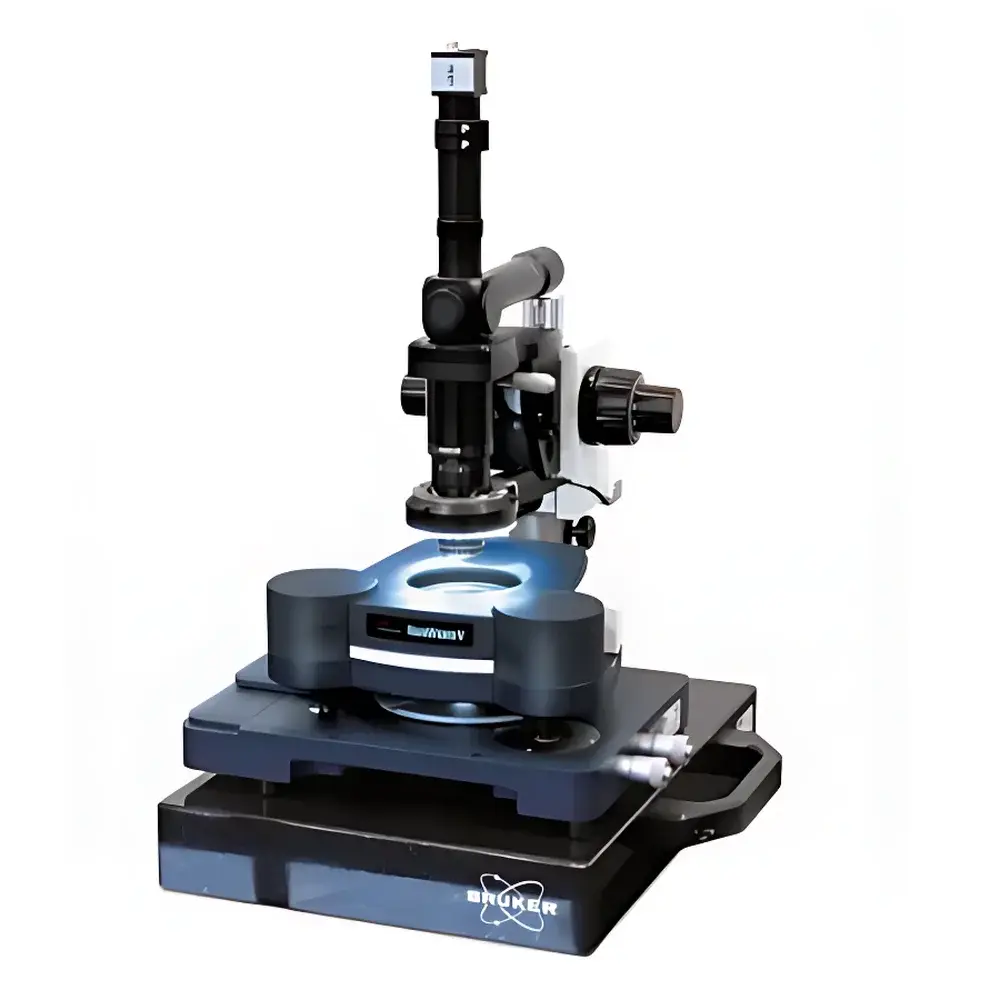
Bruker NanoWizard V Bio-Atomic Force Microscope
| Brand | Bruker |
|---|---|
| Origin | Germany |
| Model | NanoWizard V |
| Instrument Type | Biological Atomic Force Microscope |
| Sample Stage Travel Range | 20 × 20 mm² |
| Maximum Sample Height (with Head-Up Stage) | 140 mm Ø × 18 mm thickness |
| Free Sample Space | Ø140 × 18 mm³ |
| Software | V8 |
| Key Capabilities | PeakForce-QI, PeakForce Tapping®, PeakForce QNM®, Quantitative Imaging (QI), Single-Molecule Force Spectroscopy, Single-Cell Force Spectroscopy, DirectOverlay 2 for AFM–Optical Correlative Imaging, ExperimentPlanner & ExperimentControl modules, Integrated High-NA Optical Microscopy, Multi-Dimensional Environmental Control |
Overview
The Bruker NanoWizard V Bio-Atomic Force Microscope represents the fifth-generation evolution of Bruker’s dedicated biological AFM platform—engineered explicitly for high-resolution, quantitative nanomechanical characterization under physiologically relevant conditions. Built upon over 25 years of continuous innovation in BioAFM, the NanoWizard V employs a robust, low-drift, closed-loop piezoelectric scanner architecture combined with active acoustic and thermal noise isolation to ensure sub-nanometer spatial fidelity and piconewton force resolution across extended acquisition times. Its core measurement principle relies on real-time, feedback-controlled probe–sample interaction monitoring via optical beam deflection, enabling simultaneous topographic mapping and mechanical property quantification—including Young’s modulus, adhesion energy, deformation, and viscoelastic relaxation—at single-molecule and single-cell scales. Designed for integration into live-cell imaging workflows, the system supports fully hydrated, temperature- and CO₂-controlled environments, making it suitable for longitudinal studies of dynamic biomolecular processes without sample dehydration or fixation.
Key Features
- Head-Up sample stage accommodating specimens up to Ø140 mm × 18 mm thick, with vertical clearance of up to 140 mm—enabling compatibility with custom flow cells, petri dishes, multi-well plates, and inverted optical microscopes.
- Closed-loop XY scanning stage with 20 × 20 mm² travel range and <1 nm linearity error—ensuring precise navigation across large biological substrates such as tissue sections or confluent cell monolayers.
- PeakForce QNM® and PeakForce-QI® modes delivering true quantitative nanomechanical mapping at video-rate speeds, with force control down to 10 pN and spatial resolution maintained below 1 nm RMS in ambient and liquid environments.
- DirectOverlay 2 correlative imaging engine enabling pixel-registered fusion of AFM topography/mechanics with fluorescence, phase contrast, DIC, or TIRF data from integrated high-numerical-aperture (NA > 1.4) optical pathways.
- V8 software platform featuring ExperimentPlanner for automated protocol sequencing (e.g., grid-based force volume mapping, time-lapse indentation series) and ExperimentControl for real-time parameter adjustment during acquisition—fully compliant with GLP/GMP audit trail requirements including user authentication, electronic signatures, and timestamped metadata logging.
Sample Compatibility & Compliance
The NanoWizard V is validated for use with diverse biospecimens—including purified proteins, lipid bilayers, DNA origami structures, bacterial biofilms, primary neurons, stem cells, and ex vivo tissue slices—under native aqueous buffers or controlled gas atmospheres. Its modular environmental chamber supports temperature regulation from 4 °C to 40 °C ± 0.1 °C, humidity control (10–95% RH), and optional CO₂/O₂ modulation for long-term viability assays. All hardware and firmware comply with IEC 61000-6-3 (EMC) and IEC 61010-1 (safety) standards. The V8 software architecture conforms to FDA 21 CFR Part 11 requirements for electronic records and signatures, supporting full traceability for regulatory submissions in pharmaceutical development and biologics characterization.
Software & Data Management
V8 provides a unified interface for instrument control, data acquisition, batch processing, and publication-ready visualization. It includes native support for HDF5-based data storage, ensuring metadata-rich, self-documenting files compatible with FAIR (Findable, Accessible, Interoperable, Reusable) principles. Advanced analysis modules include automated fibril tracing, force–distance curve fitting using Hertz, Sneddon, or DMT models, time-series elasticity heatmaps, and statistical clustering of mechanical phenotypes across cell populations. Data export options include TIFF, PNG, CSV, MATLAB (.mat), and ImageJ-compatible formats. Remote access and collaborative session sharing are enabled via secure TLS-encrypted connections.
Applications
- Quantitative structural and mechanical profiling of membrane proteins and receptor–ligand complexes in supported lipid bilayers.
- Time-resolved nanomechanical mapping of epithelial–mesenchymal transition (EMT) in cancer cell lines.
- Single-molecule unfolding kinetics of titin, fibronectin, or amyloidogenic peptides under physiological buffer conditions.
- Mechanobiological interrogation of stem cell differentiation via substrate stiffness–response correlation.
- Correlative nanoscale morphology–fluorescence colocalization in synaptic vesicle trafficking studies.
- Regulatory-grade characterization of therapeutic protein aggregates and virus-like particles (VLPs) per USP , ISO 13485, and ICH Q5A guidelines.
FAQ
What distinguishes the NanoWizard V from previous generations of BioAFM systems?
The NanoWizard V introduces enhanced thermal stability through an all-metal, monolithic scanner design; expanded sample handling capacity via the Head-Up stage; and deeper integration of optical microscopy via DirectOverlay 2—enabling true multimodal correlation without image registration artifacts.
Is the system compatible with standard inverted optical microscopes?
Yes—the NanoWizard V features a low-profile, optically transparent base and configurable mounting interfaces for seamless integration beneath commercial inverted microscopes (e.g., Nikon Ti2, Zeiss Axio Observer, Leica DMi8), preserving full NA access and epi-illumination paths.
Does V8 software support automated experiment scripting?
Yes—ExperimentPlanner allows users to define multi-step acquisition protocols (e.g., approach–retract cycles at defined grid positions, sequential mode switching, environmental ramping) with conditional logic and error recovery routines.
Can force spectroscopy data be analyzed quantitatively within V8?
Yes—V8 includes built-in curve fitting engines for elastic, viscoelastic, and adhesive models, with batch-processing capability across hundreds of force–distance curves and statistical export of fitted parameters.
What compliance documentation is provided for regulated laboratories?
Bruker supplies IQ/OQ documentation packages, 21 CFR Part 11 validation templates, and GxP-aligned SOP examples covering instrument qualification, data integrity controls, and periodic performance verification.



