
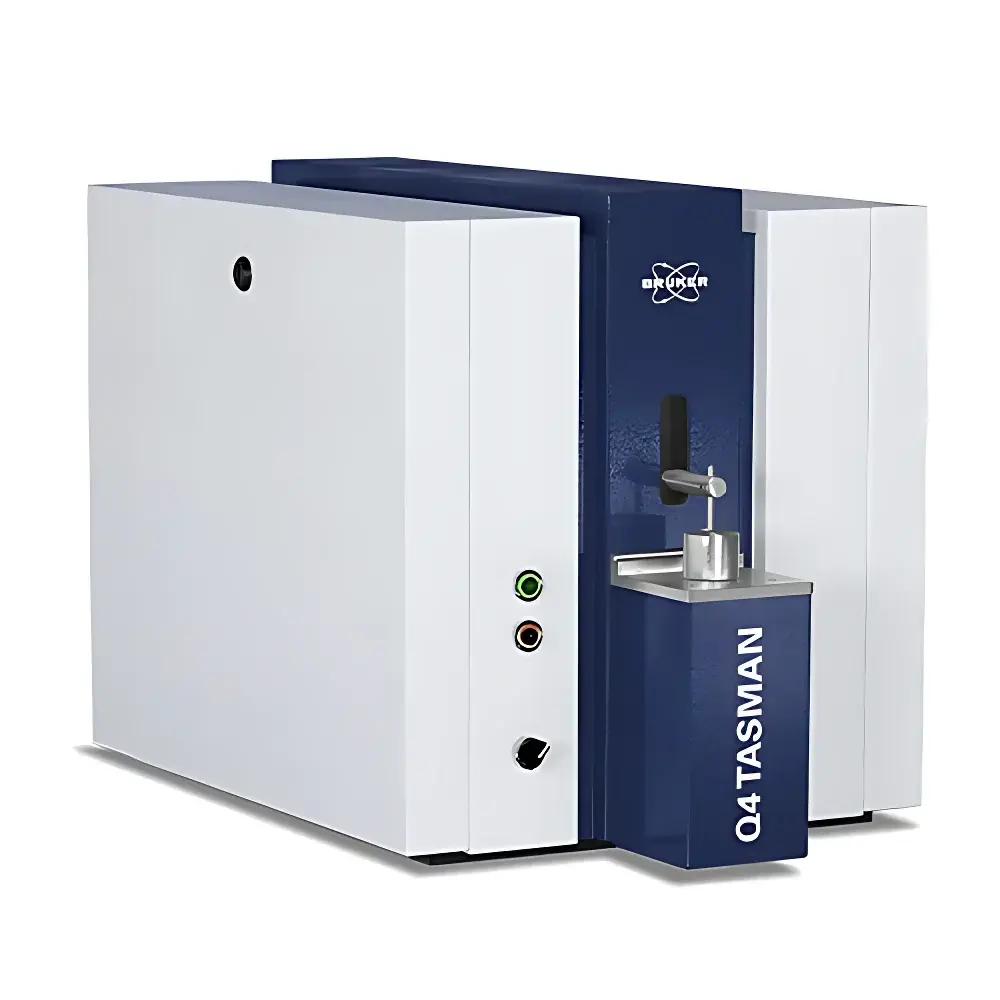
Bruker Q4 TASMAN Full-Spectrum Spark Optical Emission Spectrometer
| Brand | Bruker |
|---|---|
| Origin | Germany |
| Manufacturer Type | Authorized Distributor |
| Origin Category | Imported |
| Model | Q4 TASMAN |
| Instrument Type | Benchtop |
| Excitation Method | Spark |
| Detector Type | Dual Detector (PMT + CCD) |
| Focal Length | 800 mm |
| Grating Groove Density | 3600 lines/mm |
| Wavelength Range | 130–800 nm |
| Number of Channels | 128 |
Overview
The Bruker Q4 TASMAN is a benchtop spark optical emission spectrometer (OES) engineered for high-precision, multi-element analysis of solid metallic samples. Based on the fundamental principle of atomic emission spectroscopy, the instrument excites sample surfaces via controlled high-voltage spark discharge in an argon-purged environment, inducing element-specific line emissions across the ultraviolet to near-infrared spectrum (130–800 nm). Its full-spectrum architecture—enabled by a dual-detector system combining photomultiplier tubes (PMTs) for critical trace elements and a high-resolution CCD array for broad spectral coverage—ensures simultaneous detection of all relevant analytes without sequential scanning. The 800 mm Czerny-Turner optical bench, equipped with a 3600 lines/mm holographic grating, delivers exceptional spectral resolution and signal-to-noise ratio, supporting reliable quantification from major constituents down to sub-ppm levels in certified reference materials. Designed for routine laboratory and foundry floor deployment, the Q4 TASMAN integrates robust mechanical construction with thermal and mechanical stability features essential for long-term calibration retention.
Key Features
- Dual-detection architecture: PMT channels for high-sensitivity monitoring of low-abundance elements (e.g., C, P, S, N, B) combined with a back-thinned CCD for comprehensive spectral acquisition across the full 130–800 nm range.
- Optimized spark source: Fully sealed, maintenance-free spark stand with coaxial argon flushing and pneumatic sample clamping ensures stable plasma conditions and reproducible ablation—even on irregular or small samples.
- Modular analytical method design: Application-Specific Packages (ASPs) pre-configured for ferrous, non-ferrous, and superalloy matrices—including standardized calibrations compliant with ISO 11577, ASTM E415, and DIN EN 10052.
- Benchtop footprint with industrial-grade enclosure: Compact form factor (W × D × H: 850 × 750 × 520 mm) meets CE, UL 61010-1, and EMC Directive 2014/30/EU requirements; suitable for QA/QC labs with space constraints.
- Real-time spectral diagnostics: Onboard wavelength calibration verification using internal Hg/Ne reference lamps and automated drift correction ensure measurement integrity over extended operational cycles.
Sample Compatibility & Compliance
The Q4 TASMAN accepts flat, cylindrical, or irregular solid metal specimens up to Ø 40 mm × 30 mm height, including castings, billets, welds, and machined coupons. Sample preparation follows ISO 11084 for grinding and ASTM E1184 for surface conditioning. All ASPs are traceable to NIST SRMs and certified reference materials (CRMs) from BAM, IARM, and JSS. System validation protocols support GLP and GMP environments, with full audit trail capability in ELEMENTAL.SUITE software—including user action logging, method version control, and electronic signature compliance per FDA 21 CFR Part 11 when configured with appropriate IT infrastructure.
Software & Data Management
ELEMENTAL.SUITE is a Windows-based platform delivering intuitive workflow management—from sample registration and method selection to report generation and statistical process control (SPC). It supports customizable reporting templates (PDF, CSV, XML), real-time SPC charting (X-bar/R, Cpk), and integration with LIMS via ASTM E1384-compliant interfaces. Data security features include role-based access control, encrypted database storage (SQL Server), and configurable backup schedules. Software updates are delivered through Bruker’s secure customer portal, with version history and validation documentation provided for regulated users.
Applications
The Q4 TASMAN serves core metallurgical applications including incoming raw material verification, melt process control, heat treatment validation, scrap sorting, and failure analysis. It routinely quantifies 25+ elements in steels (C, Si, Mn, Cr, Ni, Mo, Cu, Al, Ti, V, Nb, Co, B, P, S, N, Sn, As, Pb, Zn, Mg, Ca, La, Ce, Y), aluminum alloys (Fe, Si, Cu, Mn, Mg, Zn, Ti, Cr, Ni), copper alloys (Fe, Ni, Zn, Pb, Sn, Al, Mn, Si), and nickel-based superalloys (Cr, Co, Mo, W, Al, Ti, Nb, Fe, Cu, Mn). Its rapid analysis cycle (< 30 s per sample, including purge and spark sequence) enables high-throughput screening in foundries, rolling mills, and aerospace component suppliers.
FAQ
What sample preparation is required prior to analysis?
Flat, clean, and oxide-free surfaces are mandatory. Grinding with SiC paper (grit ≤ 120) or milling under inert atmosphere is recommended per ISO 11084. Surface roughness should not exceed Ra 1.6 µm.
Can the Q4 TASMAN analyze coated or plated metals?
Yes—using depth-profile mode with controlled spark energy and pulse timing, enabling quantitative layer-by-layer analysis of galvanized, aluminized, or electroplated substrates.
Is external cooling water required?
No—the instrument uses air-cooled CCD and PMT housings with thermoelectric stabilization; ambient temperature operation range is 15–30 °C with ≤ 70% non-condensing humidity.
How often must the optical system be recalibrated?
Wavelength calibration is verified daily using built-in reference lamps; full intensity calibration is recommended every 3 months or after major maintenance, following Bruker’s documented SOPs.
Does the system support remote diagnostics and service?
Yes—via secure TLS-encrypted connection, Bruker Field Service Engineers can perform health checks, firmware updates, and troubleshooting while maintaining full data isolation per GDPR and ISO/IEC 27001 protocols.
Related Products





