
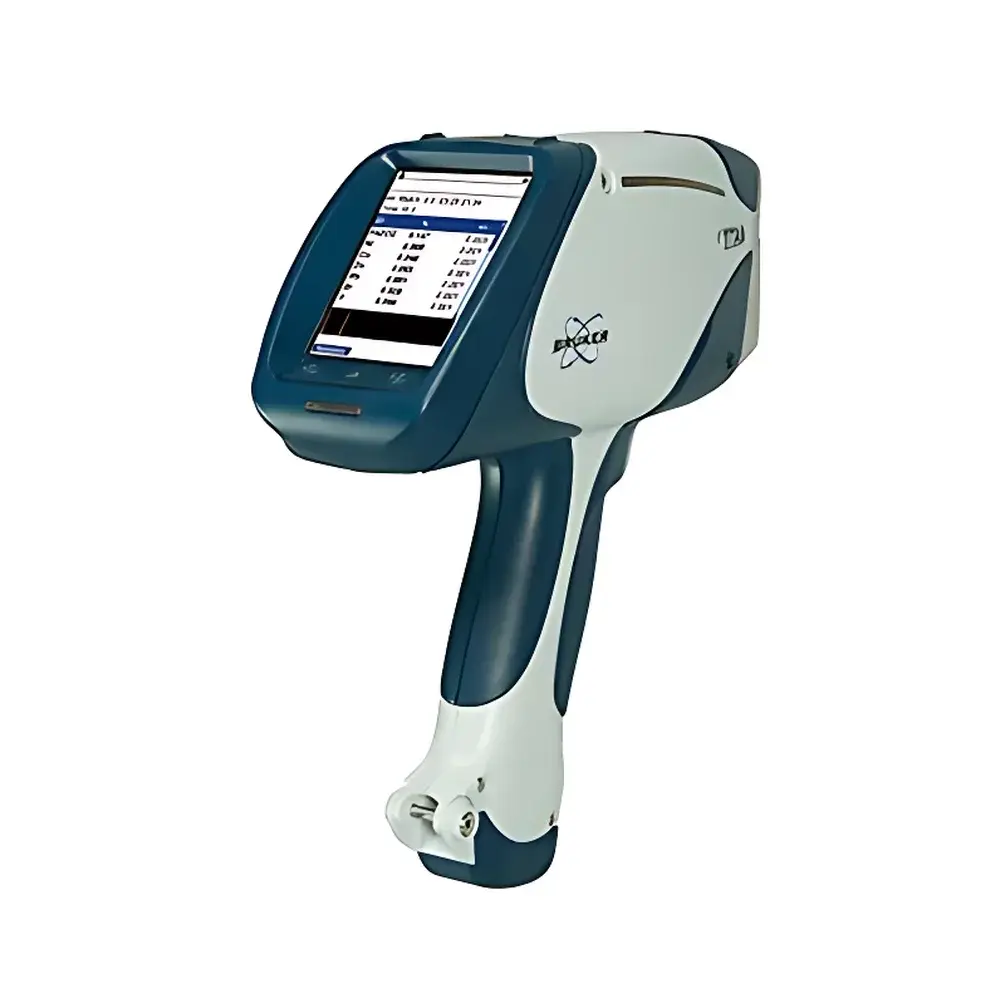
Bruker S1 TITAN Handheld Energy Dispersive X-Ray Fluorescence (ED-XRF) Spectrometer
| Brand | Bruker |
|---|---|
| Origin | Germany |
| Model | S1 TITAN Handheld |
| Application | Field-Portable |
| Element Range | Mg to U |
| Detection Limit | 1 ppm |
| Concentration Range | 1 ppm – 99.99 wt% |
| Energy Resolution | <140 eV (Mn Kα) |
| Repeatability | ≤0.1% RSD |
| Detector | Silicon Drift Detector (SDD) |
Overview
The Bruker S1 TITAN is a field-deployable, handheld energy dispersive X-ray fluorescence (ED-XRF) spectrometer engineered for rapid, non-destructive elemental analysis of solid and powdered materials in situ. Based on the fundamental principle of X-ray fluorescence—where primary X-rays excite atoms in a sample, causing emission of characteristic secondary (fluorescent) X-rays—the S1 TITAN quantifies elemental composition by measuring the energy and intensity of these emitted photons. Its compact, ruggedized chassis integrates a high-output microfocus X-ray tube, a high-resolution silicon drift detector (SDD), and real-time spectral processing firmware. Designed for operation under demanding industrial conditions—including elevated ambient temperatures, high humidity, rain exposure, and mechanical shock—the instrument meets IP54 ingress protection standards and operates continuously for up to 12 hours on dual hot-swappable Li-ion batteries. Unlike benchtop ED-XRF systems, the S1 TITAN delivers laboratory-grade precision without requiring sample preparation or vacuum/purge environments, making it suitable for immediate decision-making at point-of-use.
Key Features
- Ruggedized industrial housing with IP54-rated sealing against dust and water splashes
- Integrated SDD detector delivering <140 eV energy resolution at Mn Kα, enabling robust separation of overlapping peaks (e.g., S Kα/Pb Mα, Cr Kβ/Mn Kα)
- Optimized X-ray tube output (up to 50 kV, 20 µA) with selectable filtration for enhanced light-element sensitivity (Mg–Al–Si) and heavy-metal throughput
- Patented “Pin-Proof” detector window—a reinforced polymer composite barrier that prevents physical puncture from sharp metallic debris (e.g., swarf, wire fragments) without attenuating low-energy X-rays or degrading light-element response
- Real-time spectrum averaging, automatic peak deconvolution, and matrix-matched calibration libraries for alloy, soil, mining, and RoHS-compliant materials
- On-device color-coded pass/fail indicators, audible tone feedback, and battery-level visualization for intuitive operator guidance
- Low-power standby mode and adaptive tube current control to extend operational runtime and minimize thermal drift
Sample Compatibility & Compliance
The S1 TITAN supports direct analysis of conductive and non-conductive solids—including alloys, ores, slag, soils, catalysts, polymers, and coated surfaces—without grinding, pressing, or pelletizing. Its measurement geometry accommodates irregular geometries (pipes, valves, weld seams, scrap fragments) via adjustable stand-off distance and collimated beam targeting. The system complies with IEC 61000-4 electromagnetic compatibility standards and adheres to ISO 17025 traceability requirements when used with certified reference materials (CRMs). For regulated industries, method validation protocols align with ASTM E1621 (standard guide for XRF analysis of metals), ASTM D6440 (soil screening), and EU RoHS Directive 2011/65/EU Annex II restricted substance verification. Audit trails, user access controls, and electronic signature support are available through optional Bruker Elemental software modules compliant with FDA 21 CFR Part 11 and GLP/GMP documentation frameworks.
Software & Data Management
Data acquisition and reporting are managed via Bruker’s proprietary MSA (Mobile Spectral Analysis) software, preloaded on the device’s Android-based interface. The software provides live spectral display, automatic element identification, quantitative reporting with uncertainty estimates, and customizable report templates (PDF/CSV/XLSX export). Cloud synchronization enables secure remote data upload to Bruker’s ELEMENTAL Connect platform for fleet-wide instrument monitoring, calibration status tracking, and centralized method library deployment. All spectra, measurement metadata (GPS coordinates, operator ID, timestamp), and calibration history are stored locally with SHA-256 hashing to ensure data integrity. Optional integration with LIMS (Laboratory Information Management Systems) supports automated workflow handoff in QA/QC environments.
Applications
- Positive Material Identification (PMI) in petrochemical plants, power generation facilities, and pressure vessel fabrication per ASME B31.3 and API RP 578
- Scrap metal sorting and recycling stream optimization using grade classification algorithms for stainless steels, aluminum alloys, and copper-based materials
- In-field geochemical mapping and ore grade estimation in mining exploration, supporting NI 43-101 reporting standards
- RoHS and ELV compliance screening for Br, Cd, Pb, Hg, Cr(VI), and PBBs/PBDEs in electronics assemblies and automotive components
- Quality assurance of incoming raw materials (e.g., ferroalloys, refractory ceramics) and finished products (e.g., turbine blades, fasteners)
- Environmental site assessment—rapid detection of As, Pb, Cd, and Cr in contaminated soils per EPA Method 6200
FAQ
What elements can the S1 TITAN detect?
It detects elements from magnesium (Mg, Z=12) to uranium (U, Z=92), including all common alloying and contaminant elements such as Al, Si, P, S, Cl, K, Ca, Ti, V, Cr, Mn, Fe, Co, Ni, Cu, Zn, As, Se, Br, Sr, Zr, Nb, Mo, Ag, Cd, Sn, Sb, Ba, La, Ce, Pr, Nd, Sm, Eu, Gd, Tb, Dy, Ho, Er, Tm, Yb, Lu, Hf, Ta, W, Re, Pt, Au, Hg, Tl, Pb, Bi, Th, and U.
Is the S1 TITAN suitable for light-element analysis?
Yes—its optimized vacuum path option (available on select configurations), low-noise SDD, and specialized calibration models enable reliable quantification of Mg, Al, and Si in aluminum alloys and geological matrices, with detection limits down to 1 ppm under optimal conditions.
How does the Pin-Proof detector enhance operational reliability?
The detector window incorporates a multi-layer polymer barrier that physically arrests sharp particulates while maintaining >95% transmission efficiency for photons above 1 keV; this reduces unscheduled maintenance events by >80% in high-risk scrap and machining environments.
Can measurement data be integrated into enterprise quality systems?
Yes—via Bruker’s ELEMENTAL Connect API and validated LIMS connectors, raw spectra, results, and audit logs can be exported in structured formats compliant with ISO/IEC 17025 digital record requirements.
What regulatory standards does the S1 TITAN support for QA/QC workflows?
Method validation follows ASTM E2857 (uncertainty estimation), ISO 8258 (Shewhart control charts), and EN 15309 (waste characterization); instrument qualification includes annual performance verification per Bruker’s PQ/OQ protocol aligned with ISO/IEC 17025 Clause 6.4.




