
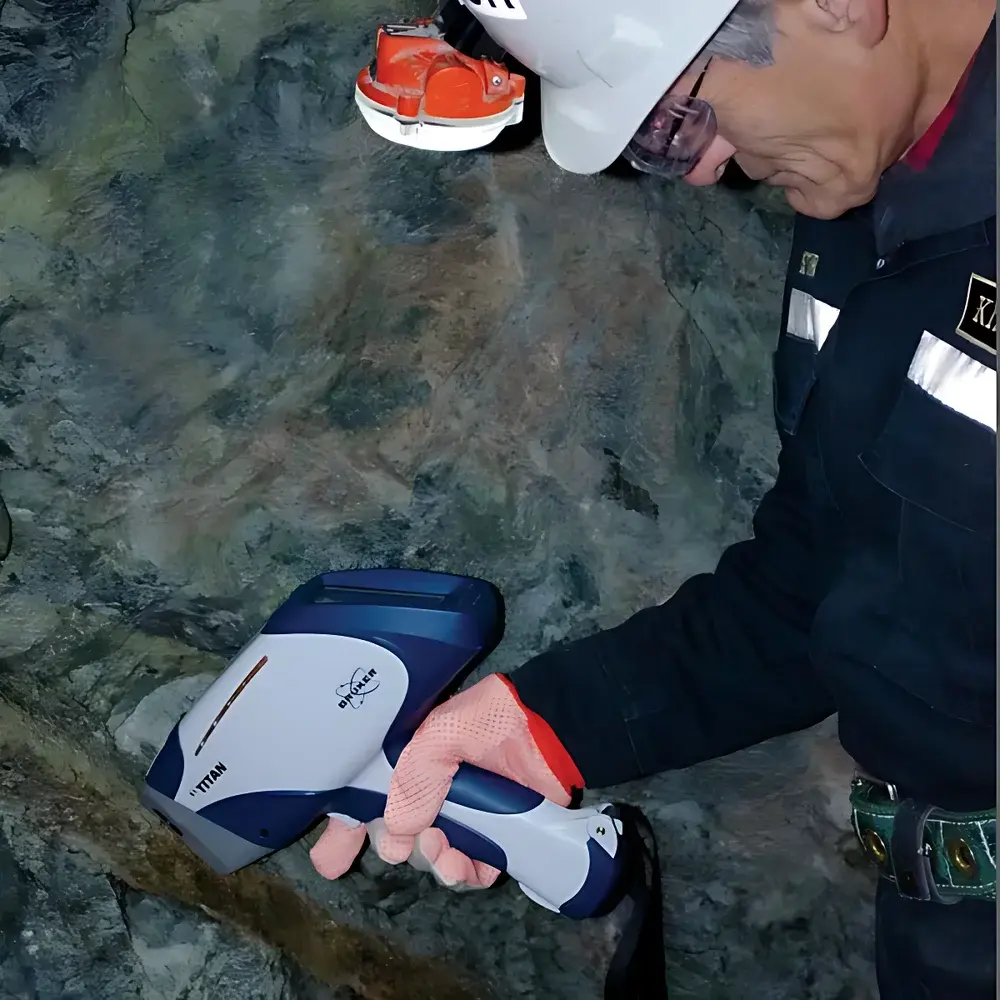
Bruker S1 TITAN Handheld Energy Dispersive X-Ray Fluorescence (ED-XRF) Spectrometer for Ore and Geological Analysis
| Brand | Bruker |
|---|---|
| Origin | Germany |
| Model | S1 TITAN |
| Application | Field-portable ore analysis |
| Element Range | Mg–U |
| Detection Limit | 1 ppm to 99.99% (w/w) |
| Energy Resolution | <140 eV at Mn Kα |
| Detector | Silicon Drift Detector (SDD) |
Overview
The Bruker S1 TITAN is a field-deployable, handheld energy dispersive X-ray fluorescence (ED-XRF) spectrometer engineered for rapid, non-destructive elemental analysis of geological materials in situ. Based on fundamental XRF physics—where primary X-rays from a micro-focus X-ray tube excite characteristic secondary (fluorescent) X-rays from sample atoms—the instrument quantifies elemental composition by measuring the energy and intensity of emitted photons. Its optimized excitation geometry, high-efficiency SDD detector, and advanced spectral deconvolution algorithms enable reliable detection of light elements down to magnesium (Mg), without requiring vacuum or helium purge environments—a critical advantage over conventional benchtop ED-XRF systems. Designed for rugged operational continuity, the S1 TITAN meets IP54 environmental protection standards and operates reliably across ambient temperatures from –10 °C to 50 °C, making it suitable for geologic reconnaissance, open-pit mining, exploration drilling, and environmental site assessment.
Key Features
- Light-element capability: Simultaneous detection and quantification of Mg, Al, Si, P, S, Cl, and other low-Z elements under atmospheric conditions
- Silicon drift detector (SDD) with <140 eV resolution at Mn Kα, delivering high peak-to-background ratios and improved signal-to-noise performance
- Integrated Peltier-cooled X-ray tube ensuring stable tube output and extended lifetime under variable thermal loads
- Real-time spectrum acquisition and on-device quantitative analysis with Bruker’s proprietary FP (fundamental parameters) and empirical calibration algorithms
- High-resolution CCD camera with optional micro-spot collimation (≤3 mm diameter) for precise targeting of heterogeneous samples such as drill core segments or mineral veins
- Full internal data logging: automatic storage of spectra, measurement metadata (GPS coordinates, time stamp, operator ID), and quantitative reports in standardized formats (e.g., CSV, XML)
- Ruggedized enclosure: sealed, dust-resistant, impact-tested housing compliant with MIL-STD-810G for shock and vibration resistance
- Intuitive multi-language interface supporting 17 languages—including English, Spanish, Mandarin, Russian, and Arabic—with context-aware menu navigation and customizable report templates
- One-touch timed measurement mode with configurable dwell times (1–120 s) and auto-shutdown for power conservation
- Onboard spectral library management and user-defined calibration models for application-specific matrices (e.g., iron ore, bauxite, copper sulfides, rare earth concentrates)
Sample Compatibility & Compliance
The S1 TITAN accommodates solid, powdered, and irregularly shaped geological specimens—including drill core, crushed ore, tailings, soil, sediment, filter media, and slag—without sample preparation beyond surface cleaning. It supports both qualitative screening and semi-quantitative to quantitative analysis across concentration ranges from trace levels (1 ppm) to major constituents (up to 99.99 wt%). Method validation aligns with ASTM D6440 (Standard Guide for XRF Analysis of Solid Waste), ISO 12847 (Soil quality — Determination of elements by XRF), and USP (Elemental Impurities — Procedures). Data integrity features include audit-trail-enabled software (compliant with FDA 21 CFR Part 11 requirements when used with Bruker’s optional secure network configuration), electronic signatures, and version-controlled method files. All measurements are traceable to NIST SRM reference materials through factory-installed calibrations.
Software & Data Management
The instrument runs Bruker’s proprietary MSA (Mobile Spectral Analysis) software, which integrates real-time spectral processing, matrix correction, and reporting workflows. Raw spectra are stored in standard .rxf format and exportable via USB, Wi-Fi, or Bluetooth to laboratory information management systems (LIMS) or GIS platforms. The software supports offline calibration transfer, statistical process control (SPC) charting, spatial mapping (via integrated GPS), and batch report generation compliant with GLP/GMP documentation standards. Remote firmware updates and method synchronization are supported through Bruker’s cloud-based Instrument Management Portal, enabling centralized fleet monitoring and compliance verification across multi-site operations.
Applications
- Exploration geochemistry: Rapid field screening of outcrops, trench samples, and RC/rotary drill cuttings to identify anomalous element associations and vector toward mineralization
- Drill core logging: High-resolution elemental profiling along core length for lithological correlation and grade estimation prior to assay lab submission
- Mine face and stockpile analysis: Real-time grade control during excavation, haulage, and blending to optimize feed consistency to processing plants
- Environmental monitoring: In-situ assessment of heavy metal contamination (e.g., As, Pb, Cd, Cr) in soils, sediments, and mine drainage solids
- Resource reconciliation: Validation of mill feed assays against handheld field data to improve reserve modeling accuracy
- Tailings and waste characterization: Quantitative determination of residual metals and gangue components for rehabilitation planning and regulatory reporting
- Industrial mineral evaluation: Analysis of kaolin, bentonite, feldspar, and phosphate rock for commercial grade certification
FAQ
Does the S1 TITAN require external vacuum or helium gas for light-element analysis?
No. Its optimized X-ray optics, high-power microfocus tube, and SDD detector enable robust Mg–P quantification in air.
Can the instrument be calibrated for specific ore types like lateritic nickel or polymetallic sulfides?
Yes. Users can develop and deploy custom calibrations using certified reference materials (CRMs) and Bruker’s calibration wizard.
Is GPS data embedded in exported reports?
Yes—geotagged measurements include latitude, longitude, altitude, and UTC timestamp, exportable in KML or shapefile-compatible formats.
What safety certifications does the S1 TITAN hold?
It complies with IEC 62471 (photobiological safety), IEC 61010-1 (electrical safety), and regional radiation safety standards including 21 CFR 1020.40 (USA) and EN 62471 (EU).
How is data security maintained during remote software updates?
All firmware and method packages are digitally signed and verified before installation; TLS 1.2+ encrypted channels are enforced for cloud communications.




