
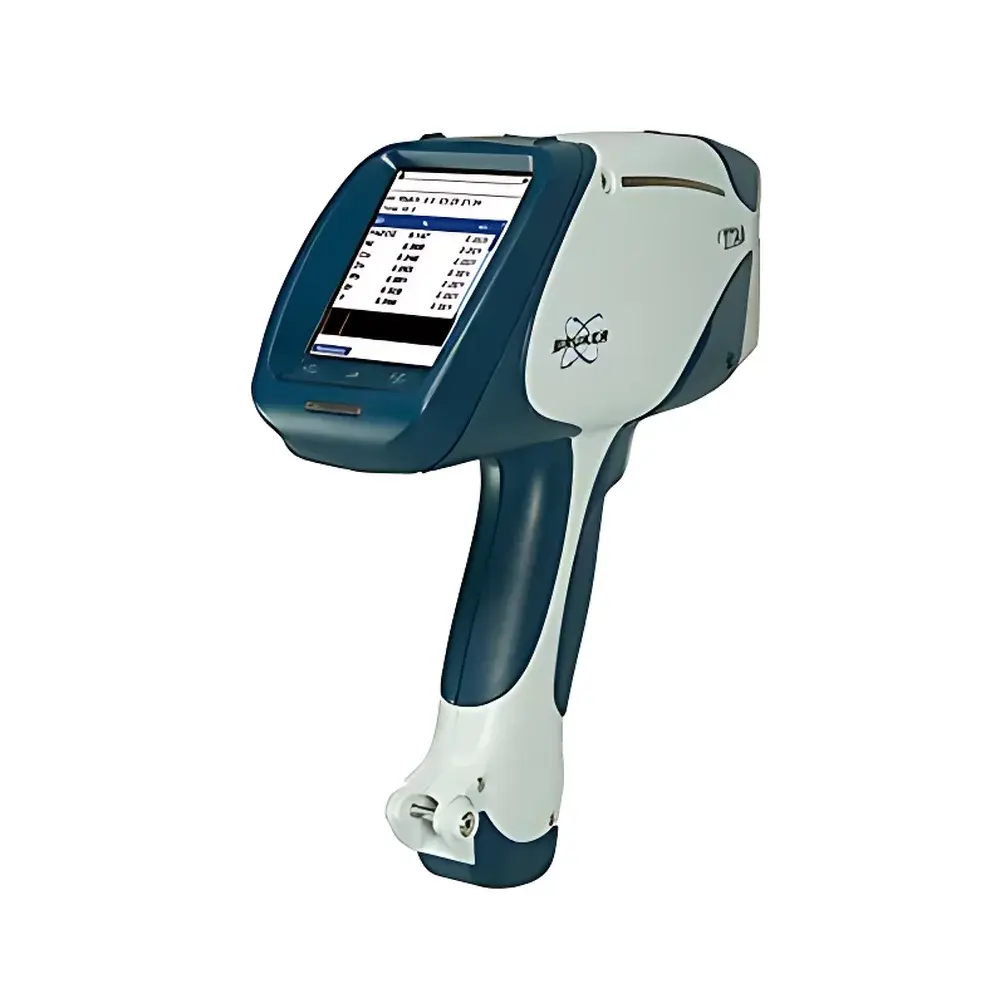
Bruker S1 TITAN Handheld Energy Dispersive X-Ray Fluorescence (ED-XRF) Spectrometer for Soil Heavy Metal Analysis
| Brand | Bruker |
|---|---|
| Origin | Germany |
| Model | S1 TITAN |
| Application | Field-Portable Soil & Environmental Analysis |
| Elemental Range | Mg to U |
| Detection Limit | 1 ppm (typical for heavy metals in soil matrices) |
| Energy Resolution | <140 eV at Mn Kα |
| Repeatability | RSD ≤ 0.1% (for major elements under optimized conditions) |
| Detector | Silicon Drift Detector (SDD) |
Overview
The Bruker S1 TITAN is a field-deployable, handheld energy dispersive X-ray fluorescence (ED-XRF) spectrometer engineered for rapid, non-destructive elemental analysis of soils, sediments, sludges, and other solid environmental matrices. Based on fundamental XRF physics—where primary X-rays excite characteristic secondary (fluorescent) X-rays from atoms in the sample—the instrument quantifies elemental composition by measuring the energy and intensity of emitted photons. Its compact architecture integrates a high-output miniature X-ray tube, a large-area silicon drift detector (SDD), and real-time spectrum processing firmware. Designed specifically for environmental monitoring workflows, the S1 TITAN delivers laboratory-grade data quality under ambient field conditions without sample digestion or vacuum requirements—enabling immediate decision-making during site assessments, regulatory compliance checks, and emergency response scenarios.
Key Features
- Optimized for soil matrix analysis: Pre-calibrated factory methods for Pb, As, Cd, Hg, Cr, Ni, Cu, Zn, and other regulated heavy metals per EPA Method 6200 and ISO 18507.
- Ruggedized industrial design: IP54-rated enclosure with shock-absorbing housing, MIL-STD-810G compliance for drop resistance, and operating temperature range of −10 °C to 50 °C.
- High-performance SDD detector: Delivers superior count-rate capability (>100,000 cps) and low-noise spectral resolution (<140 eV at Mn Kα), critical for resolving overlapping peaks (e.g., As Kα/Pb Lα, Se Kα/Br Kα) in complex soil spectra.
- Intelligent beam filtration: Automatic selection of primary beam filters (Ti, Al, Cu) and voltage/current settings (up to 50 kV / 40 µA) to maximize sensitivity across light (Mg–Ca) and heavy (Pb–U) elements.
- Battery-operated autonomy: Hot-swappable Li-ion battery packs support >8 hours of continuous operation; integrated GPS and digital camera geotag all measurements.
Sample Compatibility & Compliance
The S1 TITAN accommodates heterogeneous, unprepared environmental samples—including moist soils, dried sediments, filter media, dust wipes, slag, and construction debris—without grinding or pelletization. Its measurement geometry employs a fixed 3 mm collimated beam and automatic distance compensation, minimizing matrix effects through fundamental parameter (FP) modeling and empirical calibration libraries. All quantitative methods are traceable to NIST SRM 2710a, 2711a, and 1646a reference materials. The system supports audit-ready documentation compliant with ISO/IEC 17025, EPA SW-846 Chapter 6, and EU Council Directive 2009/90/EC for environmental monitoring. Data integrity adheres to ALCOA+ principles (Attributable, Legible, Contemporaneous, Original, Accurate, Complete, Consistent, Enduring, Available), with optional 21 CFR Part 11-compliant software modules available for regulated laboratories.
Software & Data Management
Instrument control, spectral acquisition, and quantitative reporting are managed via Bruker’s proprietary S1 PX software suite. Real-time spectrum visualization includes peak deconvolution, background subtraction, and interference correction algorithms. Quantitative results are generated using matrix-matched calibrations validated against certified reference materials, with uncertainty estimation per ISO 11843-7. Export formats include CSV, PDF reports with embedded spectra, and XML for LIMS integration. Cloud-enabled synchronization (via Bruker Connect platform) allows secure remote data backup, multi-user method sharing, and centralized fleet management for environmental agencies deploying multiple units across regional monitoring networks.
Applications
- Regulatory soil screening: Rapid identification of exceedances against national soil quality standards (e.g., China GB 15618-2018, US EPA Regional Screening Levels, EU Soil Thematic Strategy thresholds).
- Industrial site characterization: On-site delineation of contamination plumes at brownfields, smelters, battery recycling facilities, and electroplating plants.
- Agricultural land assessment: Monitoring of Cd, Cu, Zn accumulation in farmland adjacent to traffic corridors or wastewater irrigation zones.
- Emergency response: First-responder deployment during chemical spills, illegal dumping incidents, or post-disaster environmental triage (e.g., flood-affected soils).
- Long-term trend analysis: Repetitive monitoring of remediation effectiveness at capped landfills or phytoremediation sites using geo-referenced longitudinal datasets.
FAQ
Does the S1 TITAN require sample preparation before analysis?
No—soil samples may be analyzed in situ or as loose, air-dried material. For highest precision in regulatory reporting, homogenization and particle-size reduction (<250 µm) are recommended but not mandatory for screening.
How does the instrument handle moisture content in field-collected soils?
The S1 TITAN’s FP-based quantification engine incorporates moisture correction factors derived from empirical calibration sets spanning 5–30% water content; optional add-on moisture sensors enable real-time compensation.
Is spectral data export compatible with third-party chemometric tools?
Yes—raw spectra (.spx) and processed quantitative results (.csv) are fully exportable for multivariate analysis in MATLAB, R, or Python-based PLS regression frameworks.
What maintenance is required for long-term field reliability?
Annual calibration verification using check sources (e.g., Fe/Mn/Cu alloy) and detector resolution validation with Mn Kα are recommended; no consumables or routine vacuum pump servicing are needed.
Can the S1 TITAN differentiate between elemental speciation (e.g., Cr(III) vs. Cr(VI))?
No—XRF is inherently total-element technique. Speciation requires complementary techniques such as HPLC-ICP-MS or XANES; however, S1 TITAN data informs targeted sampling for downstream speciation analysis.
Related Products






