
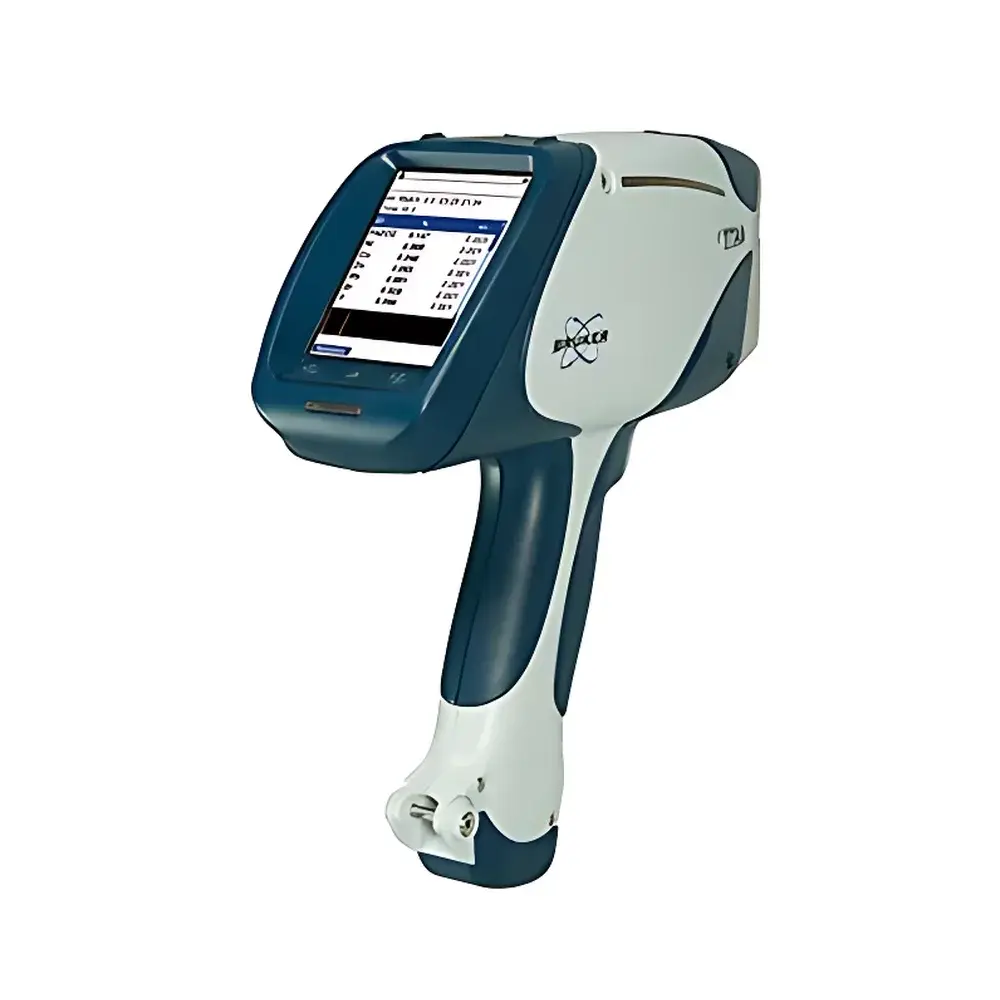
Bruker S1 TITAN Handheld Energy Dispersive X-Ray Fluorescence Spectrometer
| Brand | Bruker |
|---|---|
| Origin | Germany |
| Model | S1 TITAN |
| Application | Handheld/Portable |
| Element Range | Mg–U |
| Concentration Range | 1 ppm – 99.99% |
| Energy Resolution | <140 eV (Mn Kα) |
| Detector | Silicon Drift Detector (SDD) |
| X-ray Tube | 50 kV |
| Weight | 1.23 kg |
| Compliance | ASTM F963, RoHS, USP <232>/<233>, EPA Method 6200, ISO 12885, EN 62321 |
Overview
The Bruker S1 TITAN is a handheld energy dispersive X-ray fluorescence (EDXRF) spectrometer engineered for field-deployable elemental analysis of solid and powdered materials. Based on microfocus X-ray tube excitation and high-performance silicon drift detector (SDD) technology, the instrument operates on fundamental principles of X-ray fluorescence: incident X-rays eject inner-shell electrons from sample atoms; subsequent electron transitions emit characteristic secondary X-rays whose energies are element-specific and intensities quantitatively correlate with concentration. Designed for rugged industrial and regulatory environments, the S1 TITAN delivers laboratory-grade precision in a portable form factor—enabling real-time, non-destructive compositional verification without sample preparation. Its lightweight chassis (1.23 kg), sealed IP54-rated enclosure, and integrated color touchscreen interface support extended operation in demanding conditions including outdoor geological surveys, refinery perimeter inspections, scrap sorting facilities, and manufacturing QA/QC lines.
Key Features
- SharpBeam® Optics: Bruker’s proprietary X-ray beam geometry optimization reduces scatter, enhances signal-to-noise ratio, and improves detection limits—particularly critical for light elements (Mg–Al–Si) and trace-level contaminants (e.g., Pb, Cd, Cr in RoHS-compliant components).
- X-Flash® SDD Detector: High-count-rate silicon drift detector with <140 eV energy resolution at Mn Kα ensures precise peak deconvolution across the full Mg–U range, enabling accurate multi-element quantification even in complex matrices.
- 50 kV Microfocus X-ray Tube: Adjustable voltage and current settings allow method-specific excitation—optimized for heavy metals (e.g., Ni, Co, Mo in superalloys) or light elements (e.g., Mg, Al, Si in aluminum alloys and soils).
- SMART®Grade Timing: Adaptive acquisition logic automatically adjusts measurement duration based on sample composition and required precision—reducing analysis time by up to 40% without compromising statistical confidence.
- Ruggedized Industrial Design: Fully sealed housing meets IP54 standards for dust and moisture resistance; shock-absorbing casing and reinforced display protect against drops from 1 m height—validated per MIL-STD-810G.
Sample Compatibility & Compliance
The S1 TITAN supports direct analysis of heterogeneous solids—including metal alloys, ores, slag, soil, polymers, ceramics, and coated substrates—without digestion or pelletization. It is routinely deployed for positive material identification (PMI) in ASME B31.3-compliant piping systems, ASTM E1999-based scrap metal sorting, and ISO 17025-accredited environmental screening. Regulatory alignment includes full support for RoHS Directive 2011/65/EU (Cd, Pb, Hg, Cr⁶⁺, Br), US Consumer Product Safety Improvement Act (CPSIA) lead limits in children’s products, California Proposition 65, and EPA Method 6200 for field-portable XRF soil screening. Instrument firmware and data handling comply with FDA 21 CFR Part 11 requirements for electronic records and signatures when configured with audit trail and user access control modules.
Software & Data Management
Powered by Bruker’s proprietary S1 PX software, the S1 TITAN enables intuitive method creation, calibration management, and spectral evaluation via touchscreen interface. Preloaded calibrations cover >30 certified reference materials (CRMs) for stainless steels, tool steels, titanium alloys, brass, bronze, and geological standards (e.g., NIST SRM 2710a, GBW07105). All spectra, quantitative reports, GPS-tagged location metadata, and operator logs are stored in encrypted SQLite databases compliant with GLP/GMP documentation standards. Data export supports CSV, PDF, and XML formats compatible with LIMS integration (e.g., Thermo Fisher SampleManager, LabWare LIMS). Remote firmware updates and cloud-based calibration validation are supported via Bruker’s secure SaaS portal.
Applications
- Material verification in aerospace (e.g., Ti-6Al-4V, Inconel 718), nuclear power (stainless steel cladding), and automotive supply chains
- On-site ore grade estimation and core logging during exploration drilling campaigns
- RoHS and REACH compliance screening of electronic assemblies, packaging, and consumer goods
- Scrap metal sorting and recycling yield optimization (e.g., distinguishing 304 vs. 316 stainless, Cu–Ni separation)
- Lead-in-soil assessment at brownfield sites per EPA Region 9 protocols
- Platinum group metal (PGM) quantification in automotive catalytic converters and spent catalysts
- QA/QC of precious metal jewelry and bullion (Au, Ag, Pt, Pd) with certified CRM traceability
FAQ
What elements can the S1 TITAN detect?
It detects elements from magnesium (Mg, Z=12) to uranium (U, Z=92), including all common alloying elements (Fe, Cr, Ni, Mo, Co, Ti, Al, Cu, Zn, Sn, Pb) and regulated substances (Cd, Hg, As, Se, Br, Cl).
Is the instrument suitable for light element analysis?
Yes—optimized vacuum/purge modes and SharpBeam® geometry enhance sensitivity for Mg, Al, and Si, particularly in aluminum alloys and geological samples.
How is data integrity ensured for regulated applications?
With optional 21 CFR Part 11 configuration, the system provides electronic signatures, audit trails, role-based access, and immutable data archiving—fully auditable for ISO 17025, GMP, and FDA inspections.
Can the S1 TITAN be calibrated for custom materials?
Yes—Bruker offers method development services and supports user-defined calibrations using in-house CRMs or customer-supplied standards, with full uncertainty propagation reporting.
What battery life can be expected during continuous operation?
Standard Li-ion battery provides ≥8 hours of typical use; hot-swappable dual-battery option extends field operation to >14 hours without shutdown.





