
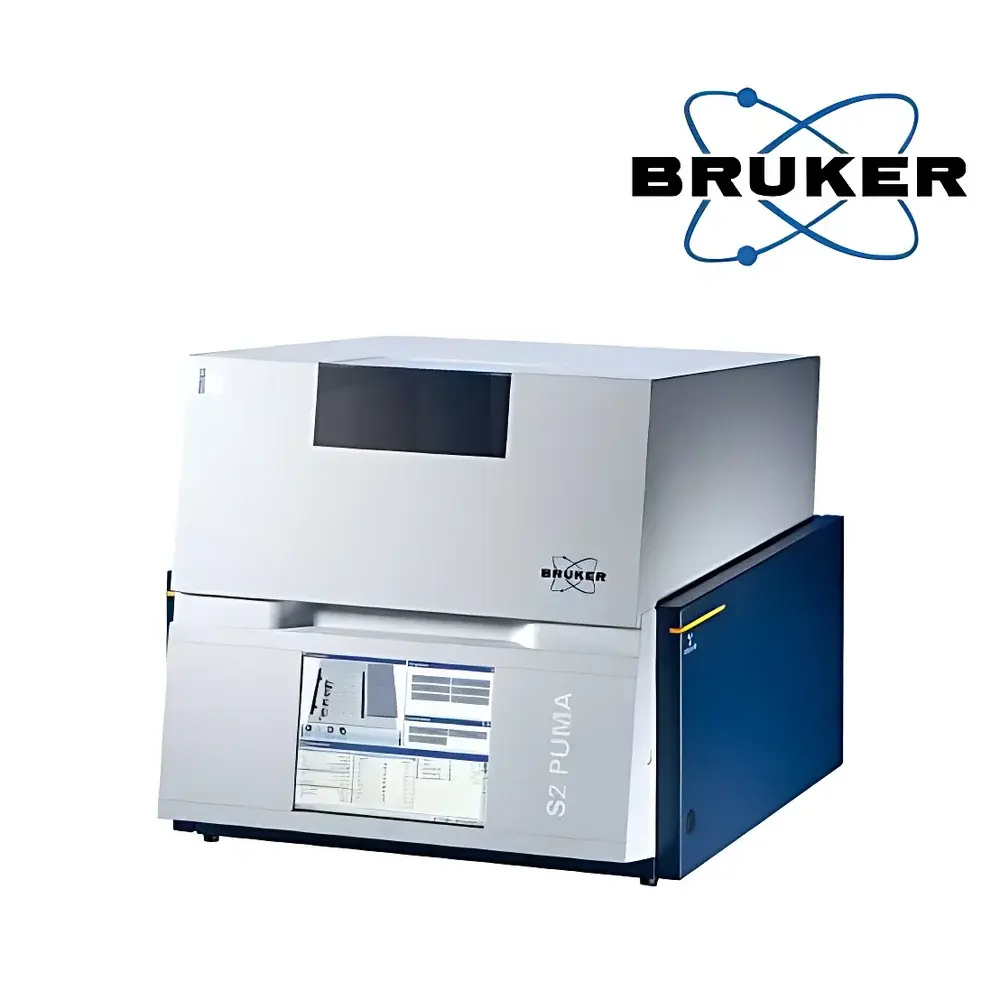
Bruker S2 PUMA Series II Energy Dispersive X-Ray Fluorescence (EDXRF) Spectrometer
| Brand | Bruker |
|---|---|
| Origin | Germany |
| Model | S2 PUMA Series II |
| Element Range | Na (11) to Am (95) [C (6) to Am (95)] |
| Detection Range | ppm to 100% |
| Energy Resolution | <135 eV |
| Repeatability | <0.1% RSD |
| Detector | HighSense™ Silicon Drift Detector (SDD) |
| Configuration Options | Manual Single-Position, XY Autochanger, Carousel Autosampler |
| Sample Chamber Dimensions | 450 × 420 × 100 mm |
| X-ray Tube | 50 W Rh anode |
| Filter Changer | 10-position automatic |
| Software Suite | SPECTRA.ELEMENTS with Smart-Quant FP, Geo-Quant, Cement-Quant, and regulatory-compliant modules |
Overview
The Bruker S2 PUMA Series II is a benchtop energy dispersive X-ray fluorescence (EDXRF) spectrometer engineered for precision elemental analysis across research, industrial quality control, and regulatory compliance environments. Based on the fundamental principle of X-ray fluorescence—where primary X-rays excite atoms in a sample, inducing emission of characteristic secondary (fluorescent) X-rays—the instrument delivers non-destructive, multi-element quantification from sodium (Na, Z=11) through americium (Am, Z=95), with extended light-element capability down to carbon (C, Z=6) under optimized vacuum or helium purge conditions. Its robust architecture integrates a high-power 50 W rhodium-target X-ray tube, a 10-position automatic filter changer for excitation optimization, and the proprietary HighSense™ silicon drift detector (SDD), which provides exceptional count-rate linearity and energy resolution (<135 eV at Mn Kα), enabling rapid acquisition without spectral degradation. Designed for operational stability and long-term reproducibility (<0.1% RSD for repeated measurements), the S2 PUMA Series II meets the analytical demands of laboratories requiring trace-level detection (ppm), major/minor constituent quantification (up to 100%), and routine throughput—without compromising accuracy or method transferability.
Key Features
- High-sensitivity HighSense™ SDD detector delivering superior energy resolution and count-rate performance for reduced measurement times and improved peak-to-background ratios
- Ergonomic TouchControl™ interface with glove-compatible integrated touchscreen, supporting nine languages and enabling standalone operation without external PC
- Large sample chamber (450 × 420 × 100 mm) accommodating diverse geometries: solids, pressed pellets, fused beads, loose powders, liquids, and irregular bulk specimens
- Modular automation options: manual single-position, XY autochanger (for up to 12 samples), or Carousel autosampler (supporting mixed-diameter loading—up to 18 × 40 mm or 12 × 51.5 mm samples)
- Micro-spot analysis capability via interchangeable collimators (1–34 mm diameter), coupled with high-resolution camera-assisted positioning for heterogeneous or large-area samples
- Optimized excitation system featuring a 50 W Rh-anode X-ray tube and programmable 10-position filter changer for matrix-adapted excitation
Sample Compatibility & Compliance
The S2 PUMA Series II supports direct analysis of heterogeneous, unprepared, or minimally prepared samples—including geological matrices, cement clinker, metal alloys, polymers, environmental filters, pharmaceutical excipients, and food-grade packaging materials. Its non-destructive nature ensures sample integrity for archival or downstream testing. The instrument complies with international standards governing elemental analysis workflows, including ASTM E1621 (EDXRF for RoHS screening), ISO 21047 (cement analysis), ISO 8289 (water analysis), and USP / (elemental impurities in pharmaceuticals). Software modules such as Geo-Quant and Cement-Quant are pre-validated against relevant ASTM and EN methods. All SPECTRA.ELEMENTS software versions support audit trails, electronic signatures, and user access controls aligned with FDA 21 CFR Part 11 and EU Annex 11 requirements for regulated environments operating under GLP or GMP frameworks.
Software & Data Management
Powered by Bruker’s SPECTRA.ELEMENTS platform, the S2 PUMA Series II offers a unified software environment for instrument control, data acquisition, quantification, and reporting. Smart-Quant FP implements fundamental parameter (FP) algorithms for fast, calibration-free quantitative analysis—ideal for unknown or variable matrices. Geo-Quant and Cement-Quant provide domain-specific calibration libraries and procedural workflows compliant with industry-standard reference materials (e.g., NIST SRMs, BCR, BAM). Data export conforms to ASTM E1357 and ISO/IEC 17025 reporting templates. All measurement parameters, spectra, and processing logs are stored in a secure, timestamped database with version-controlled method files. Remote operation is supported via Ethernet or USB, allowing integration into LIMS or MES systems through standardized OPC UA or CSV/JSON APIs.
Applications
The S2 PUMA Series II serves cross-sectoral analytical needs: in metallurgy, it verifies alloy composition and detects tramp elements; in construction materials, it performs rapid cement raw meal and clinker analysis per ISO 29581; in environmental labs, it screens soils and sediments for heavy metals (Pb, As, Cd, Hg) per EPA Method 6200; in electronics manufacturing, it conducts RoHS-conformant screening of Pb, Br, Cd, Cr, and Hg in PCBs and solder; in academia and R&D, it supports catalyst characterization, thin-film thickness determination, and forensic material comparison. Its flexibility extends to food safety (As, Cd, Pb in rice flour), cosmetics (heavy metal contaminants), and polymer additives (Cl, Ca, Ti, Zn).
FAQ
Does the S2 PUMA Series II require liquid nitrogen cooling?
No—it uses Peltier-cooled HighSense™ SDD technology, eliminating cryogenic maintenance.
Can the instrument analyze light elements such as sodium or magnesium in air?
Yes, with optional helium purge or vacuum mode, enabling reliable quantification from carbon upward.
Is method validation support available for regulated industries?
Yes—Bruker provides IQ/OQ documentation packages, SOP templates, and on-site qualification assistance aligned with ISO/IEC 17025 and FDA expectations.
What sample preparation is typically required?
Minimal to none for homogeneous solids; powders may be pressed or fused depending on matrix homogeneity and detection limits required.
How is data security ensured during remote operation?
All network communications use TLS 1.2+ encryption; local storage employs AES-256 encryption with role-based access control and full audit trail logging.



