
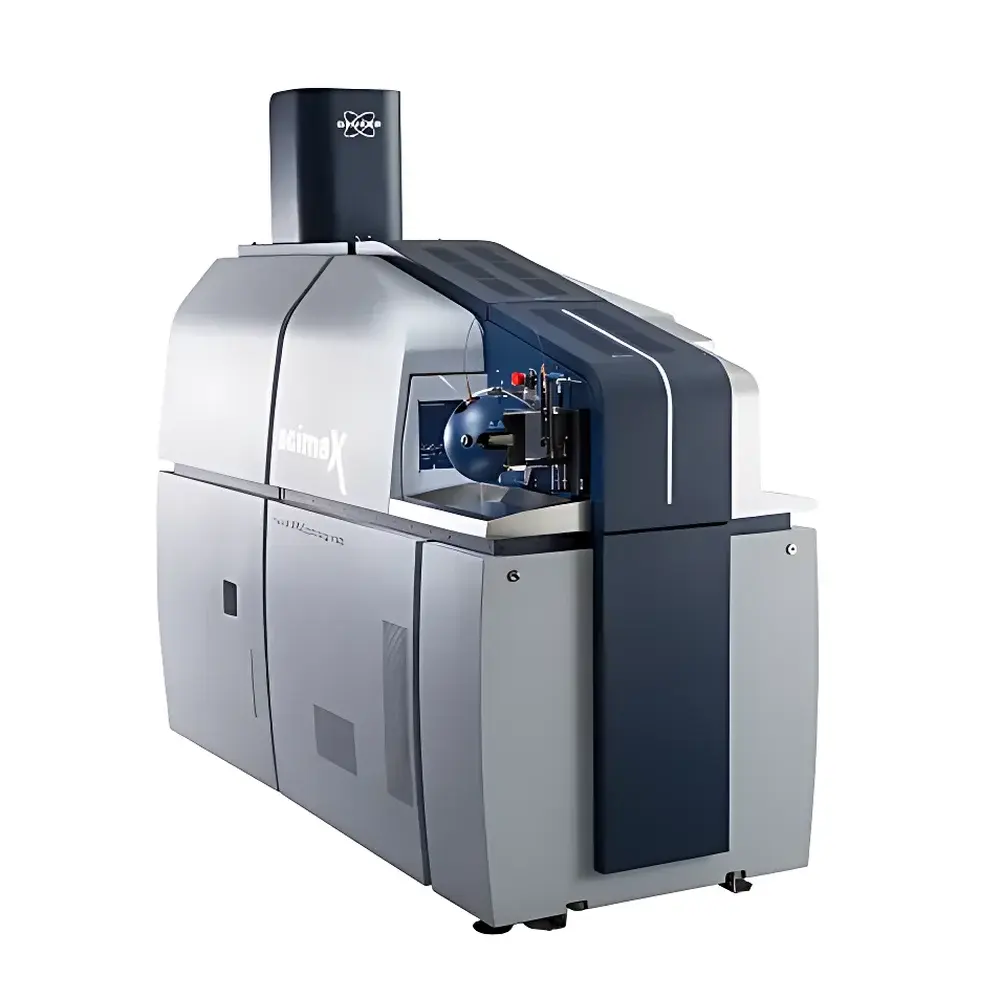
Bruker scimaX™ Magnetic Resonance Mass Spectrometer
| Brand | Bruker |
|---|---|
| Origin | Germany |
| Instrument Type | FTMS (Fourier Transform Mass Spectrometry) |
| Model | scimaX™ |
| Resolution | R > 20,000,000 (at m/z 400) |
| Cooling System | Helium-gas-cooled Maxwell™ superconducting magnet (cryogen-free) |
| Ion Sources | Dual ESI/MALDI with automated switching |
| Fragmentation Modes | ECD, EID, ETD, CID, EDD, SORI-CID, MALDI-ISD, NETD |
| Acquisition Mode | CASI (Collision-Activated Selective Ion accumulation) |
| Application Scope | Universal — petroleumomics, phenomics, metabolomics, native proteomics, label-free MSI, fragment-based drug discovery |
Overview
The Bruker scimaX™ Magnetic Resonance Mass Spectrometer (MRMS) represents a paradigm shift in ultra-high-resolution mass spectrometry. Engineered around Bruker’s proprietary cryogen-free Maxwell™ superconducting magnet technology, the scimaX delivers Fourier Transform mass spectral resolution exceeding 20 million (R > 20,000,000 at m/z 400) without liquid helium or liquid nitrogen. This is achieved through a compact, two-stage closed-cycle helium gas cooling system—consuming less helium than a benchtop GC-TQ—and enabling installation in standard laboratory environments without structural modifications, dedicated cryogenic infrastructure, or specialized ventilation.
Unlike conventional FT-ICR MS instruments constrained by cryogenic logistics and spatial footprint, the scimaX leverages advanced magnet miniaturization and optimized ion optical design to maintain exceptional magnetic field homogeneity and temporal stability—critical for long transient acquisition and high-fidelity IFS (isotopic fine structure) detection. Its MRMS architecture enables unambiguous determination of elemental composition directly from full-spectrum data, even in highly complex, unseparated mixtures—eliminating the need for prior chromatographic separation in workflows such as flow injection analysis (FIA-MRMS).
Key Features
- Cryogen-free operation via Maxwell™ superconducting magnet cooled by gaseous helium only—no liquid cryogens required
- Mass resolution > 20,000,000 (FWHM) at m/z 400, enabling baseline-resolved isotopic fine structure (IFS) across broad m/z ranges
- Dual-source configuration with fully automated ESI/MALDI switching for maximum analytical flexibility
- Comprehensive fragmentation suite: ECD, ETD, CID, EID, EDD, SORI-CID, MALDI-ISD, and NETD—supporting top-down, middle-down, and bottom-up structural characterization
- CASI (Collision-Activated Selective Ion accumulation) for enhanced sensitivity and dynamic range in targeted and untargeted analyses
- Compact footprint (< 2.5 m²) compatible with standard ISO Class 5–7 lab spaces; no reinforced flooring or magnetic shielding required
- Integrated vacuum architecture with turbomolecular pumping and non-evaporable getter (NEG) panels for ultra-high vacuum stability and reduced maintenance cycles
Sample Compatibility & Compliance
The scimaX supports direct infusion, nanoESI, microflow LC-MRMS, and MALDI imaging—making it suitable for small molecules, lipids, glycans, oligonucleotides, intact proteins, and protein complexes. Its robustness in native MS conditions has been validated in GLP-compliant laboratories for biopharmaceutical characterization per ICH Q5E and USP . Data integrity is ensured through full 21 CFR Part 11 compliance—including electronic signatures, audit trails, and role-based access control—within Bruker’s Compass® software suite. All instrument control, acquisition, and processing protocols adhere to ISO/IEC 17025 requirements for testing laboratories and support traceable calibration using certified reference materials (e.g., Agilent Tune Mix, Pierce Calibration Mixture).
Software & Data Management
Controlled by Bruker’s Compass® 2.0 platform, the scimaX integrates seamlessly with DataAnalysis™, BioPharmaAnalyzer™, and ms-IQ™ for automated elemental composition assignment, molecular formula generation, and structural annotation. The software includes built-in support for mzCloud™ spectral libraries and enables batch processing of FIA-MRMS datasets for high-throughput phenotyping (up to 200 samples/day). Raw data files are stored in open-format .d directories compliant with Proteomics Standards Initiative (PSI) mzML specifications. All processing steps—including peak picking, deconvolution, charge state deconvolution, and IFS fitting—are fully scriptable via Python API and reproducible under version-controlled workflow templates.
Applications
- Petroleomics: Direct characterization of heteroatom-class distributions (NxOy, Sz) and carbon number distributions in crude oil and refinery streams without prior fractionation
- Phenomics & Metabolomics: Untargeted molecular phenotyping of biofluids, tissues, and microbial extracts using FIA-MRMS workflows with sub-ppb mass accuracy and IFS-driven formula validation
- Native Proteomics: Intact mass analysis of multi-subunit complexes, post-translational modifications (PTMs), and ligand-binding stoichiometries under non-denaturing conditions
- Label-Free Mass Spectrometry Imaging (MSI): High-spatial-resolution (≤ 20 µm) MALDI-MRMS imaging of tissue sections with simultaneous detection of metabolites, lipids, and peptides—all resolved by exact mass and IFS
- Fragment-Based Drug Discovery (FBDD): Detection of weak non-covalent interactions between low-molecular-weight fragments and target proteins via native MS screening
FAQ
Does the scimaX require liquid helium or liquid nitrogen?
No. The scimaX operates entirely cryogen-free using Bruker’s Maxwell™ magnet cooled by compressed helium gas. No dewars, refills, or boil-off management are necessary.
What is the typical magnetic field strength and stability specification?
The Maxwell™ magnet operates at 12 Tesla with short-term field drift < 0.1 Hz/hour over 12-hour transients, ensuring consistent resolution and mass accuracy across extended acquisitions.
Can the scimaX be integrated with UHPLC systems?
Yes. It supports nanoflow to standard-flow LC interfaces with real-time spectral averaging and lock-mass correction for sub-ppm mass accuracy in LC-MRMS mode.
Is remote monitoring and diagnostics supported?
Yes. Compass® software includes secure TLS-encrypted remote access, predictive maintenance alerts, and cloud-synced instrument health logs compliant with ISO/IEC 27001 data handling standards.
How does scimaX compare to traditional FT-ICR MS in terms of data quality for elemental composition assignment?
At R > 20M, scimaX resolves isotopic fine structure (e.g., 13C/12C splitting) across m/z 200–2000, enabling confident C/H/N/O/S/P/Cl/Br elemental assignments without retention time or tandem MS confirmation.





