
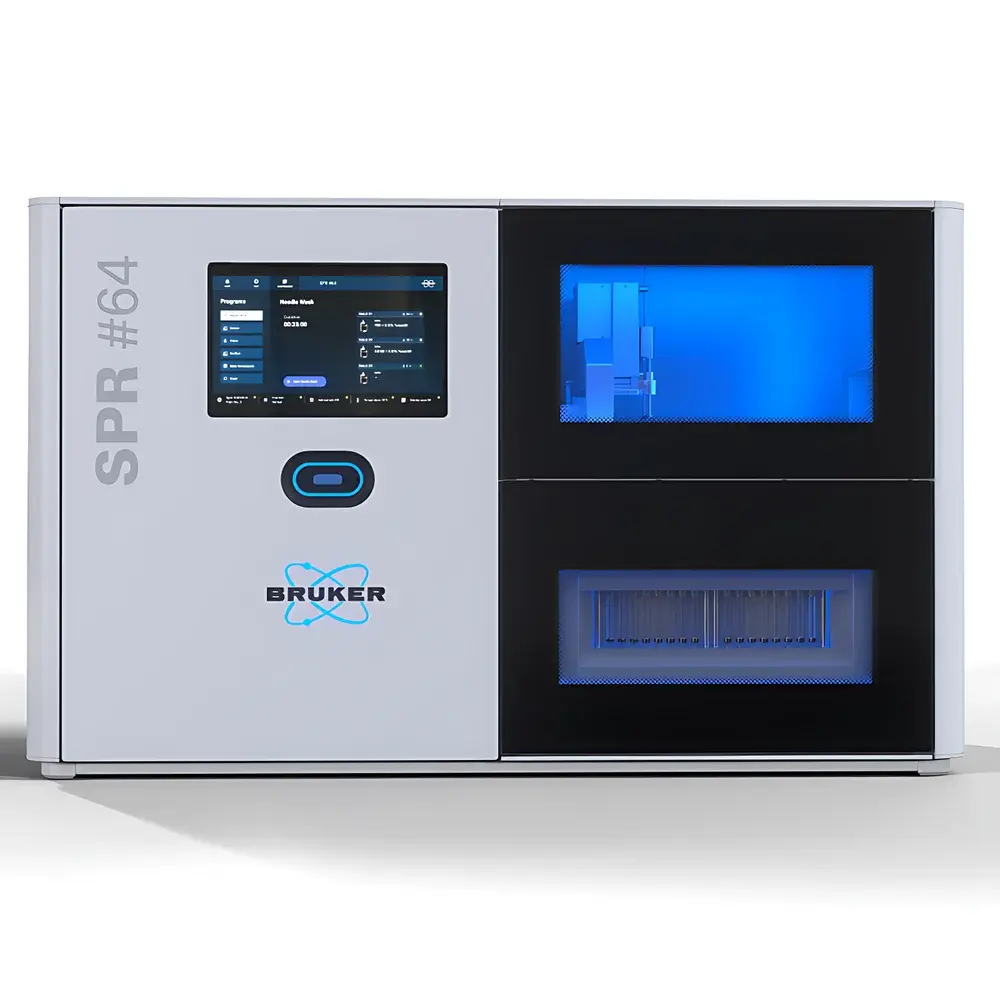
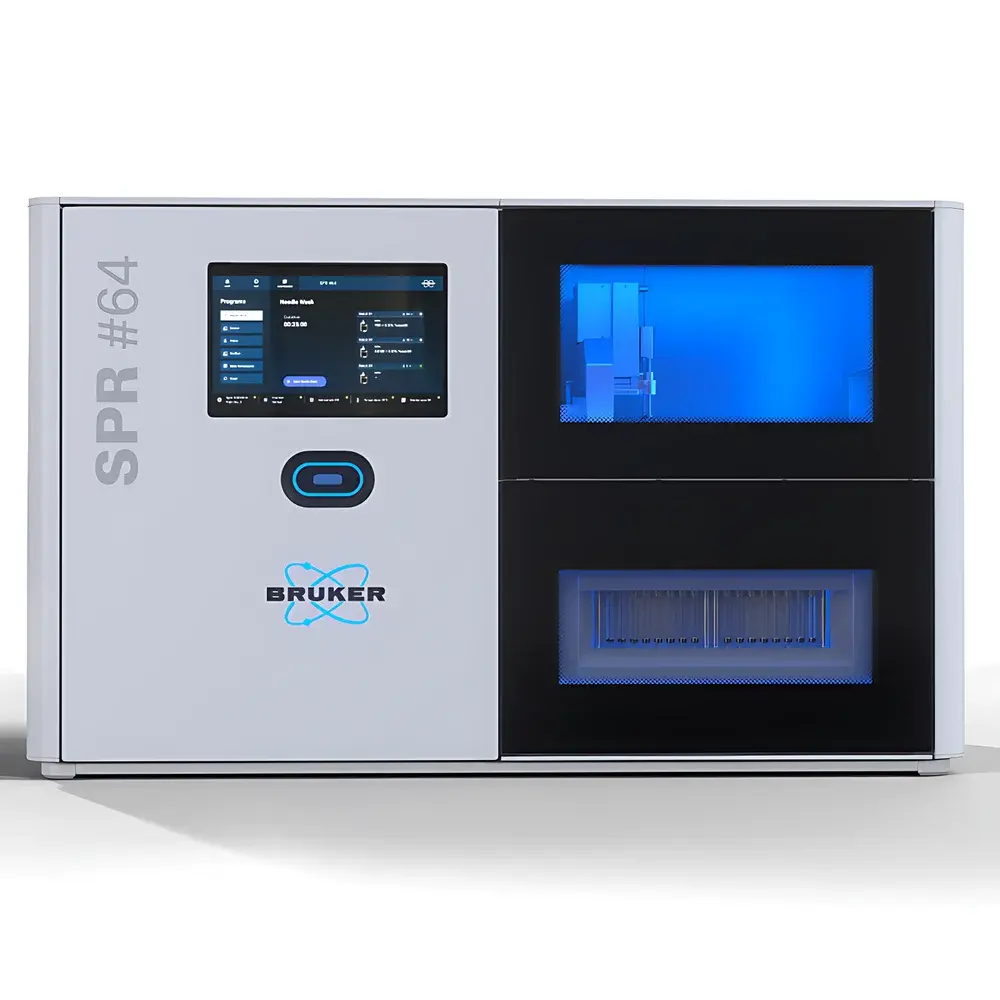
Bruker SPR #64 Surface Plasmon Resonance Analyzer
| Brand | Bruker |
|---|---|
| Origin | Germany |
| Model | SPR #64 |
| Instrument Type | Surface Plasmon Resonance (SPR) |
| Channel Configuration | 8-Channel Orthogonal Flow Cell with 64 Sensor Spots |
| Fluidic Flexibility | Up to 8 Simultaneous Buffer Streams |
| Automation Interface | RESTful API & Robotic Integration Ready |
| Sample Format Support | 96-well & 384-well Microplates, Reagent Reservoirs, External Cooling-Compatible Stage |
| Cleaning Mechanism | Integrated Dual-Prism Cartridge with Auto-Clean Protocol |
| Data Output Format | Open HDF5, CSV, and JSON |
Overview
The Bruker SPR #64 is a next-generation surface plasmon resonance (SPR) analyzer engineered for high-throughput, quantitative molecular interaction analysis in life science research and biopharmaceutical development. It operates on the physical principle of evanescent wave coupling at a gold-coated sensor surface, where changes in refractive index—induced by real-time binding or dissociation of biomolecules—are detected as shifts in resonance angle (measured in resonance units, RU). Unlike conventional single- or dual-channel SPR platforms, the SPR #64 employs an 8-channel orthogonal flow cell architecture rotated 90° to enable simultaneous interrogation of a dense 8 × 8 array of 64 independent sensor spots. This design delivers true parallelism—not sequential multiplexing—allowing concurrent kinetic profiling of up to 64 unique target-analyte pairs within a single injection cycle. The system is optimized for robust microfluidic performance under continuous-flow conditions, supporting precise buffer switching, multi-condition screening, and automated regeneration—all without manual intervention.
Key Features
- 64-Spot Parallel Detection: Full spatial resolution across an 8 × 8 sensor array enables simultaneous measurement of binding kinetics, affinity, and stoichiometry across diverse target-analyte combinations.
- Orthogonal Flow Cell Architecture: Independent vertical (target immobilization) and horizontal (analyte delivery) fluidic paths allow combinatorial surface patterning—e.g., 8 targets pre-coupled vertically, followed by 8 analytes injected horizontally—yielding 64 discrete interaction channels per run.
- Frame Injection Technology: Enables rapid, low-volume buffer exchange during association/dissociation phases using sub-microliter volumes of alternative buffers—reducing reagent consumption by >70% while preserving kinetic integrity.
- Double-Injection Mode: Supports sequential injection of two distinct analytes in one command cycle: first for binding-only monitoring (e.g., epitope binning), second for full association-dissociation profiling—eliminating inter-injection baseline drift.
- Individual Needle Control (INC): Eight independently addressable sample needles permit flexible configuration—from single-point validation to full 8-needle parallel dispensing—optimizing throughput, material use, and experimental scalability.
- Dual-Prism Cartridge System: Integrates sensor chip and cleaning manifold into a single consumable; auto-executes post-run microfluidic flush and surface regeneration, reducing downtime by ~30 minutes per day and eliminating manual maintenance steps.
Sample Compatibility & Compliance
The SPR #64 accommodates a broad molecular weight range—from small molecules (<500 Da) and oligonucleotides to large biologics including monoclonal antibodies, viral-like particles (VLPs), liposomes, and membrane protein complexes. Its open surface chemistry supports amine, thiol, streptavidin-biotin, Ni-NTA, and custom covalent coupling chemistries. The platform complies with GLP/GMP-aligned operational requirements: audit-trail-enabled software (optional 21 CFR Part 11 compliance), electronic signature support, method version control, and raw-data immutability. All calibration, qualification, and maintenance logs are timestamped and exportable. The instrument meets ISO/IEC 17025 traceability standards for analytical instrumentation when operated with certified reference materials and documented SOPs.
Software & Data Management
SPRControl™ software provides a unified interface for method development, acquisition, and analysis. Its drag-and-drop workflow editor supports modular step definition—including ligand capture, analyte injection, buffer switching, regeneration, and sensor referencing. Preconfigured templates accelerate assay setup for common applications (e.g., KD screening, epitope binning, thermodynamic profiling). Real-time heatmaps visualize response across all 64 spots; kinetic fitting uses global or local models (1:1, bivalent analyte, heterogeneous ligand, etc.) with confidence interval estimation. Data exports are natively machine-readable: HDF5 (for AI/ML pipeline ingestion), CSV (for Excel or R integration), and JSON (for LIMS or ELN interoperability). All processed data includes metadata tags (instrument ID, user, timestamp, method hash), ensuring FAIR (Findable, Accessible, Interoperable, Reusable) data principles.
Applications
- High-throughput primary screening of compound libraries against immobilized targets
- Label-free kinetic characterization (ka, kd, KD) of antibody-antigen, receptor-ligand, and protein-protein interactions
- Epitope binning and mapping via double-injection competitive assays
- pH-, salt-, or co-factor-dependent binding thermodynamics (ΔG, ΔH, ΔS) using Frame Injection across 8 buffer conditions
- Concentration analysis of crude lysates or partially purified samples using reference-subtracted response calibration
- Stability assessment of immobilized ligands over repeated regeneration cycles
- Binding mode analysis under physiological or stress-induced conditions (e.g., oxidative, thermal)
FAQ
What is the maximum number of independent interactions measurable per injection cycle?
Up to 64 distinct molecular interactions can be monitored simultaneously—each corresponding to a unique spot in the 8 × 8 sensor array.
Does the SPR #64 support kinetic analysis of low-affinity interactions (KD > 1 µM)?
Yes—the system’s high signal-to-noise ratio, low drift (<0.5 RU/h), and extended dissociation monitoring windows (up to 2 hours) enable reliable off-rate determination for weak binders.
Can the instrument be integrated into a fully automated lab environment?
Yes—it features a documented RESTful API, robotic arm trigger I/O ports, and compatibility with third-party scheduling software (e.g., Genedata, Benchling, LabVantage).
Is sensor chip regeneration included in the dual-prism cartridge?
Yes—regeneration solutions are delivered through the same microfluidic path used for sample injection, and the cartridge contains dedicated reservoirs for regeneration reagents.
What data formats are supported for export and downstream analysis?
HDF5 (primary), CSV (tabular), and JSON (metadata-rich); all include embedded timestamps, method parameters, and instrument configuration hashes.






