
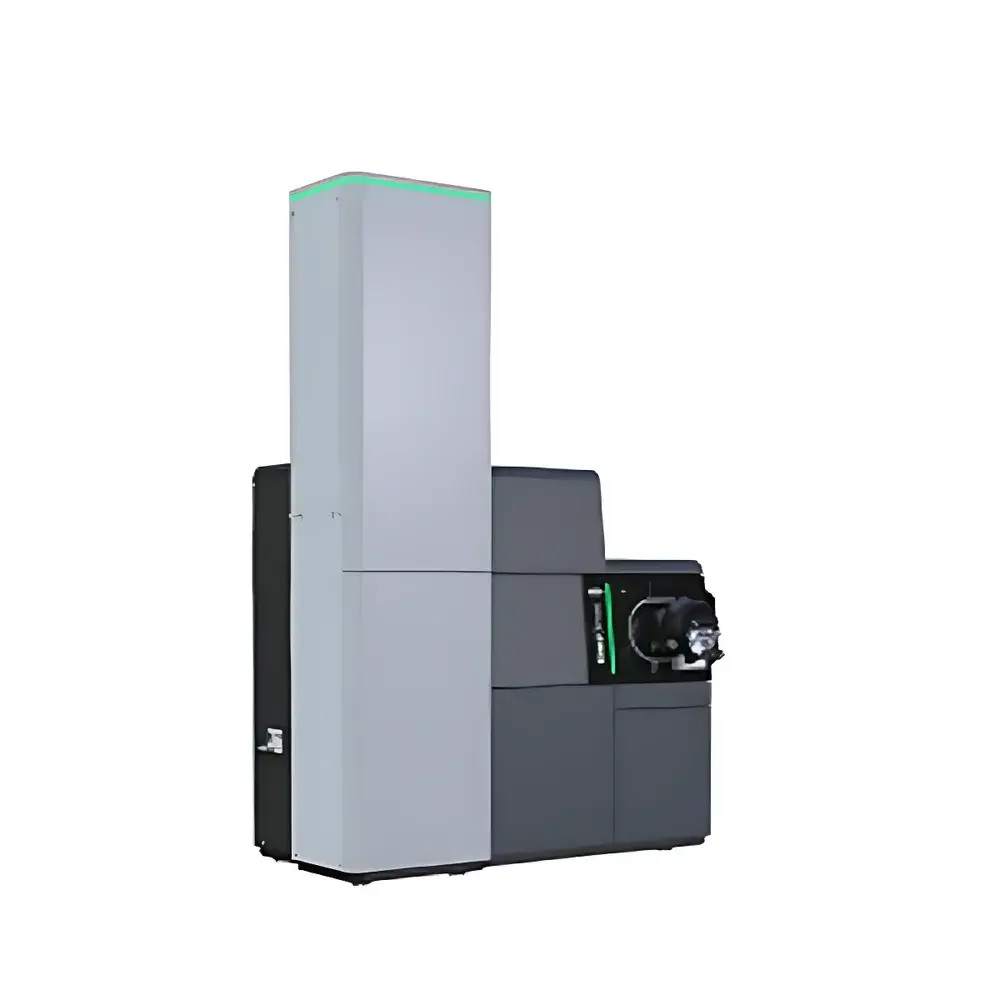
Bruker timsMetabo™ Trapped Ion Mobility Spectrometry-Mass Spectrometry System
| Brand | Bruker |
|---|---|
| Origin | Germany |
| Instrument Type | Trapped Ion Mobility Spectrometry (TIMS) Mass Spectrometer |
| Model | timsMetabo™ |
| Application Scope | Universal (Metabolomics, Lipidomics, Untargeted Small-Molecule Analysis) |
| Regulatory Compliance | Designed for GLP/GMP-aligned workflows |
Overview
The Bruker timsMetabo™ is a high-performance trapped ion mobility spectrometry–mass spectrometry (TIMS-MS) system engineered for comprehensive, quantitative, and structurally resolved small-molecule analysis. At its core, the platform integrates TIMS separation—based on the differential mobility of ions in an electric field under controlled buffer gas conditions—with high-resolution time-of-flight mass spectrometry (timsTOF architecture). This enables true four-dimensional (4D) separation: retention time (LC), m/z (mass spectrometry), intensity (quantitation), and collision cross-section (CCS)—a physicochemical property directly linked to molecular conformation and stereochemistry. Unlike conventional LC-MS systems, timsMetabo™ resolves co-eluting isomers, isobars, and isobaric lipids with high reproducibility, delivering clean, unambiguous MS/MS spectra essential for confident annotation in untargeted metabolomics and lipidomics. The system is purpose-built for deep coverage of endogenous metabolites and lipids across biological matrices—including plasma, urine, tissue extracts, and microbial supernatants—without requiring derivatization or extensive fractionation.
Key Features
- TIMS-MX mobility analyzer with Mobility Range Enhancement (MoRE) technology: extends CCS separation range by >30% versus prior-generation TIMS platforms, improving resolution of structurally similar metabolites (e.g., epimers, regioisomers) and enabling robust CCS calibration using internal standards.
- Athena Ion Propulsion (AIP): a patented ion acceleration module that increases transmission efficiency across the full m/z range, enhancing both MS and MS/MS sensitivity—particularly critical for low-abundance signaling lipids and modified bile acids.
- VIP-HESI (Variable Ionization Pressure–Heated Electrospray Ionization): delivers stable, high-current ionization with reduced in-source fragmentation, optimized for polar and semi-polar metabolites across wide dynamic concentration ranges.
- dia-PASEF® acquisition mode: dynamically couples parallel accumulation–serial fragmentation with ion mobility gating, maximizing sequencing speed and duty cycle without sacrificing spectral quality—ideal for high-throughput cohort studies.
- Integrated 4D-QC framework: real-time performance monitoring via TASQ® RealTimeQC, automated system suitability testing with QSee™ (including certified 8-component test mix), and longitudinal trend analysis powered by TwinScape™ software.
Sample Compatibility & Compliance
The timsMetabo™ accepts standard LC effluents from analytical-scale reversed-phase, HILIC, and mixed-mode columns (1–2.1 mm ID). It is validated for use with biological fluids (serum, plasma, CSF, urine), cell lysates, tissue homogenates, and microbial culture supernatants. All hardware and software components comply with ISO/IEC 17025 requirements for testing laboratories and support audit-ready workflows aligned with FDA 21 CFR Part 11, EU Annex 11, and GLP/GMP documentation standards. MetaboScape® includes electronic signature capability, full audit trail logging, and configurable user access controls—ensuring data integrity throughout the analytical lifecycle.
Software & Data Management
Data acquisition and processing are unified within Bruker’s MetaboScape® 6.0+ platform, which natively supports 4D feature detection, CCS-aligned alignment, and database-driven annotation against HMDB, LIPID MAPS, METLIN, and in-house spectral libraries. The software implements machine-learning–enabled deconvolution of overlapping isotopic patterns and retention time shifts, while preserving raw CCS values for every detected feature. TwinScape™ provides cross-instrument performance benchmarking and long-term QC trending, linking instrument metrics (e.g., mass accuracy, CCS deviation, peak capacity) to batch-level metadata. All processed datasets export to open formats (mzML, CCS-XML) compatible with third-party bioinformatics pipelines including XCMS Online, MZmine, and Galaxy-based metabolomics workflows.
Applications
The timsMetabo™ addresses analytical challenges in multiple domains: structural characterization of novel bile acid conjugates (e.g., glycine- vs. taurine-linked variants); discrimination of smoking-associated urinary biomarkers based on CCS-anchored identification; high-confidence annotation of oxidized phospholipids in inflammatory models; and large-scale longitudinal metabolite profiling in clinical cohorts. Its ability to generate reference-quality CCS values—traceable to NIST-traceable calibrants—supports community-wide standardization efforts such as the Metabolomics Standards Initiative (MSI) Level 2 identification confidence criteria. The platform also serves as a unified front-end for integrated multi-omics studies, sharing underlying timsTOF infrastructure with 4D-proteomics and phosphoproteomics workflows.
FAQ
What distinguishes timsMetabo™ from conventional LC-MS/MS platforms?
It adds collision cross-section (CCS) as a fourth orthogonal dimension of separation—enabling isomer resolution, improved signal-to-noise in complex matrices, and enhanced annotation confidence without method re-optimization.
Is CCS measurement reproducible across instruments and laboratories?
Yes—when calibrated using internal standards and operated under standardized gas pressure, temperature, and voltage conditions, CCS values exhibit inter-laboratory RSD < 0.5%, supporting cross-platform data harmonization.
Can timsMetabo™ be used for targeted quantitation?
Absolutely—the system supports scheduled MRM and parallel reaction monitoring (PRM) modes with TIMS filtering, achieving sub-pg/mL LODs for metabolites in plasma when coupled with microflow LC.
Does the platform support regulatory submission-ready data packages?
Yes—MetaboScape® generates ALCOA+ compliant data packages including raw files, processing parameters, audit logs, and validation reports required for IND/NDA submissions.
How does MoRE technology improve metabolite coverage?
By extending the effective drift time window, MoRE increases the number of resolvable mobility bins per LC peak—particularly beneficial for highly branched or rigid molecules (e.g., sterols, glycosylated metabolites) that exhibit narrow CCS distributions.




