
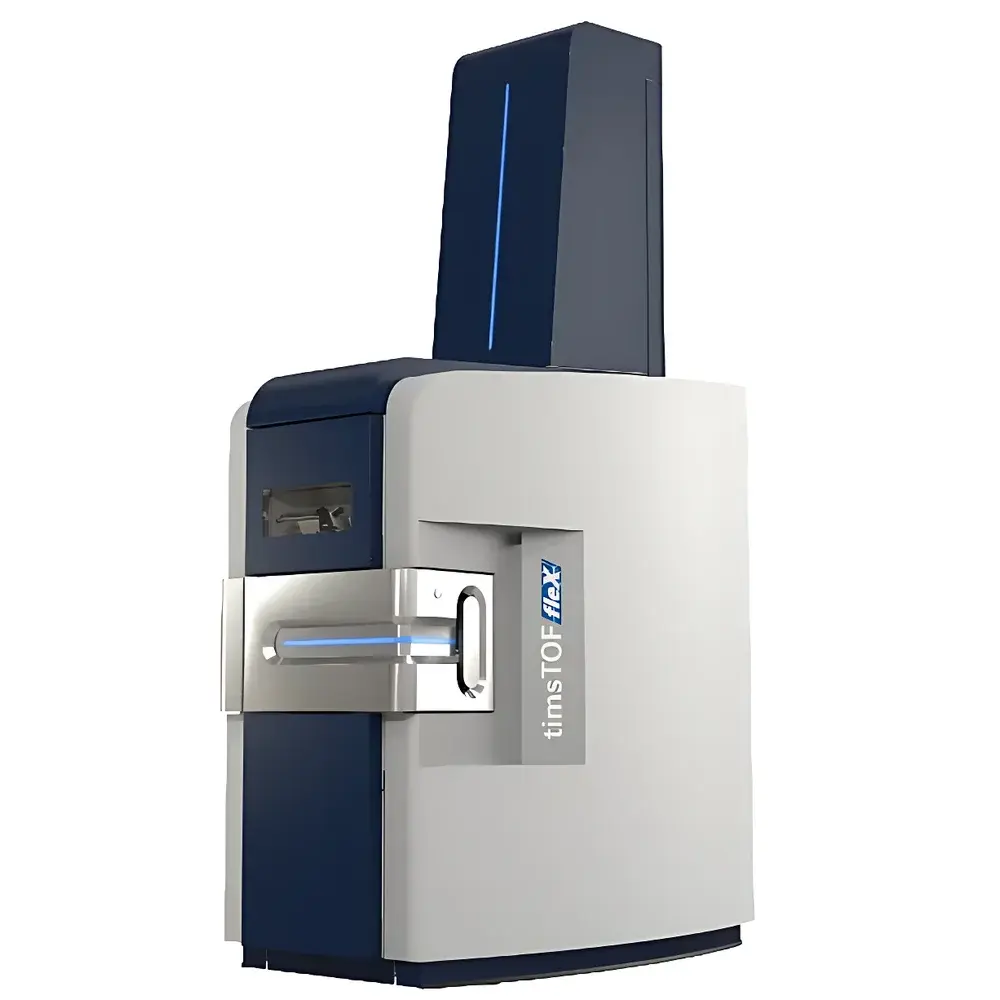
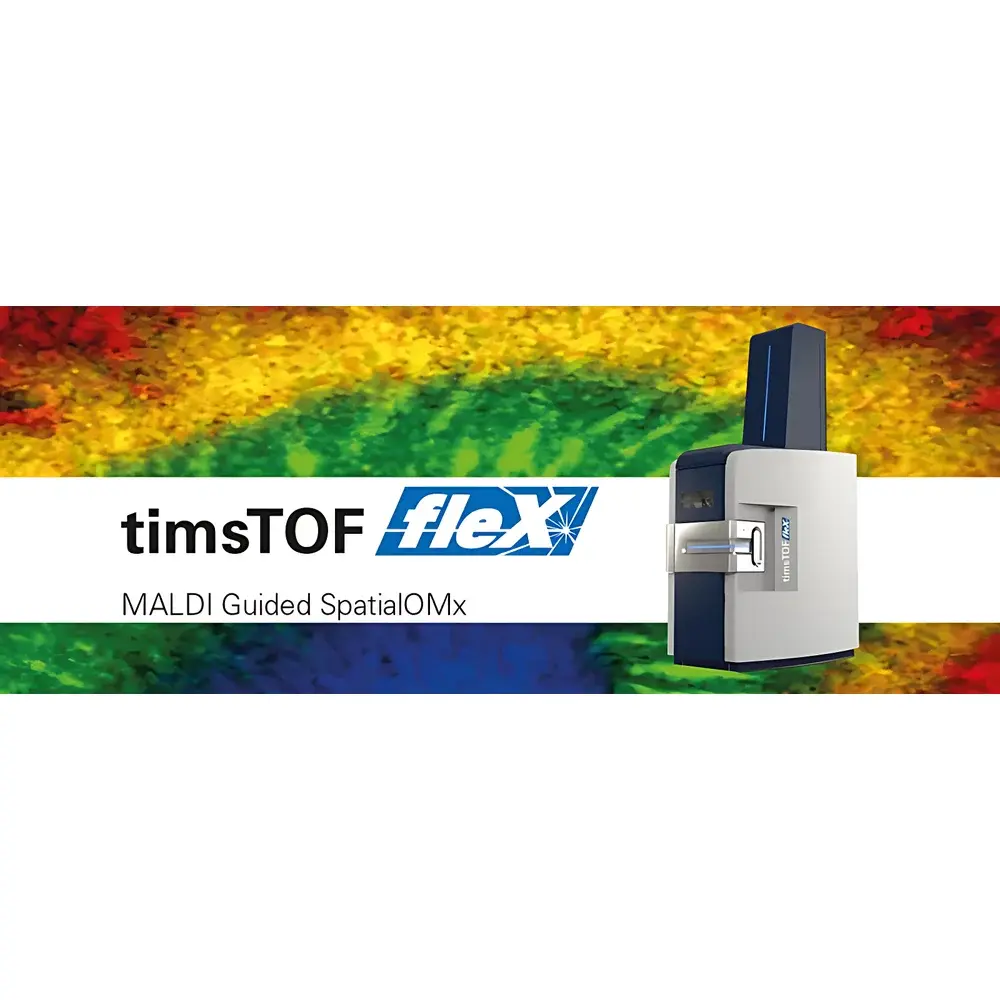
Bruker timsTOF fleX Spatial Omics and Imaging Mass Spectrometry System
| Brand | Bruker |
|---|---|
| Origin | Germany |
| Manufacturer Type | Authorized Distributor |
| Product Category | Imported Instrument |
| Model | timsTOF fleX™ |
| Instrument Type | Trapped Ion Mobility Spectrometry (TIMS) Mass Spectrometer |
| Application Scope | Universal Platform for Spatial Omics and Molecular Imaging |
Overview
The Bruker timsTOF fleX is a dual-source, high-performance hybrid mass spectrometry platform engineered for spatially resolved multi-omics analysis. It integrates trapped ion mobility spectrometry (TIMS) with parallel accumulation–serial fragmentation (PASEF®) and matrix-assisted laser desorption/ionization (MALDI) imaging in a single instrument architecture. Built upon the proven timsTOF HT platform, the system delivers 4D proteomics, lipidomics, metabolomics, and glycomics workflows—where the fourth dimension is collision cross-section (CCS), derived from TIMS separation. Unlike conventional LC-MS/MS systems, timsTOF fleX enables label-free, high-spatial-resolution molecular imaging directly on tissue sections while concurrently supporting deep, quantitative ESI-based bottom-up omics profiling. Its core innovation lies in the unified ion path: both MALDI- and ESI-generated ions traverse identical TIMS analyzers and time-of-flight detectors, ensuring consistent CCS calibration, reproducible spectral quality, and seamless method transfer between imaging and liquid chromatography modes.
Key Features
- Dual-ion-source architecture: Integrated smartbeam™ 3D MALDI source and electrospray ionization (ESI) source, enabling rapid (<5 s) software-controlled switching without hardware realignment or recalibration.
- microGRID™ technology: A precision-engineered mechanical and optical upgrade combining a high-stability MALDI stage with sub-5 µm laser beam positioning accuracy, delivering routinely achievable spatial resolution down to 5 µm for tissue imaging experiments.
- Trapped Ion Mobility Spectrometry (TIMS): Dual-TIMS design provides gas-phase separation based on ion shape (CCS), resolving isobaric and isomeric species—including structurally distinct lipids, glycans, and peptides—that cannot be distinguished by m/z or high mass resolution alone.
- PASEF® acquisition: Enables ultra-high sensitivity and sequencing speed in LC-MS/MS mode, achieving >100 Hz MS/MS spectra acquisition with >95% duty cycle—critical for comprehensive deep-coverage omics profiling from limited sample amounts.
- SCiLS™ autopilot integration: Fully automated, protocol-driven MALDI imaging data acquisition that minimizes user intervention, ensures inter-experimental reproducibility, and supports GLP-compliant workflow documentation.
- IntelliSlides™ and fleXmatrix® consumables: Pre-coated, standardized MALDI target slides and optimized matrix formulations designed for uniform crystallization, reduced spot-to-spot variability, and compatibility with automated SCiLS™ Lab workflows.
Sample Compatibility & Compliance
The timsTOF fleX accommodates a broad range of biological specimens—including formalin-fixed paraffin-embedded (FFPE) and frozen tissue sections, cell cultures, biofluids, and microbial colonies—without requiring derivatization or enrichment. Its MALDI imaging mode supports untargeted detection of metabolites, lipids, peptides, proteins (up to ~20 kDa), and glycans across mass ranges from m/z 50 to 20,000. The platform complies with ISO/IEC 17025 analytical validation principles and supports audit-trail-enabled operation under FDA 21 CFR Part 11 when deployed with SCiLS™ Lab in validated environments. All TIMS-derived CCS values are traceable to NIST-traceable calibrants, and instrument performance verification follows Bruker’s certified QC protocols aligned with ASTM E2965 and ISO 13012 standards for MALDI imaging instrumentation.
Software & Data Management
Data acquisition, processing, and interpretation are unified through Bruker’s SCiLS™ Lab software suite—widely recognized as the industry reference for MALDI imaging informatics. SCiLS™ Lab provides pixel-wise spectral visualization, unsupervised clustering (e.g., k-means, HCA), spatial segmentation, and statistical mapping (t-test, ANOVA, ROC). Integration with MetaboScape® enables direct annotation of MALDI imaging peaks using LC-MS/MS spectral libraries or retention time–CCS–m/z databases, facilitating confident molecular identification in anatomical context. CCS correlation algorithms automatically align spatial imaging features with LC-MS/MS identifications, linking molecular identity to histological morphology. All raw and processed datasets adhere to the imzML open standard, ensuring interoperability with third-party tools such as MSiReader, Cardinal, and OpenMS. Audit trails, user access controls, and electronic signature support comply with GLP/GMP requirements for regulated research environments.
Applications
The timsTOF fleX serves as the foundational platform for SpatialOMx®—Bruker’s integrated strategy for spatially resolved multi-omics. Key application domains include:
- Tumor microenvironment mapping: Co-localization of immune cell markers, oncogenic lipids, and post-translationally modified peptides within histopathologically defined regions.
- Neurodegenerative disease research: Subcellular-level distribution of amyloid-beta isoforms, phospholipid asymmetry, and neurotransmitter metabolites in brain tissue sections.
- Drug distribution and metabolism studies: Quantitative imaging of parent compounds and phase I/II metabolites in liver, kidney, and tumor xenograft models.
- Developmental biology: Temporal-spatial tracking of glycosphingolipid isoforms during embryonic tissue patterning.
- Microbiome–host interface analysis: In situ characterization of bacterial membrane lipids and host antimicrobial peptides at mucosal interfaces.
Its ability to resolve isomeric lipids (e.g., sn-position isomers, double-bond location) and quantify low-abundance signaling metabolites in native tissue context makes it uniquely suited for hypothesis-generating discovery workflows where spatial fidelity and molecular specificity are non-negotiable.
FAQ
How does TIMS improve spatial imaging specificity compared to conventional MALDI-TOF?
TIMS adds a gas-phase separation dimension orthogonal to m/z, enabling discrimination of isobaric and isomeric species—such as lipid regioisomers or glycan linkage variants—based on their collision cross-section (CCS). This reduces spectral complexity per pixel and increases confidence in spatial assignment.
Can CCS values acquired in ESI mode be directly applied to MALDI imaging data?
Yes. Because both ionization modes share the same TIMS analyzer and detector path, CCS calibration performed under ESI conditions remains valid for MALDI-derived ions, eliminating the need for separate MALDI-specific CCS calibration runs.
Is microGRID™ compatible with existing timsTOF fleX instruments?
Yes. microGRID™ is a field-upgradable hardware module available for all timsTOF fleX systems installed after Q1 2021, and retrofittable to earlier units via Bruker Field Service.
Does SCiLS™ Lab support batch processing of multiple imaging datasets for comparative analysis?
Yes. SCiLS™ Lab includes project-level batch processing modules with standardized normalization, peak alignment, and multivariate statistical pipelines—enabling robust group-level comparisons across cohorts of tissue sections.
What level of IT infrastructure is required to handle timsTOF fleX imaging datasets?
A minimum of 64 GB RAM, 16-core CPU, and ≥10 TB high-throughput storage (RAID 5 or NAS) is recommended for efficient handling of full-resolution 5 µm datasets spanning >1 million pixels per section.
Related Products





