
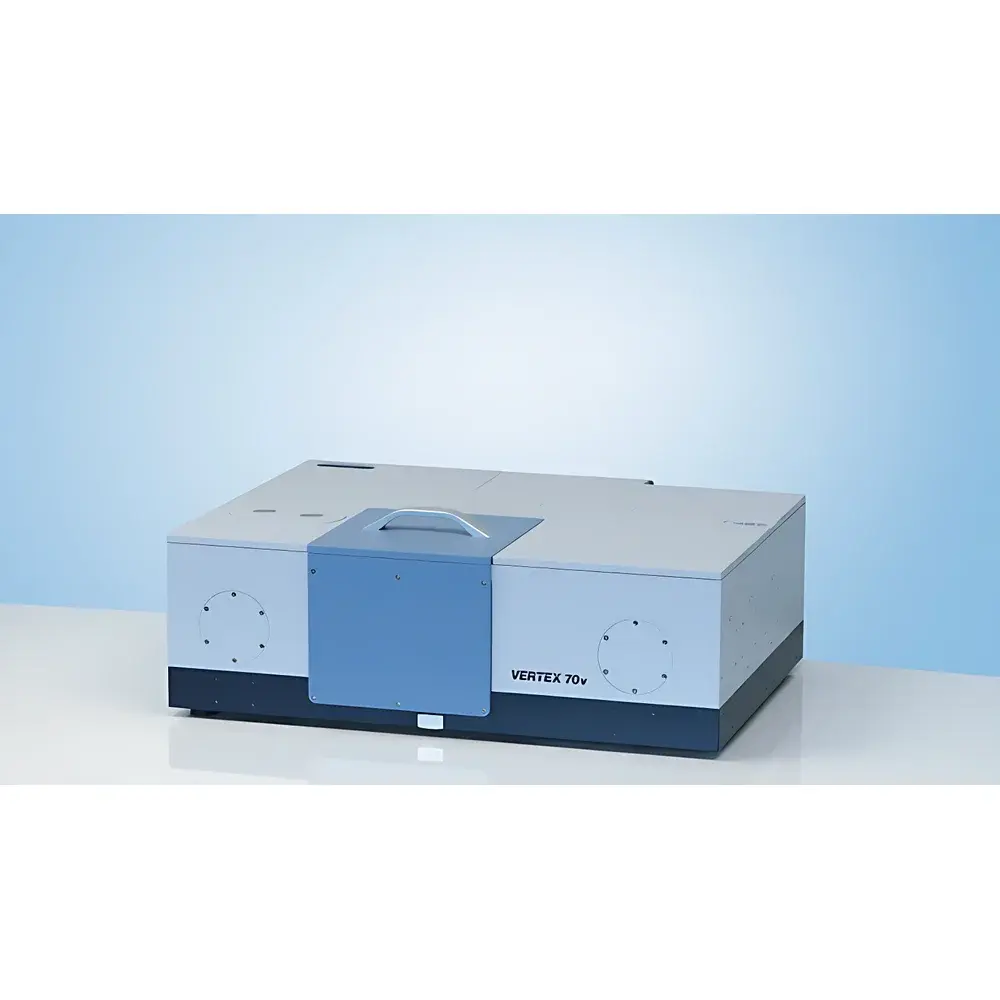
Bruker VERTEX 70v High-End Research-Grade Fourier Transform Infrared (FTIR) Spectrometer
| Brand | Bruker |
|---|---|
| Origin | Germany |
| Model | VERTEX 70v |
| Instrument Type | Laboratory FTIR Spectrometer |
| Wavenumber Range | 10–30,000 cm⁻¹ |
| Spectral Resolution | ≤0.4 cm⁻¹ (standard), upgradable to 0.16 cm⁻¹ |
| Scan Speed | 80 scans/sec |
| Signal-to-Noise Ratio | 50,000:1 (at 4 cm⁻¹, 1 min measurement) |
| Interferometer | RockSolid™ permanently aligned, gold-coated optics |
| Vacuum Capability | Full-vacuum optical bench optional |
| Beam Splitter Exchange | Motorized BMS-c unit supports up to 4 beam splitters without breaking vacuum |
| Detector Compatibility | Up to 5 software-controlled detectors (RT, LN₂-cooled, LHe-cooled) |
| Compliance | ASTM E1421, ISO 17025, USP <851>, FDA 21 CFR Part 11 (with OPUS software suite) |
Overview
The Bruker VERTEX 70v is a high-performance, research-grade Fourier Transform Infrared (FTIR) spectrometer engineered for maximum spectral fidelity, long-term stability, and experimental flexibility in demanding academic, pharmaceutical, and materials science laboratories. Built upon Bruker’s proprietary RockSolid™ interferometer architecture, the VERTEX 70v employs a permanently aligned, gold-coated optical design with 30° mirror incidence to maximize throughput, minimize polarization artifacts, and ensure intrinsic mechanical and thermal stability—eliminating the need for routine realignment. Its core measurement principle relies on Michelson interferometry coupled with fast-scanning, high-precision digitization (DigiTect detector technology), enabling precise acquisition of interferograms across the full mid- to far-infrared spectrum. The system supports both ambient-air, purged, and fully evacuated optical bench configurations—effectively removing atmospheric CO₂ and H₂O absorption bands that compromise spectral integrity below 600 cm⁻¹ or above 5,000 cm⁻¹. With a standard wavenumber range of 10–30,000 cm⁻¹ and resolution down to 0.16 cm⁻¹ (unapodized), the VERTEX 70v delivers benchmark performance for molecular fingerprinting, reaction monitoring, thin-film characterization, and low-concentration trace analysis.
Key Features
- RockSolid™ permanently aligned interferometer with gold-coated mirrors and optimized 30° beam incidence for >90% optical throughput and minimal polarization dependence
- Full-vacuum optical bench option eliminates atmospheric water vapor and CO₂ interference—critical for far-IR (10–400 cm⁻¹) and high-accuracy quantitative work
- Motorized beam splitter changer (BMS-c) accommodating up to four interchangeable beam splitters (e.g., KBr, quartz, Mylar, polyethylene)—enabling seamless spectral region extension from far-IR/THz to UV without vacuum break
- Software-controlled multi-detector station supporting simultaneous installation of up to five detectors: DTGS, MCT (LN₂-cooled), InSb, Si, and bolometric (LHe-cooled)
- DigiTect digital detector electronics with integrated analog-to-digital conversion—reducing electronic noise floor and improving dynamic range by >20 dB versus conventional designs
- Step-scan and slow-scan acquisition modes for time-resolved spectroscopy, phase-modulated measurements (e.g., PM-FTIR), and synchrotron-compatible experiments
- Fully automated accessory recognition via RFID and optical encoding—ensuring correct parameter loading and calibration traceability
Sample Compatibility & Compliance
The VERTEX 70v accommodates a broad range of sample forms—including transmission cells (gas, liquid, solid), ATR accessories (diamond, ZnSe, Ge), diffuse reflectance (DRIFTS), specular reflectance, photoacoustic (PAS), and cryogenic stages (4–300 K). Its modular beam path supports custom external optics, synchrotron coupling, and ultrafast pump-probe configurations. From a regulatory perspective, the system complies with ISO/IEC 17025:2017 requirements for testing laboratories when operated with validated OPUS software protocols. Optional 21 CFR Part 11 compliance packages include electronic signature workflows, audit trails, user role management, and data integrity safeguards—meeting GLP/GMP expectations for pharmaceutical QC, stability studies, and regulatory submissions (e.g., ICH Q5, Q6A). All factory calibrations are traceable to NIST SRM standards, and wavelength accuracy is verified using polystyrene film (ASTM E1421).
Software & Data Management
Controlled exclusively by Bruker’s OPUS spectroscopy software platform (v8.5+), the VERTEX 70v integrates instrument control, real-time spectral processing, multivariate analysis (PCA, PLS), and report generation within a single validated environment. OPUS supports automated method templates, sequence-based batch acquisition, and metadata-rich HDF5 file storage compliant with FAIR (Findable, Accessible, Interoperable, Reusable) principles. Raw interferogram data is preserved alongside processed spectra, enabling retrospective reprocessing with updated apodization, zero-filling, or phase correction algorithms. Network deployment options allow centralized license management and remote diagnostics. For enterprise integration, OPUS provides OPC UA and RESTful API interfaces compatible with LIMS (e.g., LabVantage, Thermo SampleManager) and ELN systems. Audit trail logs record all user actions—including parameter changes, calibration events, and file exports—with immutable timestamps and operator identification.
Applications
The VERTEX 70v serves as a foundational analytical platform across multiple domains: polymer crystallinity and degradation kinetics (via time-resolved FTIR); catalytic surface reaction mechanisms under in situ/operando conditions; protein secondary structure quantification (amide I/II band deconvolution); semiconductor dopant profiling using far-IR free-carrier absorption; isotopic ratio analysis (e.g., ¹³C/¹²C in metabolites); and nanomaterial phonon mode mapping in 2D materials. Its vacuum capability and sub-0.2 cm⁻¹ resolution make it suitable for high-resolution gas-phase rovibrational spectroscopy (e.g., atmospheric chemistry, combustion intermediates). In pharmaceutical development, it supports polymorph screening, excipient compatibility studies, and counterfeit drug detection per USP . Academic users leverage its step-scan functionality for picosecond-scale photochemical dynamics and THz-TDS coupling.
FAQ
What vacuum level is required for optimal far-IR performance?
A pressure ≤10⁻² mbar is recommended for measurements below 400 cm⁻¹; the VERTEX 70v achieves this via integrated turbomolecular pumping with automatic pressure regulation and interlock safety.
Can the VERTEX 70v be upgraded to VERTEX 80v specifications?
No—the VERTEX 70v and 80v differ fundamentally in interferometer design (RockSolid™ vs. UltraScan™), vacuum architecture, and detector interface bandwidth; upgrades are not supported.
Is OPUS software included with the base system?
Yes—OPUS v8.5 with full instrument control, spectral processing, and basic chemometrics is supplied standard; advanced modules (e.g., Quant, Identify, Thin Film) are licensed separately.
How does the BMS-c beam splitter changer maintain alignment during exchange?
Each beam splitter mount incorporates precision kinematic定位 pins and laser-verified registration surfaces; positional repeatability is ±0.5 µrad, ensuring no recalibration is needed after switching.
What detector cooling options are available for low-noise far-IR measurements?
Liquid helium-cooled bolometers (4.2 K) and liquid nitrogen-cooled Si composite detectors are supported; both integrate with the automated detector selection logic in OPUS.




