
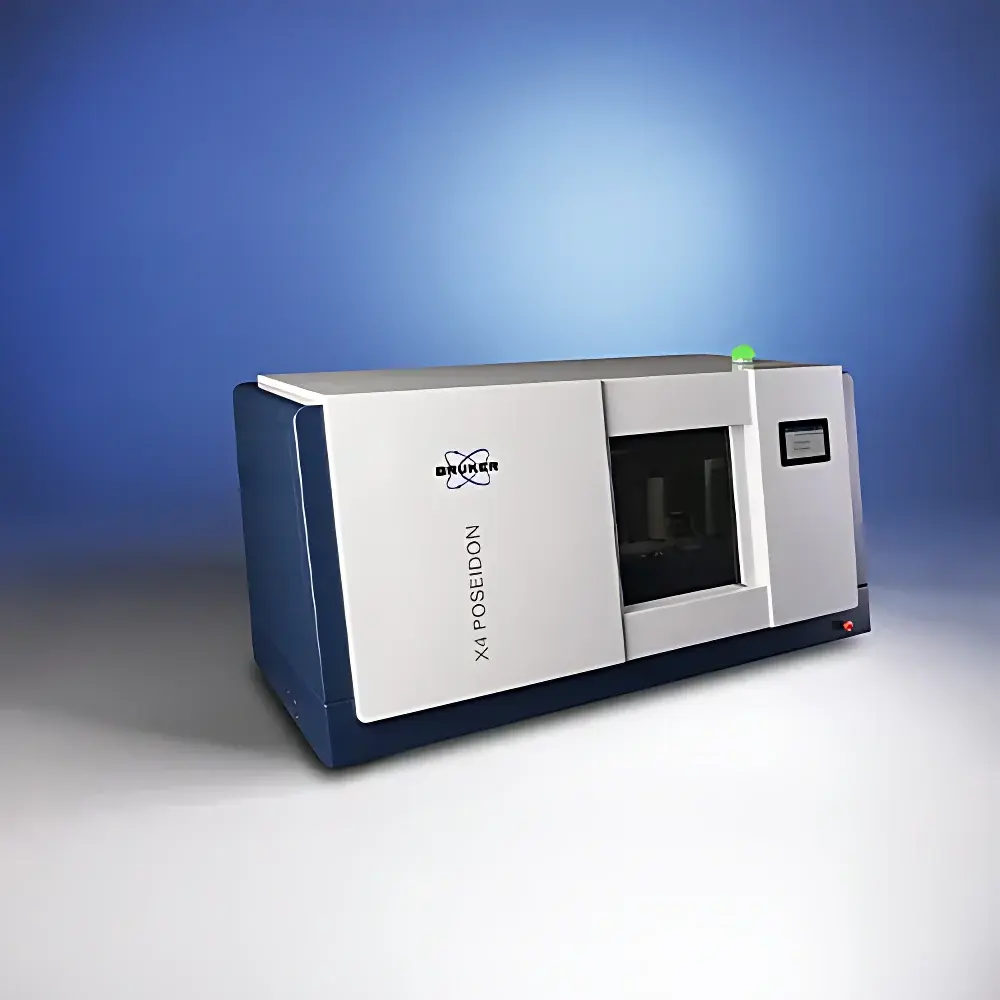
Bruker X4 POSEIDON 3D X-ray Microscope
| Brand | Bruker |
|---|---|
| Origin | Germany |
| Model | X4 POSEIDON |
| Detector Type | High-Resolution Scientific CMOS Sensor |
| Scan Mode | Translation-Rotation (TR) |
| Spatial Resolution | 2 µm |
| Density Resolution | <1% |
| X-ray Energy | 110 kV |
| Maximum Sample Dimensions | Ø110 mm × 300 mm (H) |
| Max Sample Weight | 5 kg |
| System Footprint | 1250 × 960 × 690 mm (L × D × H) |
| Precision Level | Nanoscale |
| Configuration | Modular Benchtop Micro-CT Platform |
Overview
The Bruker X4 POSEIDON 3D X-ray Microscope is a next-generation benchtop micro-computed tomography (micro-CT) system engineered for high-fidelity, non-destructive 3D imaging across materials science, life sciences, geosciences, and industrial quality assurance. Leveraging cone-beam X-ray tomography principles, the X4 POSEIDON reconstructs volumetric datasets from hundreds to thousands of 2D projection images acquired during controlled rotational and translational motion of the sample. Unlike conventional desktop CT systems constrained by fixed geometry or single-detector limitations, the X4 POSEIDON implements a dual-detector architecture—combining a high-dynamic-range flat-panel detector with a scientific-grade CMOS sensor—to decouple resolution, field-of-view (FOV), and acquisition speed. This enables true multi-scale imaging: users can resolve sub-2 µm features in localized regions while maintaining full-sample context at lower magnifications—all within a single scan session or via seamless workflow integration.
Key Features
- Modular Dual-Detector Architecture: Supports simultaneous or interchangeable use of a large-area flat-panel detector (optimized for speed and FOV) and a high-resolution sCMOS detector (optimized for pixel-level detail and contrast-to-noise ratio).
- GEM Plus™ Geometric Enhancement Mode: Dynamically adjusts source–sample–detector distances during acquisition to optimize geometric magnification, beam utilization, and scanning efficiency without mechanical reconfiguration.
- Translation-Rotation (TR) Scanning: Eliminates cone-beam artifacts inherent in pure rotation schemes; ensures quantitative accuracy and isotropic voxel fidelity across extended sample heights up to 300 mm.
- Nanoscale Precision Engineering: Precision-machined air-bearing rotation stage and motorized linear stages deliver sub-micron positional repeatability and thermal stability over extended acquisitions.
- Benchtop Form Factor with Floor-Standing Capability: Compact footprint (1250 × 960 × 690 mm) fits standard laboratory benches yet supports payloads up to 5 kg and accommodates samples up to Ø110 mm × 300 mm.
- 110 kV Microfocus X-ray Source: High-brightness reflection-target tube with adjustable focal spot size (<5 µm nominal), enabling optimal penetration for low-to-medium Z materials including polymers, composites, bone, and light metals.
Sample Compatibility & Compliance
The X4 POSEIDON accommodates a broad spectrum of sample types—from intact biological specimens (e.g., murine femurs, insect exoskeletons, plant vasculature) to engineered components (additively manufactured metal lattices, battery electrodes, ceramic filters, and electronic assemblies). Its open-stage design permits custom sample holders, environmental cells (heating/cooling stages, humidity chambers), and in situ mechanical testers. All hardware and firmware comply with IEC 61000-6-3 (EMC emissions), IEC 61000-6-2 (immunity), and EU Machinery Directive 2006/42/EC. Data acquisition and reconstruction workflows support audit-ready operation under GLP and GMP environments; metadata embedding (including acquisition parameters, calibration logs, and user annotations) meets ISO/IEC 17025 traceability requirements. Optional NIST-traceable phantoms and calibration protocols facilitate compliance with ASTM E1441 (Standard Guide for Computed Tomography), ISO 15783 (Industrial CT terminology), and USP (for pharmaceutical solid dosage forms).
Software & Data Management
Controlled via Bruker’s proprietary CT Analyzer software suite, the X4 POSEIDON integrates acquisition, reconstruction, segmentation, quantification, and reporting into a unified, scriptable environment. The GUI supports multilingual localization (English, German, French, Japanese, Chinese) and role-based access control. Reconstruction leverages GPU-accelerated filtered back-projection (FBP) and iterative algorithms (SART, SIRT) with ring-artifact suppression and beam-hardening correction. Quantitative analysis modules include pore-network modeling (Pore3D), fiber orientation mapping (FiberFit), grain segmentation (GrainAnalyzer), and dimensional metrology (CT-Metrology) compliant with VDI/VDE 2630 Part 1.2. All raw projections, reconstructed volumes, and analysis reports are stored in vendor-neutral formats (TIFF stacks, DICOM-CT, HDF5) with embedded EXIF-style metadata. Optional 21 CFR Part 11 compliance package provides electronic signatures, audit trails, and secure user authentication for regulated laboratories.
Applications
- Materials Science: Porosity quantification in metal AM parts, crack propagation tracking in thermal barrier coatings, fiber alignment analysis in carbon-fiber composites.
- Life Sciences: Morphometric analysis of trabecular bone architecture, vascular network reconstruction in cleared tissue, developmental staging in zebrafish embryos.
- Electronics & Packaging: Void detection in solder joints, wire-bond integrity assessment, delamination mapping in stacked die packages.
- Geosciences: Pore-throat network characterization in shale cores, fluid saturation dynamics in sandstone under simulated reservoir conditions.
- Pharmaceuticals: Coating thickness uniformity in tablet cores, granule density distribution in direct-compression blends, dissolution pathway visualization.
FAQ
What distinguishes the X4 POSEIDON from prior SKYSCAN models like the 1272 or 1275?
The X4 POSEIDON introduces a dual-detector platform, GEM Plus™ real-time geometric optimization, TR scanning for artifact-free tall-sample imaging, and a fully modular hardware architecture designed for field-upgradable components—including future detector generations and in situ stages.
Can the system perform time-resolved (4D) imaging?
Yes—when paired with programmable environmental or mechanical stages, the X4 POSEIDON supports sequential scanning protocols with sub-minute temporal resolution, enabling dynamic process monitoring such as compression-induced crack formation or hydration-driven swelling.
Is training and application support included?
Bruker provides on-site installation qualification (IQ), operational qualification (OQ), and comprehensive user training covering acquisition, reconstruction, and advanced quantification workflows. Application scientists offer remote and on-site method development assistance for domain-specific challenges.
Does the system require special power or shielding infrastructure?
No—it operates on standard 230 V / 50 Hz single-phase power and meets Class I radiation safety standards. No dedicated vault or lead shielding is required; integrated interlocks and dose monitoring ensure compliance with local regulatory limits for uncontrolled areas.
How is data integrity ensured during long-duration scans?
The system implements automatic checksum verification for every projection frame, real-time disk-write validation, and redundant storage options (RAID-1 or network-attached storage). All reconstruction jobs generate provenance logs with timestamps, parameter sets, and operator IDs.



