
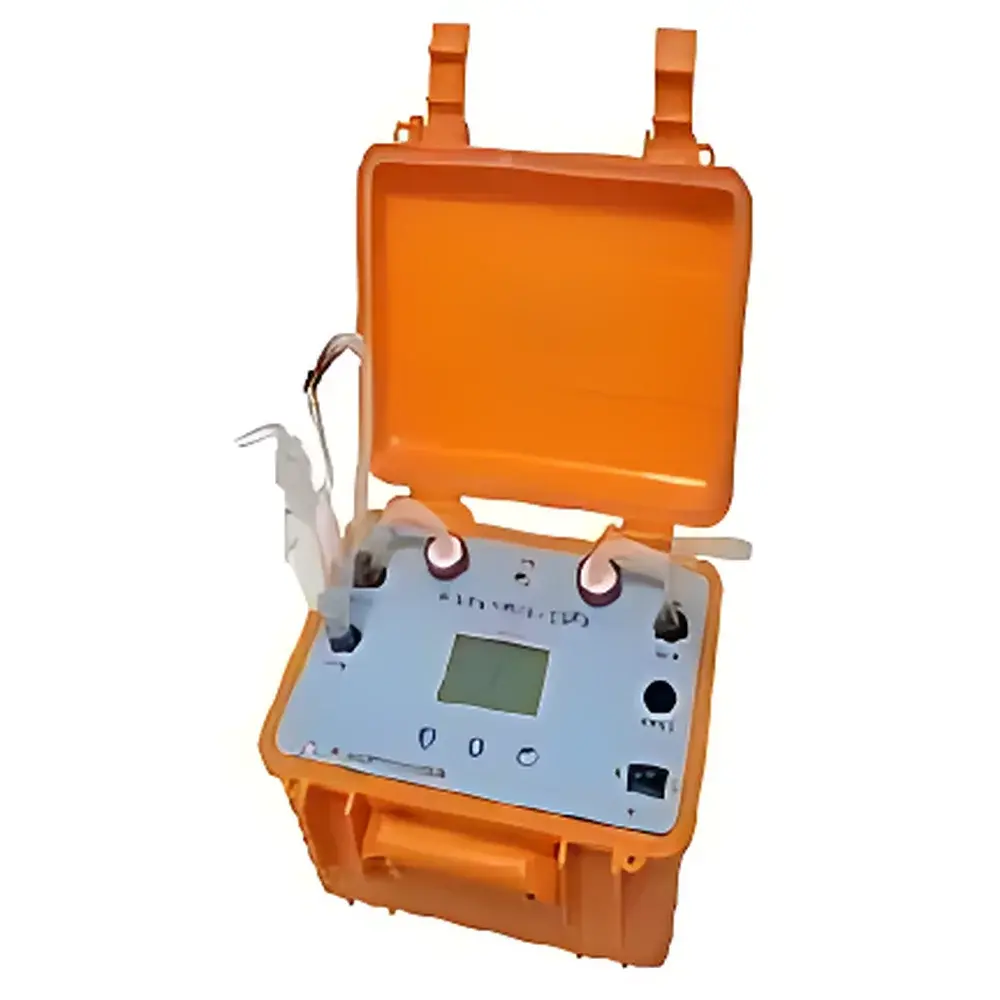
BS-H2 Dual-Channel Constant-Flow Air Sampler
| Origin | Beijing, China |
|---|---|
| Manufacturer Type | Authorized Distributor |
| Origin Category | Domestic (China) |
| Model | BS-H2 |
| Quotation | USD 920 (FOB Beijing) |
| Instrument Type | 24-Hour Temperature- and Flow-Controlled Gas Sampler |
| Instrument Configuration | Dual-Independent Sampling Channels |
| Flow Range | 100–500 sccm |
| Maximum Vacuum Pressure | >26 kPa |
| Flow Stability | ≤±1% FS |
| Flowmeter Accuracy | ±2.5% FS |
| Service Life Under Max Load & Resistance | 5–10 years |
| Continuous Operation Duration at Max Flow & Backpressure | 2–8 h |
Overview
The BS-H2 Dual-Channel Constant-Flow Air Sampler is an engineered solution for regulatory-compliant ambient and indoor air sampling in environmental monitoring laboratories, public health institutions, occupational safety departments, and research facilities. Designed to meet the stringent flow control and volumetric accuracy requirements of GB 50325–2010 (Code for Control of Indoor Environmental Pollution in Civil Building Engineering), this instrument employs a closed-loop electronic mass flow control architecture—based on thermal dispersion sensing and real-time PID feedback—to maintain constant volumetric flow under variable backpressure conditions (e.g., when coupled with Tenax-TA, activated carbon, or silica gel sorbent tubes). Unlike analog float-type samplers, the BS-H2 delivers true standard-state flow (0 °C, 101.3 kPa) directly, eliminating manual temperature/pressure correction and associated calculation errors in final pollutant concentration reporting (e.g., µg/m³ for benzene, formaldehyde, or TVOC).
Key Features
- Dual independent sampling channels with fully programmable, non-volatile time settings—enabling simultaneous or staggered collection of volatile organic compounds (VOCs) and semi-volatile organics (SVOCs) across differing adsorption kinetics.
- High-stability diaphragm vacuum pump rated for continuous operation at ≥26 kPa differential pressure—capable of driving airflow through high-resistance media including packed-bed Tenax GR, Carbopack B, and multi-sorbent tubes per EPA TO-17 and ISO 16017-1 protocols.
- Digital thermal mass flow sensors (±2.5% full-scale accuracy) with real-time LCD display—providing traceable, observer-independent flow readouts in sccm without parallax or calibration drift.
- Automatic standard-condition compensation: all displayed and logged flow values are referenced to 0 °C and 101.3 kPa, ensuring direct compatibility with GC–MS quantitation workflows requiring standardized volume input.
- Hybrid power architecture supporting both AC 220 V/50 Hz mains operation and rechargeable Li-ion battery backup (≥6 h runtime at 300 sccm), certified to IEC 62133 for portable field deployment.
- Robust mechanical design (260 × 200 × 160 mm; 3.65 kg) with IP54-rated enclosure—validated for reliable operation across –5 °C to +45 °C ambient range and relative humidity up to 85% RH non-condensing.
Sample Compatibility & Compliance
The BS-H2 is validated for use with standard 6-mm OD glass or stainless-steel sorbent tubes compliant with ASTM D6196–22 (Standard Practice for Selecting Adsorbents for the Analysis of Volatile Organic Compounds), ISO 16017-1:2022 (Indoor, ambient and workplace air — Sampling and analysis of volatile organic compounds), and Chinese national standard HJ 644–2013 (Environmental air and waste gas—Determination of volatile organic compounds by thermal desorption–gas chromatography–mass spectrometry). Its dual-channel architecture supports parallel sampling for method validation, duplicate analysis, or co-sampling of target analytes with internal standards. All firmware and hardware configurations conform to GLP documentation requirements—including timestamped event logging, operator ID entry, and audit-trail-capable parameter change records.
Software & Data Management
While the BS-H2 operates as a standalone embedded system, its internal memory stores up to 1,000 sampling session logs—including start/stop timestamps, setpoint flow, actual mean flow, total sampled volume (L at STP), battery voltage, and error flags (e.g., over-pressure, low-flow timeout). Data export is supported via USB-C interface using vendor-provided Windows-compatible desktop utility (v3.2+), generating CSV files compatible with LIMS integration (e.g., Thermo Fisher SampleManager, LabWare LIMS). The utility enforces FDA 21 CFR Part 11–compliant user authentication, electronic signatures, and immutable audit trails for regulated environments.
Applications
- Indoor air quality (IAQ) assessment per GB 50325–2010 and JGJ/T 436–2018 (Technical specification for detection of indoor environmental pollutants).
- Workplace exposure monitoring for VOCs (benzene, toluene, xylene, ethylbenzene) in accordance with GBZ/T 160 series occupational health standards.
- Field validation of passive sampler performance against active reference methods.
- Pre-concentration sampling for thermal desorption–GC–MS analysis targeting C2–C12 hydrocarbons, carbonyls, and halogenated organics.
- Long-term ambient air monitoring campaigns where dual-channel redundancy improves data continuity and statistical confidence.
FAQ
Does the BS-H2 require external barometric or temperature sensors for volume correction?
No. The instrument performs real-time conversion to standard temperature and pressure (0 °C, 101.3 kPa) internally using integrated thermistor and pressure transducer inputs—no field measurements or post-processing corrections are needed.
Can the two channels operate at different flow rates simultaneously?
Yes. Each channel features independent digital flow control and timer programming—allowing asymmetric configurations (e.g., 200 sccm for formaldehyde + 400 sccm for BTEX) without cross-interference.
What maintenance intervals are recommended for long-term reliability?
Pump diaphragms and inlet filters should be inspected every 500 operational hours; flow sensor calibration verification is advised annually or after 2,000 sampling cycles, traceable to NIM-certified standards.
Is the device suitable for use with ozone-generating sampling systems?
No. The BS-H2 is not ozone-resistant; prolonged exposure to >50 ppb ozone may degrade internal elastomers and sensor coatings—use only with inert sampling trains.
How is compliance with ISO/IEC 17025 documented for laboratory accreditation?
The instrument’s factory calibration certificate includes uncertainty budgets (k=2), traceability to CNAS-accredited primary standards, and verification of flow stability per ISO 5725–2 repeatability criteria—fully supporting Method Validation Annex A.2 requirements.
Related Products







