
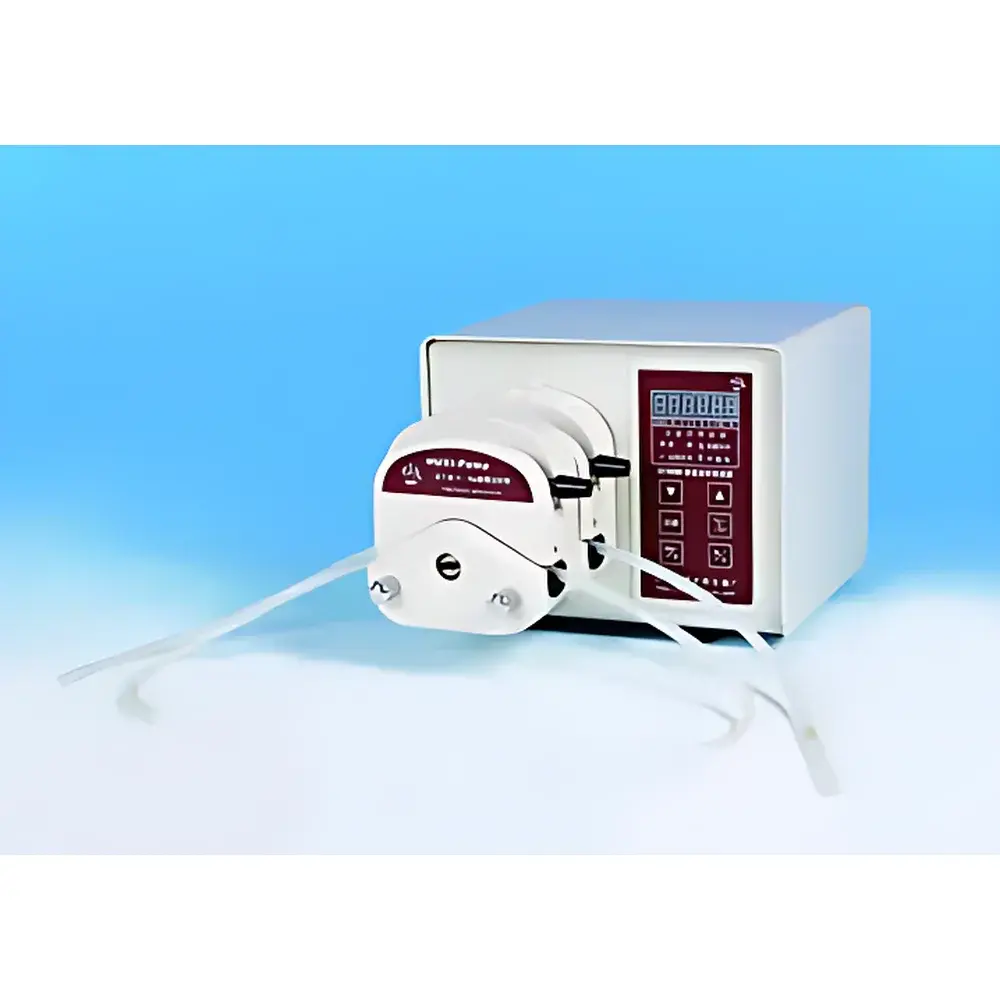
BT100-2 Dual-Channel Digital Constant-Flow Peristaltic Pump
| Origin | Shanghai, China |
|---|---|
| Manufacturer Type | Authorized Distributor |
| Origin Category | Domestic (China) |
| Model | BT100-2 |
| Flow Rate Range | 2 × (0.3–5000) mL/h |
| Max Output Pressure | ≥2.5 kg/cm² |
| Dimensions (W×D×H) | 120×250×120 mm |
| Display | Dual-channel digital RPM/flow rate readout |
| Power Supply | AC 220 V, 50 Hz |
Overview
The BT100-2 Dual-Channel Digital Constant-Flow Peristaltic Pump is a precision-engineered laboratory fluid transfer system designed for accurate, pulse-free, and contamination-free delivery of liquids across independent parallel streams. Operating on the principle of peristalsis—where rollers compress flexible tubing to propel fluid without contact between the pump mechanism and the medium—the BT100-2 eliminates risk of cross-contamination, seals, or valves, making it ideal for sensitive applications in bioprocessing, analytical sample introduction, and reagent dispensing. Its dual-channel architecture enables simultaneous, independently adjustable flow control—critical for gradient elution in chromatography, parallel cell culture media feeding, or comparative dosing studies. The pump’s constant-flow capability is achieved via closed-loop speed regulation, ensuring high reproducibility under variable backpressure conditions up to 2.5 kg/cm² (≈245 kPa), consistent with ISO 8573-1 clean air and low-pressure fluid handling standards.
Key Features
- Dual independent channels with synchronized or asynchronous operation—each equipped with real-time digital RPM and calibrated flow rate display
- Wide adjustable flow range per channel: 0.3–5000 mL/h, supported by interchangeable tubing sizes (ID 0.5–6.4 mm) to match viscosity and pressure requirements
- Brushless DC motor drive ensures low noise (10,000 hours MTBF), and stable torque output across speed ranges
- Front-panel keypad and rotary encoder for intuitive parameter entry; memory function retains last-used settings after power cycle
- Robust aluminum alloy chassis with ESD-safe surface finish, optimized for benchtop integration in GLP-compliant laboratories
- Overload protection circuitry automatically halts operation upon tubing occlusion or motor stall, preserving pump integrity and experimental continuity
Sample Compatibility & Compliance
The BT100-2 accommodates a broad spectrum of chemically compatible tubing materials—including silicone, Tygon®, Viton®, and PharmPure®—enabling safe handling of aqueous buffers, organic solvents, mild acids/bases, and shear-sensitive biological suspensions (e.g., mammalian cells, enzymes, plasmid solutions). Tubing selection directly governs maximum flow rate, pressure tolerance, and chemical resistance per ASTM D2000 and USP Class VI specifications. While the pump itself does not require regulatory certification as a standalone device, its design supports compliance with Good Manufacturing Practice (GMP) Annex 11 data integrity expectations when integrated into validated systems. It meets IEC 61000-6-3 (EMC emission) and IEC 61000-6-2 (immunity) standards for laboratory environments.
Software & Data Management
The BT100-2 operates as a stand-alone instrument with no mandatory software dependency. However, optional RS-485 serial interface (Modbus RTU protocol) enables bidirectional communication with LIMS, SCADA, or custom LabVIEW/Python control platforms for automated scheduling, remote start/stop, and real-time flow logging. When connected, audit trails—including time-stamped setpoint changes, runtime duration, and fault events—can be exported for 21 CFR Part 11–compliant recordkeeping where system-level validation is performed. Firmware updates are delivered via USB-to-serial adapter, supporting version traceability and calibration history retention.
Applications
- Continuous perfusion in bioreactors and hollow-fiber cell culture systems
- Gradient solvent delivery in HPLC and ion chromatography pre-injection modules
- Parallel reagent addition in multi-well plate assays and automated synthesis workstations
- Waste collection and fraction collection in size-exclusion or affinity chromatography
- Controlled infusion in pharmacokinetic simulation rigs and dialysis loop testing
- Environmental monitoring—sequential sampling from multiple water sources into a single analyzer
FAQ
What tubing sizes are recommended for optimal performance at maximum flow rates?
For 5000 mL/h per channel, use tubing with inner diameter 4.8–6.4 mm (e.g., PharMed BPT 0.25″ ID); lower viscosities permit larger IDs, while higher viscosities require smaller IDs with corresponding RPM adjustment.
Can the two channels be operated at different flow rates simultaneously?
Yes—each channel has fully independent speed and direction control; flow rate ratio can be precisely maintained over extended periods with <±1.5% repeatability (per ISO 5725-2).
Is the BT100-2 suitable for sterile applications requiring SIP (steam-in-place)?
No—the pump head and motor assembly are not rated for autoclaving or SIP; however, it supports aseptic operation when paired with pre-sterilized, single-use tubing sets validated per ISO 11135.
Does the pump include flow calibration functionality?
It provides factory-calibrated RPM-to-flow conversion tables for common tubing types; users may perform secondary gravimetric calibration using certified balance and timer per ASTM D3123 guidelines.
What is the expected maintenance interval for roller assemblies and tubing?
Roller bearings are lifetime-lubricated and require no scheduled replacement; tubing lifespan depends on material, speed, and pressure—typically 100–500 hours under continuous 50 rpm operation with silicone tubing.



