
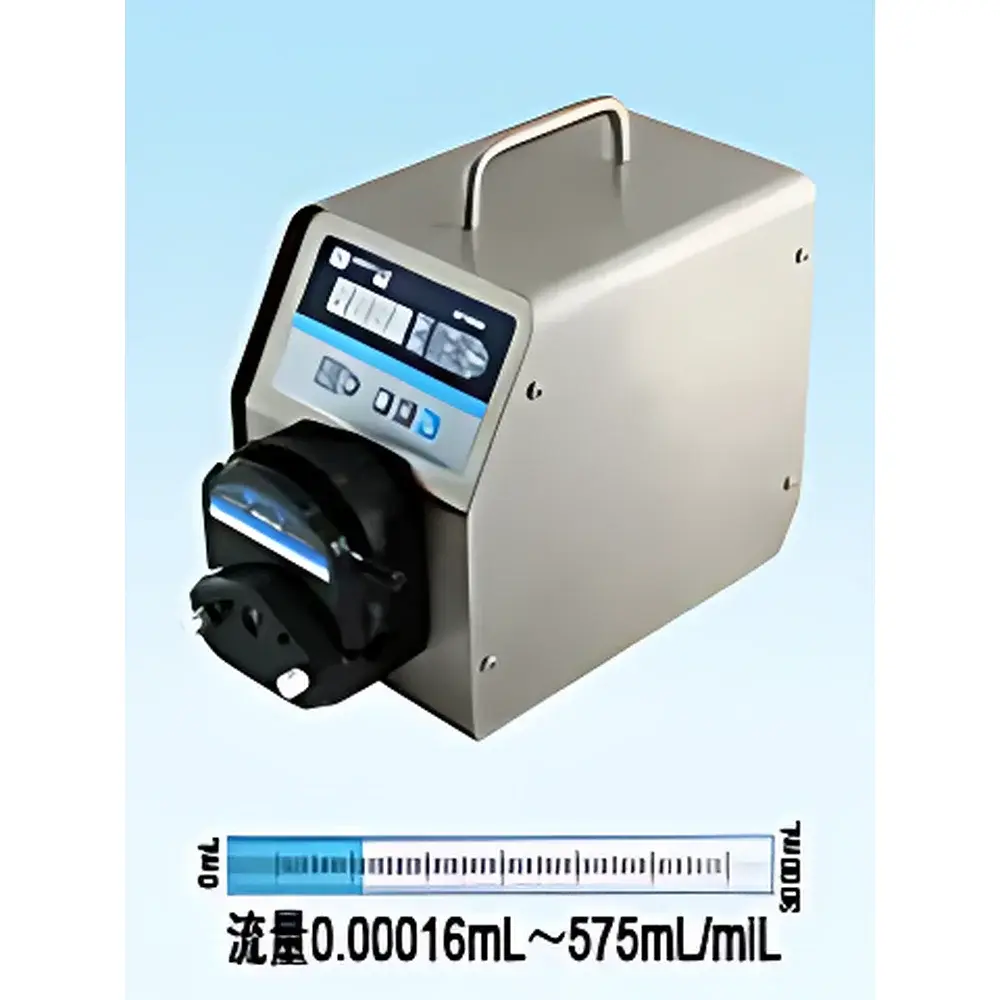
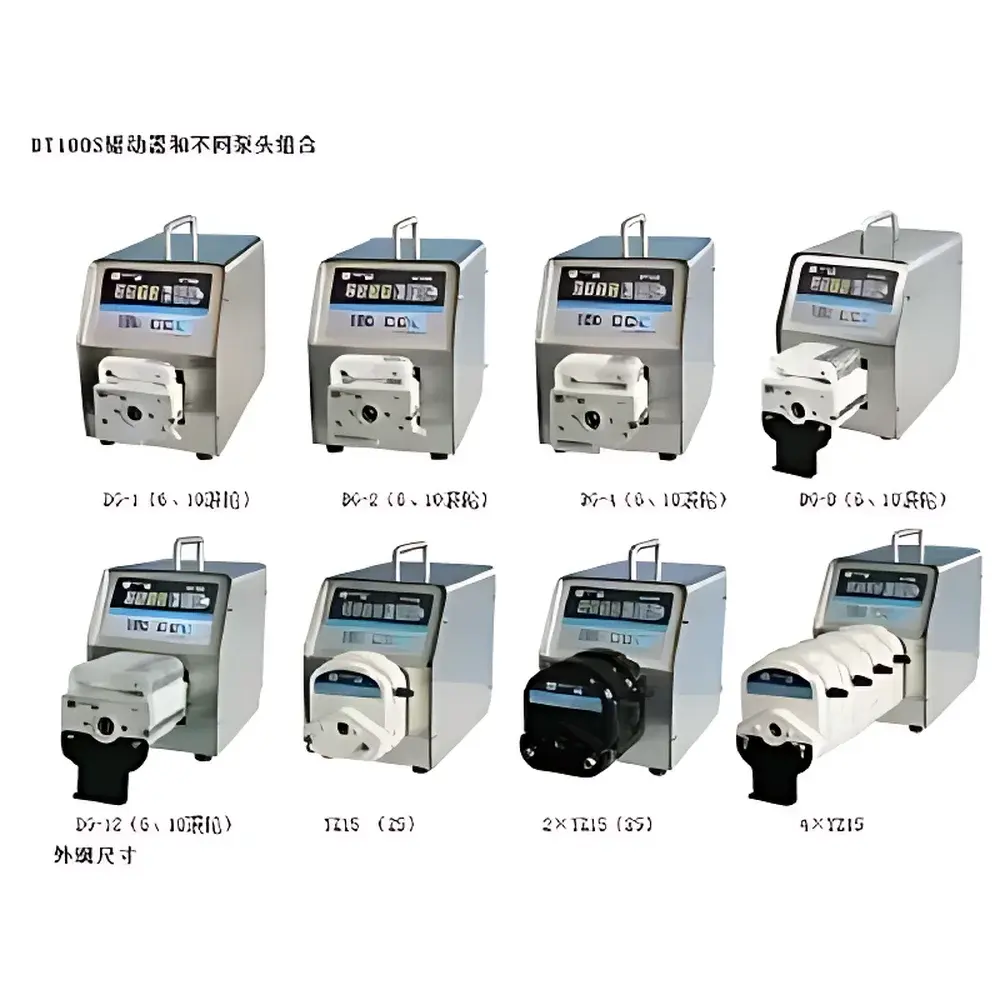
BT100S Precision Variable-Speed Peristaltic Pump with YZ15 and DG-Series Multi-Channel Pump Heads
| [Origin | Shanghai, China |
|---|---|
| Manufacturer Type | Authorized Distributor |
| Origin Category | Domestic (PRC) |
| Model | BT100S |
| Flow Range | 0.00016–570 mL/min |
| Speed Range | 0.1–150 rpm |
| Speed Resolution | 0.1 rpm (0.1–100 rpm), 1 rpm (100–150 rpm) |
| Flow Accuracy | < ±0.5% |
| Power Supply | AC 220 V ±10%, 50/60 Hz (standard) |
| Power Consumption | < 40 W |
| Enclosure Rating | IP31 |
| Dimensions (L×W×H) | 223 × 150 × 195 mm |
| Weight | 4.7 kg |
| Communication Interface | RS485 with MODBUS RTU protocol |
| External Control | TTL/CMOS-compatible digital inputs (5 V / 12 V standard, 24 V optional), analog speed control (0–5 V standard |
| Operating Temperature | 0–40 °C |
| Relative Humidity | < 80% RH (non-condensing) |
| Housing Material | 304 stainless steel |
| Protection | Dual-layer PCB isolation, conformal coating (triple anti-coating), opto-isolated I/O] |
Overview
The BT100S Precision Variable-Speed Peristaltic Pump is an engineered solution for accurate, repeatable, and contamination-free fluid handling in analytical laboratories, bioprocessing workflows, and industrial automation systems. Based on the peristaltic principle—where rollers compress flexible tubing to displace fluid without contacting internal pump components—the BT100S eliminates cross-contamination risks and enables sterile or aggressive chemical transfer. Its modular architecture supports interchangeable pump heads (YZ15, YZ25, and DG-series multi-channel variants), allowing users to configure single- to 12-channel operation while maintaining consistent flow integrity across configurations. Designed for integration into regulated environments, the pump meets essential electromagnetic compatibility (EMC) requirements and incorporates robust electrical isolation, wide-input voltage tolerance, and environmental resilience—making it suitable for use alongside PLCs, SCADA systems, and laboratory information management systems (LIMS).
Key Features
- Four-digit LED display showing real-time speed (rpm) and operational mode (forward/reverse/idle/full-speed)
- Intuitive membrane keypad interface with tactile feedback and status-indicating LEDs (direction, control source, footswitch activation)
- Full functional set: start/stop, forward/reverse rotation, full-speed purge, programmable speed adjustment, and power-loss memory retention
- Dedicated “Simple Dispensing” key enabling timed, volumetric liquid delivery with repeatable cycle execution
- High-resolution speed control: 0.1 rpm resolution up to 100 rpm; 1 rpm above that threshold
- 304 stainless steel enclosure offering resistance to acids, alkalis, and organic solvents
- High-torque motor capable of driving diverse pump head configurations—including DG6/DG10 series (1–12 channels) and YZ15/YZ25 single-channel heads
- Dual-layer circuit board isolation and triple-conformal coating for dust, moisture, and corrosion protection
- Optically isolated external control inputs supporting TTL/CMOS logic levels (5 V / 12 V standard; 24 V optional) and analog speed modulation (0–5 V standard; 0–10 V / 4–20 mA optional)
- RS485 serial interface compliant with MODBUS RTU protocol for bidirectional communication with host controllers, HMIs, or PCs
Sample Compatibility & Compliance
The BT100S accommodates a broad range of elastomeric tubing materials—including silicone, Viton®, Tygon®, and Pharmapure®—with inner diameters up to 3.17 mm and wall thicknesses between 0.8–1.0 mm. This flexibility ensures compatibility with low-viscosity aqueous buffers, viscous cell culture media, organic solvents, and mildly corrosive reagents. While not certified to ISO 13485 or FDA 21 CFR Part 11 out-of-the-box, the pump’s deterministic control architecture, non-volatile parameter storage, and audit-ready digital I/O make it readily adaptable to GLP/GMP-aligned workflows when deployed within validated system-level protocols. Its IP31-rated enclosure satisfies general-purpose indoor laboratory deployment requirements per IEC 60529.
Software & Data Management
Although the BT100S operates as a standalone instrument, its RS485/MODBUS interface allows seamless integration into supervisory control ecosystems. Users can implement custom scripts (Python, LabVIEW, MATLAB) or commercial SCADA platforms to log speed profiles, trigger dispensing cycles, monitor operational status, and synchronize with upstream/downstream process events. The MODBUS register map supports read/write access to setpoints, direction flags, run state, and fault codes—enabling traceability and remote diagnostics. For manual operation, the built-in timer-based dispensing function records elapsed time and number of cycles, supporting basic batch documentation without external software.
Applications
- Automated reagent dispensing in clinical chemistry analyzers and ELISA wash stations
- Continuous feed of nutrient media or harvest streams in benchtop bioreactors and perfusion systems
- Controlled eluent delivery in preparative chromatography and inline filtration setups
- Calibration standard delivery in environmental water testing and wastewater monitoring systems
- Multi-stream fluid routing in microfluidic platform development and assay prototyping
- Time-synchronized sample injection in automated titration and dissolution testing rigs
FAQ
What pump heads are compatible with the BT100S driver?
The BT100S supports YZ15, YZ25, and all DG-series pump heads (DG6-1 through DG10-12), enabling 1–12 channel configurations depending on head selection.
Does the pump retain settings after power loss?
Yes—the BT100S features non-volatile memory that preserves speed setting, direction, and operational mode upon restart.
Can the BT100S be controlled via a PLC?
Yes—via opto-isolated digital I/O signals or RS485 using MODBUS RTU, allowing full integration with industrial programmable logic controllers.
What is the minimum achievable flow rate with standard tubing?
Using 13# silicone tubing (ID = 0.76 mm) at 0.1 rpm with the YZ15 head, the theoretical minimum flow is approximately 0.0006 mL/min—verified under laminar, non-pulsatile conditions.
Is analog speed control supported natively?
Yes—the standard configuration includes 0–5 V analog input for continuous speed modulation; 0–10 V and 4–20 mA options are available upon request.



