
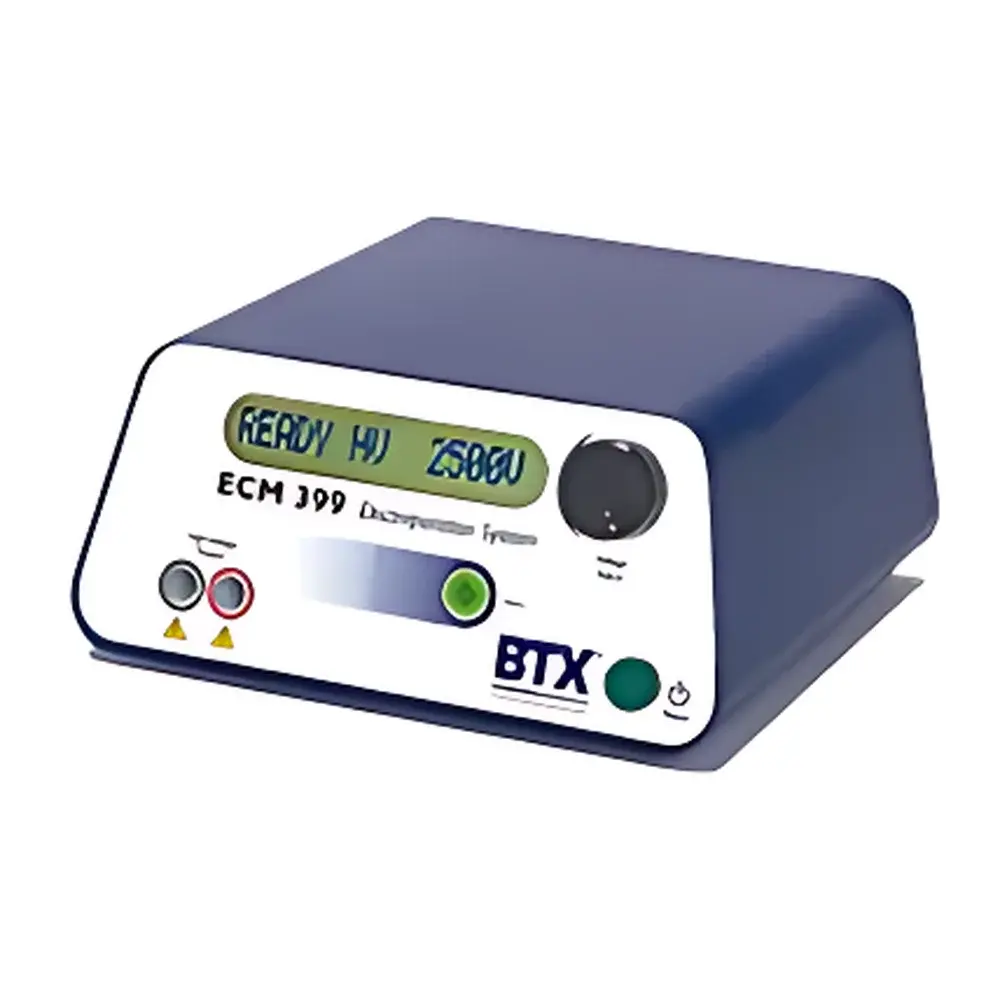
BTX ECM 399 Exponential Decay Wave Electroporation System
| Origin | USA |
|---|---|
| Manufacturer Type | Authorized Distributor |
| Origin Category | Imported |
| Model | ECM 399 |
| Price Range | USD $13,500 – $40,500 (FOB) |
| Product Type | Electroporation System for Cell Transfection and Transformation |
Overview
The BTX ECM 399 Exponential Decay Wave Electroporation System is an engineered benchtop platform designed for reproducible, parameter-controlled electroporation of diverse cell types—from prokaryotes to suspension and adherent mammalian cells. Operating on the principle of exponential decay waveform delivery, the system applies a time-varying voltage pulse across a conductive sample chamber, inducing transient membrane permeabilization via controlled dielectric breakdown. Unlike square-wave systems, the exponential decay architecture delivers rapid initial field strength followed by a natural logarithmic decay profile—optimized for minimizing thermal stress while maintaining high transfection efficiency in sensitive primary and immortalized lines. The ECM 399 is widely deployed in academic core facilities, biopharma process development labs, and molecular biology workflows requiring reliable nucleic acid or protein delivery without viral vectors.
Key Features
- Two distinct operational modes: High-Voltage (HV) mode (10–2500 V, 10 V increments; 151 Ω resistance; 36 µF capacitance) for bacterial and yeast transformation; Low-Voltage (LV) mode (2–500 V, 2 V increments; 151 Ω resistance; 1050 µF capacitance) for delicate mammalian cells.
- Compact footprint (10.9 × 23.1 × 19.6 cm) and lightweight design (3.2 kg), enabling integration into biosafety cabinets, laminar flow hoods, or shared instrumentation benches.
- Modular electrode compatibility—including PEP (Pulse Electrode Platform) holders, safety trays, two-pin array electrodes, 35 mm culture dish electrodes, microscope slide electrodes, and sandwich-type flat-cell cuvettes—supporting both bulk and low-volume (< 10 µL) electroporation protocols.
- Calibrated pulse timing and energy delivery ensure inter-experiment repeatability; no internal battery or firmware-based pulse shaping—waveform fidelity is maintained through passive RC circuitry.
- No software dependency for basic operation: front-panel controls provide direct access to voltage, mode selection, and manual triggering—ideal for GLP-compliant environments where audit-trail simplicity is prioritized.
Sample Compatibility & Compliance
The ECM 399 supports standard electroporation protocols validated under ISO/IEC 17025-accredited laboratory conditions. Its HV mode is routinely applied to Escherichia coli DH5α, TOP10, and BL21(DE3) strains, as well as Saccharomyces cerevisiae for cDNA library construction and mutagenesis screening per ASTM E2524-21 guidelines. LV mode has demonstrated consistent transfection efficiency (>60% GFP+ yield) in human peripheral blood mononuclear cells (PBMCs), murine myeloma NS0, rat C6 glioma, mouse NIH/3T3 fibroblasts, and monkey Cos-7 cells—protocols aligned with USP <71> sterility considerations and ICH S6(R1) nonclinical safety requirements. All electrode interfaces comply with IEC 61010-1:2012 for electrical safety in laboratory equipment.
Software & Data Management
While the ECM 399 operates independently of proprietary software, its analog pulse architecture ensures full traceability in regulated environments. Voltage settings, mode selection, and manual trigger events are manually recorded per batch log—fully compatible with electronic lab notebook (ELN) integration and 21 CFR Part 11-compliant documentation systems when paired with timestamped operator entries. No embedded memory or network interface is present, eliminating cybersecurity concerns and simplifying IQ/OQ validation. For laboratories requiring digital protocol archiving, BTX provides optional CSV-formatted calibration certificates and application notes compliant with GMP Annex 11 data integrity expectations.
Applications
- Bacterial and yeast transformation: High-efficiency plasmid uptake in cloning, library generation, and CRISPR-Cas9 vector delivery—particularly effective for large constructs (>10 kb) where square-wave systems show reduced viability.
- Mammalian cell transfection: Non-viral delivery of siRNA, mRNA, CRISPR RNP complexes, and expression plasmids into hard-to-transfect primary and suspension lines without serum removal or post-pulse recovery media changes.
- Vaccine development: Electroporation of dendritic cells and T cells in preclinical immunotherapy studies—leveraging LV-mode’s low thermal load to preserve antigen-presenting function.
- Stem cell engineering: Transient gene editing in iPSC-derived lineages, where pulse consistency directly impacts clonal expansion success rates and off-target assessment reliability.
FAQ
Is the ECM 399 suitable for Good Manufacturing Practice (GMP) environments?
Yes—the absence of firmware, network connectivity, or automated data logging enables straightforward qualification (IQ/OQ/PQ) and aligns with FDA guidance on legacy instrument validation.
Can the system be calibrated in-house?
Voltage output is verified using NIST-traceable high-voltage probes; BTX provides annual calibration service documentation and reference test procedures per ISO/IEC 17025.
What electrode configurations support single-cell or micro-volume applications?
The microscope slide electrode and PEP-compatible mini-cuvettes enable electroporation volumes from 5–50 µL with minimal cross-contamination risk.
Does the ECM 399 meet international electrical safety standards?
Yes—it carries CE marking per IEC 61010-1:2012 and complies with UL 61010-1 for North American laboratory use.
Are application protocols available for specific cell lines?
BTX maintains a publicly accessible repository of peer-reviewed, citable protocols—including optimized settings for HEK293T, Jurkat, RAW264.7, and primary human keratinocytes—available upon registration at btxonline.com/resources.




