
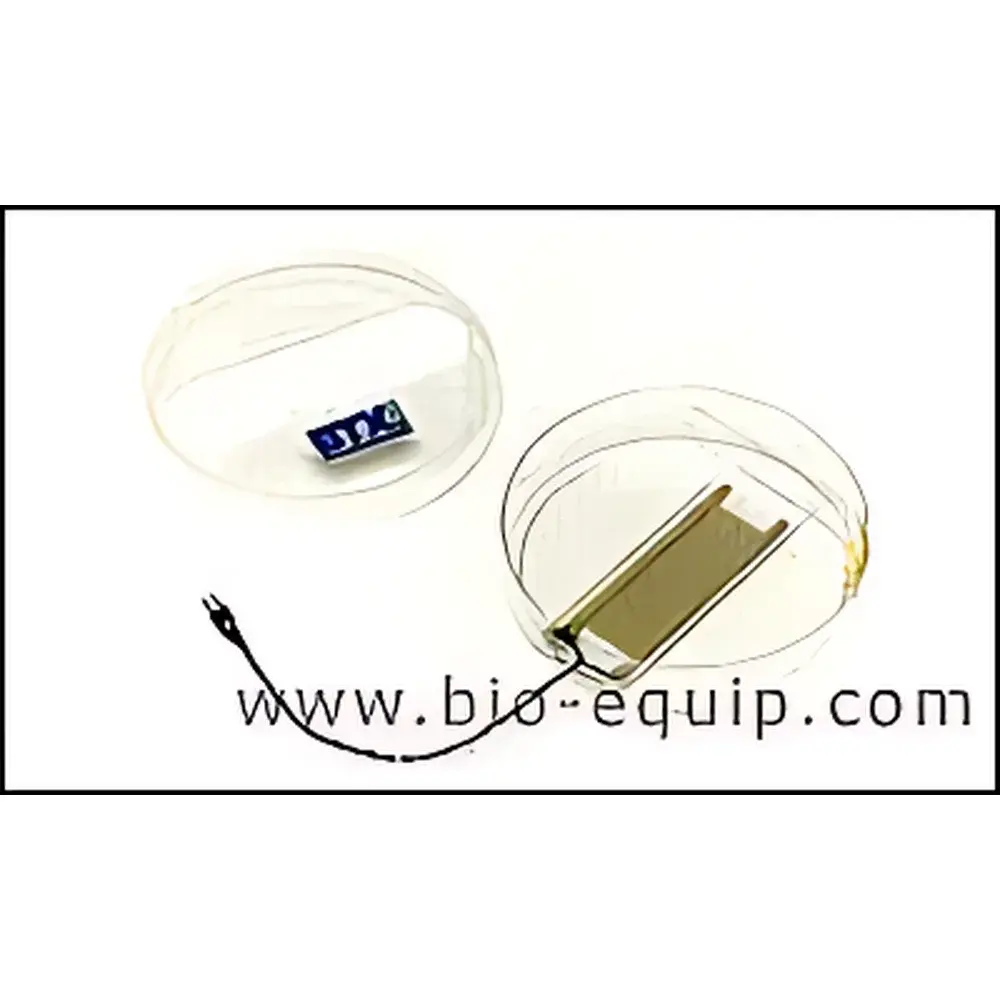
BTX Model 454 Meander Fusion Chamber
| Origin | USA |
|---|---|
| Manufacturer Type | Authorized Distributor |
| Origin Category | Imported |
| Model | 454 |
| Pricing | Available Upon Request |
Overview
The BTX Model 454 Meander Fusion Chamber is a precision-engineered microelectrofusion device designed for controlled, high-efficiency electrofusion of diverse eukaryotic and prokaryotic cell types. It operates on the principle of dielectrophoretic alignment followed by localized electroporation—leveraging an inhomogeneous electric field generated across a geometrically optimized electrode array. Unlike conventional parallel-plate or capillary-based fusion chambers, the Meander design features a conductive metal alloy (silver) deposited in interdigitated finger-like projections onto a standard microscope-grade glass slide. This architecture establishes a defined 0.2 mm gap between opposing electrode arrays, enabling direct optical observation of cell alignment, dimer formation, and membrane destabilization in real time under transmitted-light or phase-contrast microscopy. The chamber is not a standalone instrument but a consumable component engineered for integration with BTX’s family of programmable pulse generators (e.g., ECM® 630, 830, 2001), supporting precise control over voltage amplitude (0–480 Vdc), pulse duration (1 µs–99 ms), pulse count (1–99), and frequency (up to 1 MHz). Its operational envelope—5–40 °C ambient temperature, 20–80% relative humidity, and up to 2000 m altitude—is aligned with standard laboratory environmental conditions per IEC 61010-1 (Pollution Degree II, Overvoltage Category CAT I).
Key Features
- Precision-fabricated silver electrode array with 0.2 mm inter-electrode gap for reproducible field gradient generation
- Optically transparent glass substrate enabling real-time microscopic monitoring of cell pairing and fusion progression
- Scalable geometry compatible with standard 25 × 75 mm microscope slides for seamless integration into existing imaging workflows
- Robust mechanical stability during high-voltage pulsing, minimizing arcing and electrode degradation
- Designed for compatibility with BTX ECM® series pulse generators without signal attenuation or impedance mismatch
- Compliant with ISO 13485–aligned manufacturing controls for consistent batch-to-batch performance
Sample Compatibility & Compliance
The Model 454 chamber supports electrofusion across a broad phylogenetic spectrum: mammalian hybridoma and primary cells (e.g., murine B lymphocytes, human T cells), plant protoplasts (e.g., Nicotiana tabacum, Arabidopsis thaliana), fungal and yeast cells (e.g., Saccharomyces cerevisiae, Aspergillus niger), and select bacterial strains under optimized osmotic and ionic conditions. Fusion efficiency is highly dependent on buffer conductivity, cell density, and pulse parameter selection—protocols must be empirically validated per cell type and application. The device itself carries no CE marking or FDA 510(k) clearance as it is classified as a research-use-only (RUO) laboratory accessory. However, its use in GLP-compliant antibody development workflows (e.g., quadroma generation for bispecific IgG production) has been documented in peer-reviewed literature (Cao et al., J. Immunol. Methods, 1995) and aligns with USP <797> and ISO/IEC 17025 documentation expectations when paired with validated generator systems.
Software & Data Management
As a passive hardware component, the Meander Fusion Chamber does not incorporate embedded firmware or onboard data logging. All experimental parameters—including voltage, pulse width, number of pulses, and waveform shape—are configured and recorded externally via the connected BTX pulse generator’s user interface or optional PC-based control software (e.g., BTX Genepulser Xcell™ or Enhancer 400 system). When used with the Enhancer 400 (Model 4001), full audit trails—including operator ID, timestamp, protocol version, and parameter settings—are generated in accordance with FDA 21 CFR Part 11 requirements for electronic records and signatures. Raw image data from fusion events are captured independently using standard microscope camera systems and archived in vendor-neutral formats (TIFF, DICOM-SR) for downstream analysis.
Applications
- Generation of hybridomas and quadromas for monoclonal and bispecific antibody discovery
- Protoplast fusion in plant biotechnology for somatic hybridization and trait introgression
- Yeast and fungal strain engineering via cytoplasmic or nuclear content exchange
- Development of artificial cell hybrids for synthetic biology chassis construction
- Functional studies of membrane protein dynamics during electroporation-induced lipid rearrangement
- High-throughput screening of fusogenic agents and adjuvant compounds
FAQ
Is the Model 454 Meander Fusion Chamber sterilizable?
No—this is a single-use, non-sterile device intended for aseptic handling in laminar flow hoods. Autoclaving or chemical sterilization will damage the silver electrode array and compromise electrical performance.
Can it be used with non-BTX pulse generators?
While physically compatible with any generator offering BNC or coaxial output and matching voltage/pulse specifications, BTX does not validate or support third-party generator integration. Impedance mismatches may cause waveform distortion or inconsistent fusion yields.
What buffer formulations are recommended?
Low-conductivity buffers are essential; common choices include mannitol-based (0.4 M) or sucrose-based (0.6 M) solutions supplemented with 1–5 mM CaCl₂. Exact composition must be optimized per cell type to balance membrane destabilization and post-fusion viability.
How many fusions can be performed per chamber?
Each Model 454 chamber (sold in packs of 4) is intended for one experimental run. Reuse is not recommended due to irreversible electrode polarization and residual cellular debris accumulation.
Does BTX provide application support for protocol development?
Yes—BTX Technical Support offers protocol consultation, optimization guidance, and access to application notes covering >15 cell types, including troubleshooting for low dimer yield or excessive cell lysis.



