
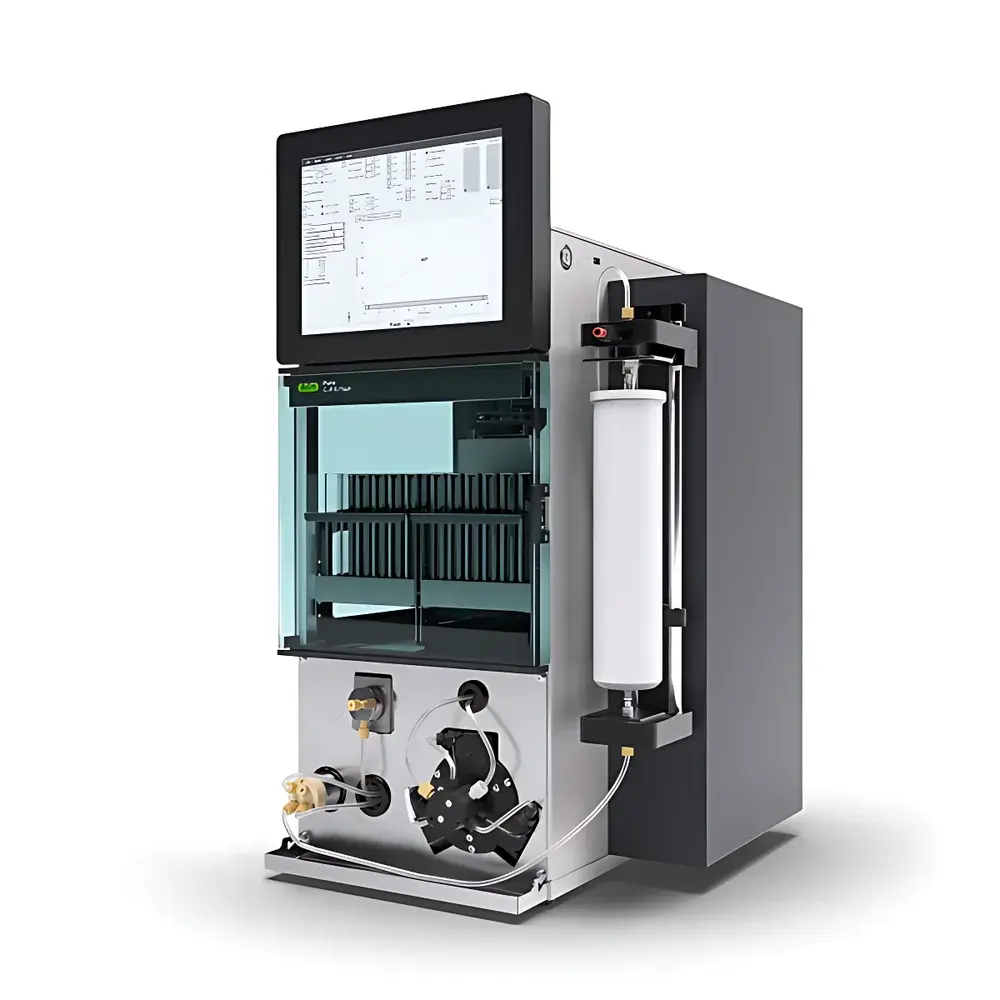
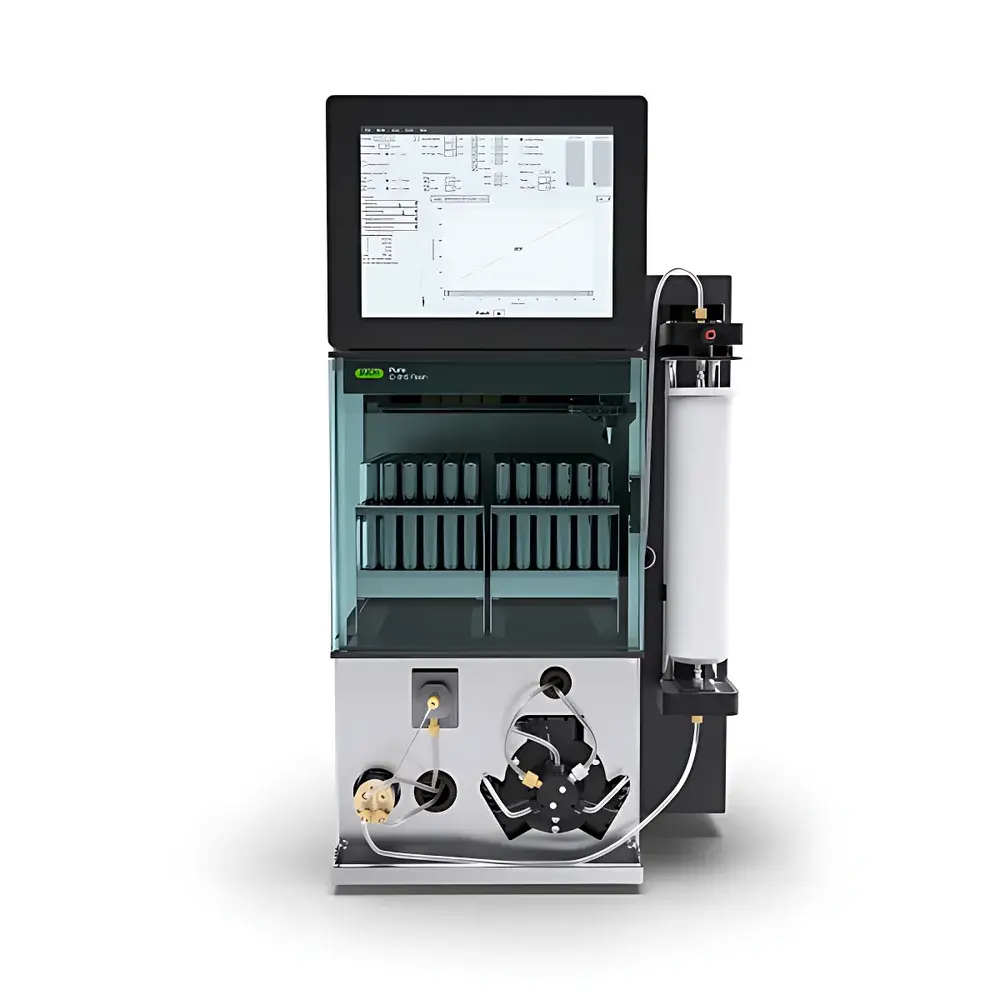
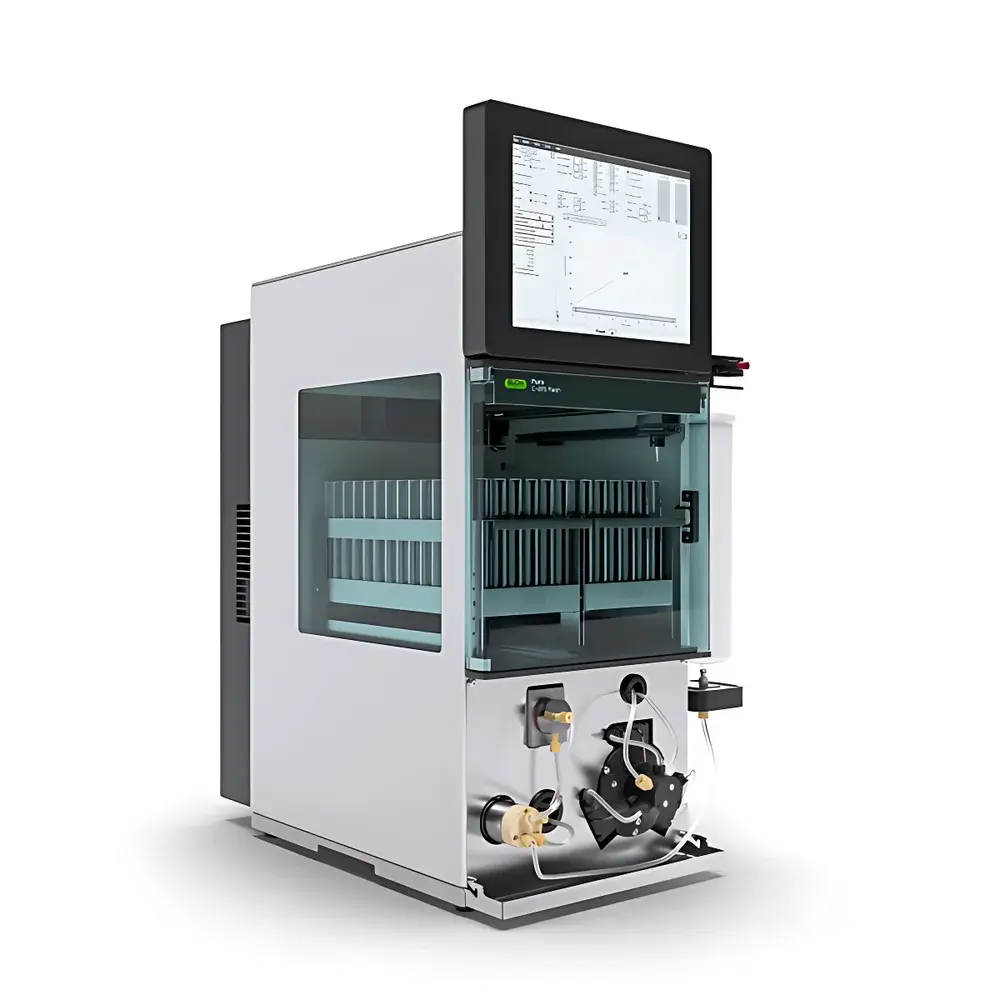
BUCHI Pure C-815/C-810 Low-Pressure Preparative Liquid Chromatography System
| Brand | BUCHI |
|---|---|
| Origin | Switzerland |
| Manufacturer | BUCHI AG |
| Product Type | Imported Instrument |
| Model | Pure C-815 / Pure C-810 |
| Application Level | Laboratory Grade |
| Instrument Category | Low-to-Medium Pressure Preparative LC |
| Flow Rate Range | 1–250 mL/min |
| Flow Accuracy | ±3% RSD |
| Flow Precision | ±0.5% RSD |
| Maximum Operating Pressure | 50 bar |
| Wavelength Accuracy | ±1 nm |
| Wavelength Repeatability | 0.4 nm |
| Baseline Noise | 5 × 10⁻⁵ AU |
| Data Acquisition Rate | 5 Hz |
Overview
The BUCHI Pure C-815 and Pure C-810 are low-pressure preparative liquid chromatography (PLC) systems engineered for robust, scalable, and operator-safe purification workflows in research and early-stage process development laboratories. Based on classical column chromatography principles—employing gravity- or pump-driven solvent elution through packed silica or reversed-phase media—the Pure series delivers reproducible fractionation of organic, pharmaceutical, natural product, and synthetic compounds across milligram-to-kilogram sample loads. Unlike high-performance liquid chromatography (HPLC) platforms, these systems operate at ≤50 bar (725 psi), enabling compatibility with cost-effective, large-bore glass or reinforced polymer columns—including BUCHI’s proprietary FlashPure and GlasPure cartridge formats—while maintaining stringent control over flow dynamics, UV/ELSD detection, and fraction collection integrity.
Key Features
- Modular dual-platform architecture: Pure C-810 (entry-level) and Pure C-815 (enhanced detection & automation) share identical fluidic design, column handling, and safety logic—ensuring method transferability and lab-wide protocol consistency.
- Integrated multi-channel detection: Simultaneous acquisition from up to six signals—UV absorbance (single or diode-array), evaporative light scattering (ELSD), and optional analog inputs—enables real-time compound tracking without post-run re-analysis.
- Intelligent ELSD operation: Fully automated gas flow and temperature optimization; fixed split-flow of 30 µL/min ensures stable nebulization across the full 1–250 mL/min mobile phase range.
- Remote operation and monitoring: Web-enabled controller supports method editing, run supervision, and alarm acknowledgment via secure LAN or local Wi-Fi—eliminating direct proximity requirements during hazardous solvent handling.
- Hermetic fraction collection: Sealed rotor-based collector prevents volatile solvent evaporation and atmospheric contamination; integrated liquid-level and vapor sensors trigger automatic shutdown upon waste reservoir overflow or leak detection.
- RFID-enabled hardware recognition: Automatic identification of fraction trays and pre-packed columns (FlashPure/GlasPure) enforces configuration validation—preventing mismatched pressure ratings, incompatible solvents, or incorrect collection geometry.
Sample Compatibility & Compliance
The Pure C-810/C-815 accommodates a broad spectrum of analytes—from non-polar hydrocarbons and alkaloids to polar glycosides and ionizable APIs—across both normal-phase (e.g., hexane/EtOAc gradients) and reversed-phase (e.g., water/acetonitrile) modes. Column orientation is user-selectable (top-down or bottom-up flow), minimizing bubble entrapment in viscous or degassed mobile phases. All wetted components comply with USP Class VI biocompatibility standards; system architecture supports audit-trail generation per FDA 21 CFR Part 11 when paired with BUCHI’s optional LabX Pure software module. Method documentation aligns with ICH Q5A and ASTM D7916 for preparative chromatographic purity assessment.
Software & Data Management
Control and data acquisition are managed via BUCHI’s intuitive touch-screen interface running embedded Linux OS. Raw detector signals, pump parameters, and collection events are timestamped and stored in vendor-neutral .csv and .mzML-compatible formats. Optional LabX Pure software provides centralized instrument management, electronic lab notebook (ELN) integration, and GLP-compliant reporting—including calibration history, user access logs, and electronic signatures. All chromatograms support baseline correction, peak integration (tangent skim, valley-to-valley), and retention time alignment across batches—critical for impurity profiling and stability-indicating methods.
Applications
- Purification of reaction mixtures in medicinal chemistry synthesis (e.g., removal of Pd catalysts, protecting group byproducts).
- Isolation of bioactive constituents from plant extracts under GMP-aligned conditions (ISO 17025 traceability supported).
- Scale-up of chiral separations using polysaccharide-based FlashPure columns prior to SMB evaluation.
- Recovery of thermally labile peptides following solid-phase synthesis—leveraging low-pressure operation to minimize shear degradation.
- Preparative cleanup of environmental samples (e.g., PAHs, PCBs) prior to GC-MS quantification.
FAQ
What is the maximum column internal diameter compatible with the Pure C-815?
Standard configurations support columns up to 110 mm ID; custom manifolds enable expansion to 150 mm ID for kilogram-scale runs.
Can the system be validated for regulated environments?
Yes—when configured with LabX Pure, IQ/OQ protocols, and 21 CFR Part 11 add-ons, it meets GMP/GLP validation requirements for QC labs.
Is gradient elution supported?
Binary gradient mixing is available as an optional upgrade (C-815 only); isocratic operation is standard on both models.
How does the RFID column recognition prevent operational errors?
Each FlashPure/GlasPure cartridge contains an embedded tag storing max pressure rating, recommended flow range, and solvent compatibility—cross-checked against active method parameters before pump start.
What maintenance intervals are recommended for the ELSD detector?
Nebulizer capillaries require cleaning every 200 hours of operation; drift tube inspection is advised quarterly—both procedures documented in the included service manual.




