
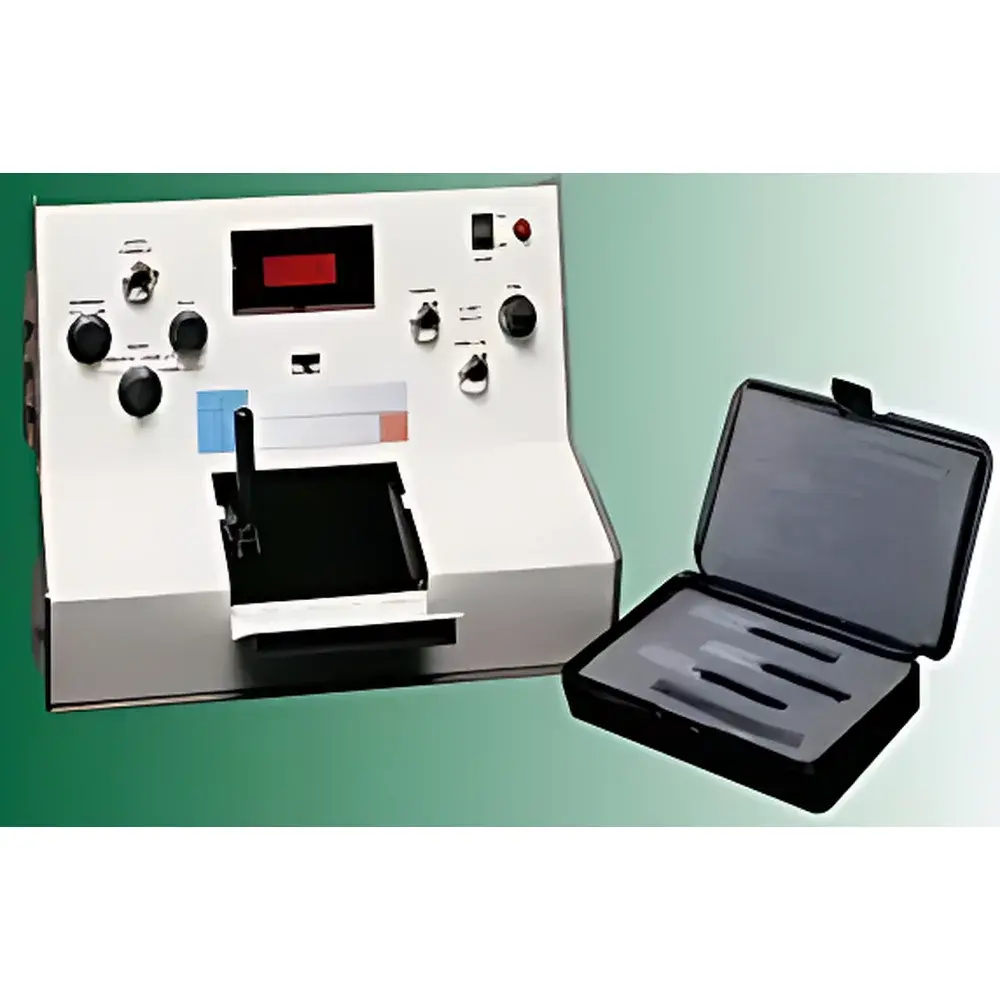
BUCK HC-404 Infrared Oil-in-Water Analyzer
| Brand | BUCK |
|---|---|
| Origin | USA |
| Model | HC-404 |
| Instrument Type | Laboratory Analyzer |
| Principle | Infrared Spectrophotometry (Fixed-Wavelength at 2924 cm⁻¹) |
| Measurement Range | Transmittance 0–100%, Absorbance 0–2.0, Bandwidth 30 cm⁻¹ (0.04 µm) |
| Detection Limit | < 0.2 mg/L |
| Accuracy | ±1% |
| Resolution | 1 ppm |
| Measurement Frequency | 6 measurements/min |
| Signal-to-Noise Ratio | > 2500:1 |
| Drift | 0.01 Abs/hr |
| Response Time | 10 s (Damping 1), 40 s (Damping 2) |
| Dimensions (W×D×H) | 36 × 28 × 26 cm |
| Weight | 10 kg |
Overview
The BUCK HC-404 Infrared Oil-in-Water Analyzer is a dedicated laboratory instrument engineered for precise quantification of total petroleum hydrocarbons (TPH) in aqueous, soil, and sludge matrices using fixed-wavelength infrared spectrophotometry. Operating at the analytically critical C–H stretching absorption band centered at 2924 cm⁻¹ (3.42 µm), the HC-404 eliminates spectral scanning complexity while delivering high reproducibility and robust baseline stability. Its optical architecture is optimized for EPA-compliant methodologies—including Methods 418.1, 413.2, and the updated Method 1664—making it a validated solution for regulatory environmental testing laboratories operating under US EPA, ISO 9001, and GLP frameworks. The system employs a thermoelectrically cooled PbSe detector, ensuring low thermal noise and long-term signal integrity essential for trace-level hydrocarbon detection down to sub-0.2 mg/L.
Key Features
- Fixed-wavelength IR detection at 2924 cm⁻¹ (3.42 µm), eliminating calibration drift associated with moving grating or filter wheel systems
- Dual-mode digital display showing transmittance (%T), absorbance (Abs), and direct concentration output in ppm (mg/L)
- Universal cuvette compatibility: accommodates standard quartz cells of 10 mm, 50 mm, and 100 mm pathlengths to support both low-concentration screening and high-range linear extension
- Three-step linear range extension protocol enables accurate quantification across orders of magnitude—from 1 ppm to >500 ppm—without hardware modification
- Thermoelectrically stabilized PbSe detector delivers signal-to-noise ratio >2500:1 and instrumental drift <0.01 Abs/hr, meeting ASTM D7066–22 requirements for hydrocarbon analyzer stability
- Intuitive front-panel interface with real-time response; ready for measurement within 15 minutes of power-on, no warm-up stabilization required
Sample Compatibility & Compliance
The HC-404 supports extraction-based sample preparation per EPA-approved protocols. It accepts Freon-113, carbon tetrachloride, or n-hexane extracts following acidification and phase separation steps. The instrument is validated for use with EPA Methods 418.1 (Freon extraction), 413.2 (CCl₄ extraction), and 1664 (n-hexane extraction), all of which are referenced in 40 CFR Part 136 for wastewater discharge compliance. Its fixed-band design ensures consistent adherence to the 2924 cm⁻¹ absorption peak specified in these methods, minimizing inter-laboratory variability. The system meets ISO/IEC 17025:2017 criteria for measurement uncertainty estimation and is compatible with GLP audit trails when integrated with external LIMS via analog recorder output (optional).
Software & Data Management
While the HC-404 operates as a standalone benchtop analyzer with embedded firmware, its analog output (0–10 V or 4–20 mA) allows seamless integration into existing laboratory data acquisition systems. Users may log absorbance values, time stamps, and operator IDs externally for full traceability. For laboratories requiring electronic records compliant with FDA 21 CFR Part 11, the HC-404 can be paired with validated third-party software platforms that provide audit trail generation, user access control, and electronic signature capability. All calibration data—including zero, span, and linearity verification points—is retained in non-volatile memory and accessible via front-panel navigation.
Applications
- Environmental monitoring: TPH analysis in surface water, groundwater, leachate, and sediment pore water per EPA and state regulatory programs
- UST (underground storage tank) site assessment: rapid screening of soil and groundwater samples during Phase II investigations
- Industrial wastewater compliance: continuous verification of effluent oil content prior to discharge under NPDES permits
- Oil & gas operations: evaluation of produced water treatment efficiency and tank cleaning validation
- Automotive service facilities: monitoring washwater and stormwater runoff from maintenance bays and repair shops
- Maritime applications: analysis of bilge water and ballast water per IMO MEPC.107(49) and USCG requirements
FAQ
Does the HC-404 require annual recalibration by the manufacturer?
No—routine calibration is performed in-house using certified mineral oil standards traceable to NIST SRM 2781. Annual verification by an accredited metrology lab is recommended but not mandatory unless required by internal QA policy or regulatory authority.
Can the HC-404 measure emulsified oil or dissolved hydrocarbons?
The HC-404 quantifies extractable petroleum hydrocarbons only. Emulsified or dissolved fractions require prior solvent extraction (e.g., hexane) per EPA 1664; the instrument does not detect non-extractable or biodegraded compounds.
Is the PbSe detector field-replaceable?
Yes—the detector module is designed as a plug-in assembly with factory alignment pre-set; replacement can be completed by trained personnel in under 30 minutes without optical realignment tools.
What is the expected lifetime of the infrared source?
The silicon carbide globar source has a typical operational life exceeding 5,000 hours under standard laboratory conditions, with output stability monitored via internal reference channel.
Does the HC-404 support multi-point calibration curves?
It supports up to three-point linear calibration (zero, mid, high) with automatic slope/intercept calculation; non-linear curve fitting requires external software integration via analog output.







