
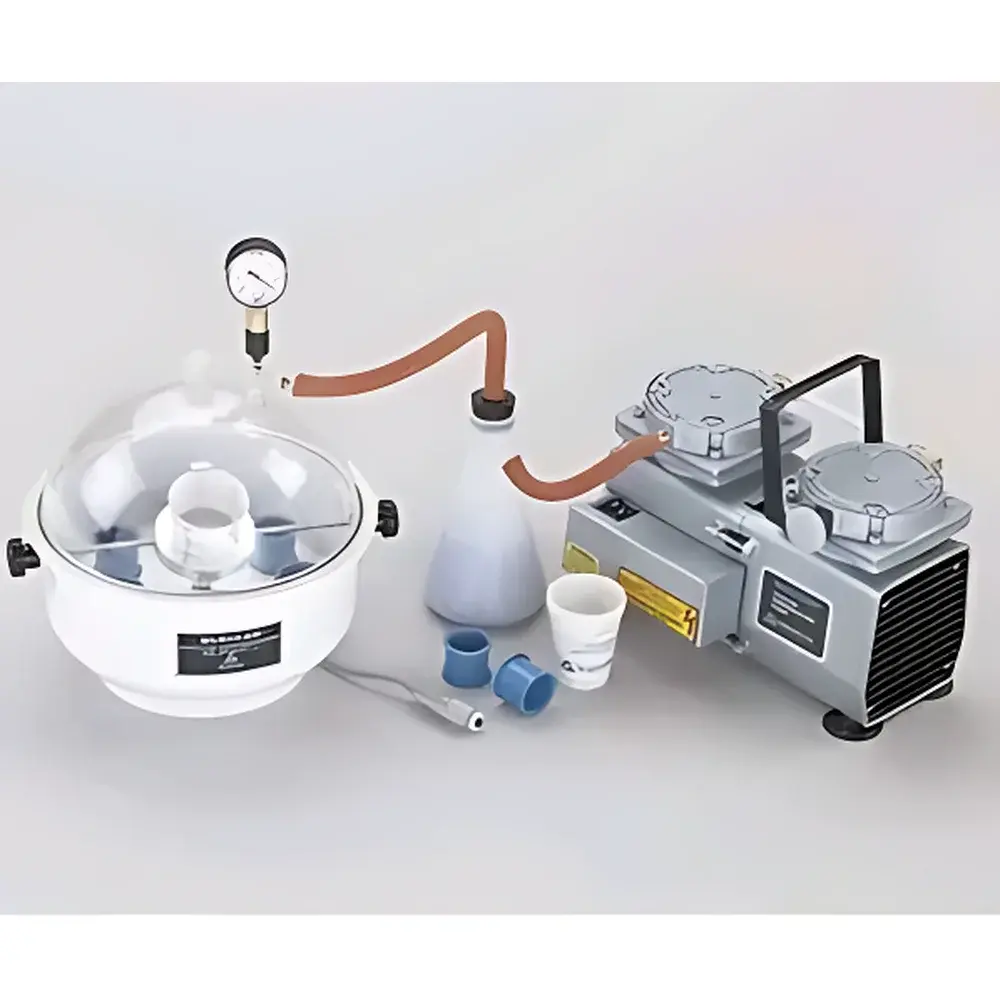
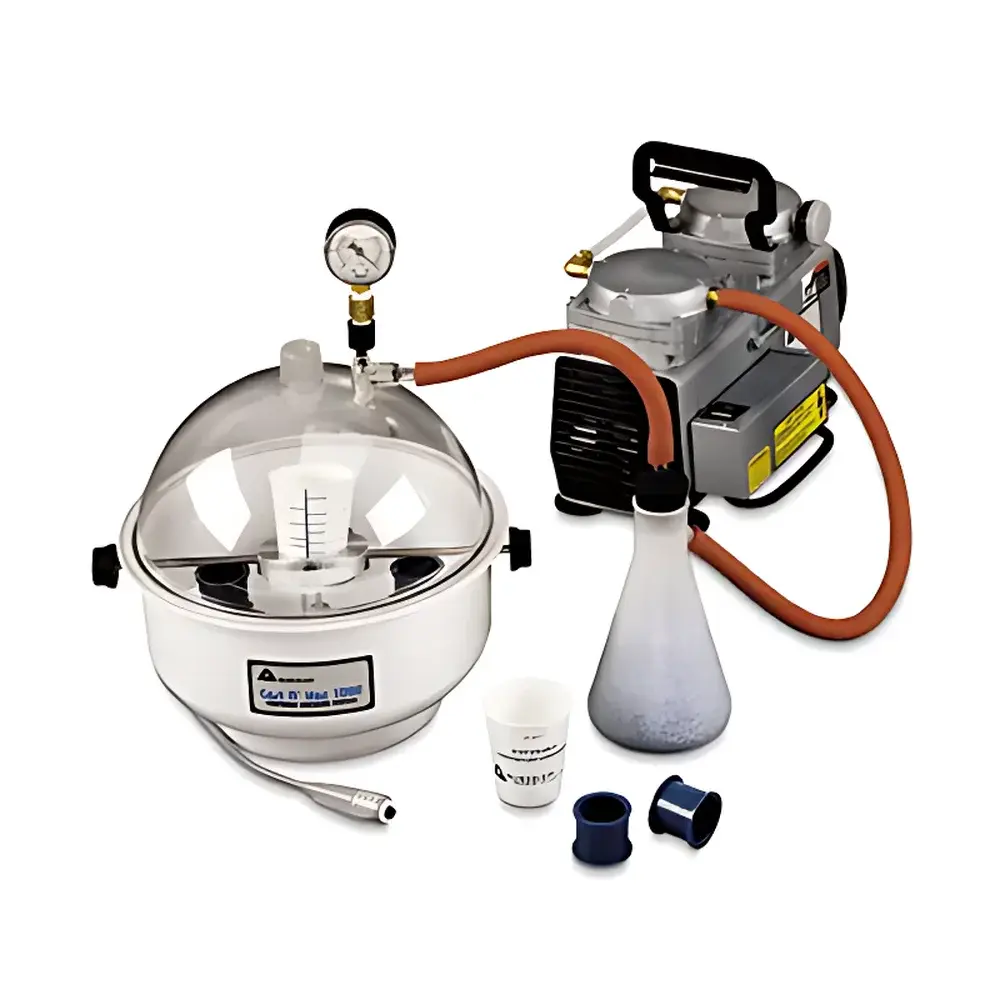
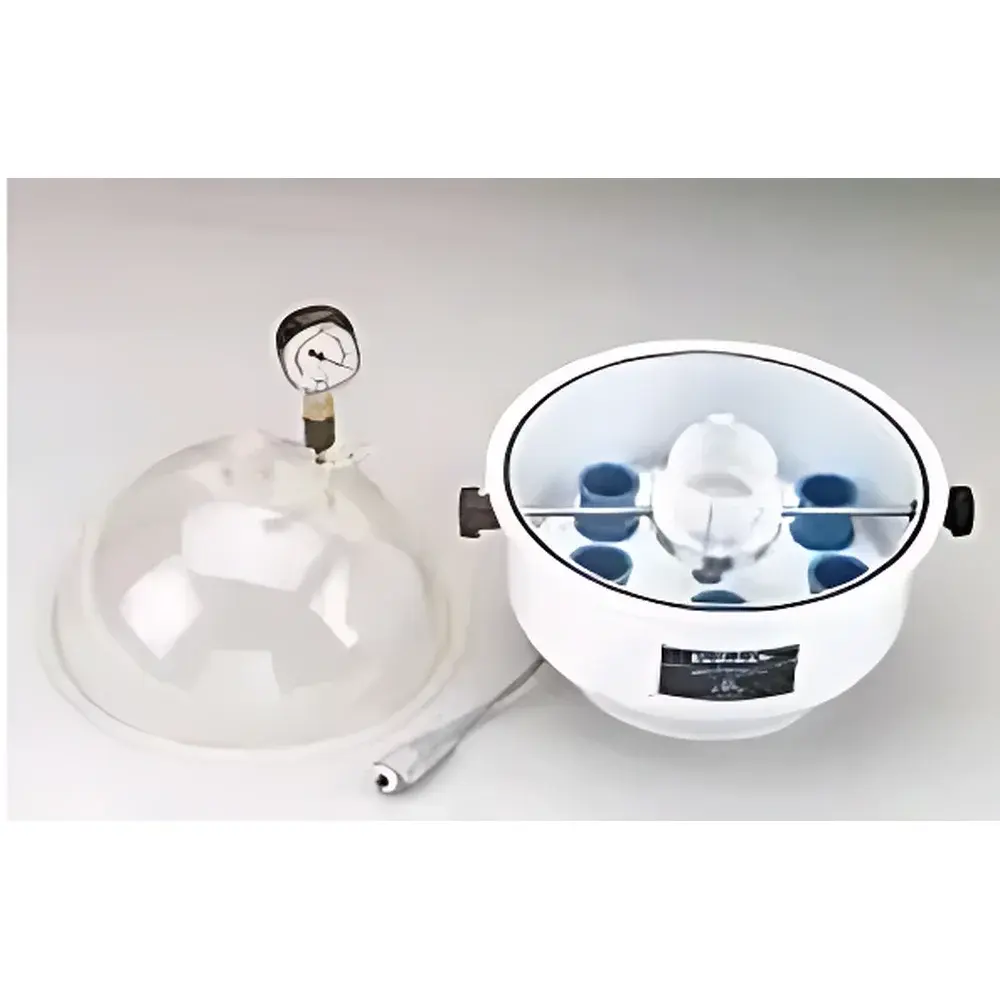
Buehler Cast N’ Vac 1000 Vacuum Mounting Press
| Brand | Buehler |
|---|---|
| Origin | USA |
| Model | Cast N’ Vac 1000 |
| Type | Cold Mounting Press |
| Vacuum Level | 26" Hg (559 Torr) |
| Sample Capacity | >10 specimens per cycle |
| Mounting Material Compatibility | Epoxy and polyester cold-mount resins |
| Rotating Platform | Yes |
| Chamber Sealing | O-ring sealed polycarbonate chamber |
| Included Components | Vacuum pump, rotating chamber base, vacuum gauge, pouring cup, measuring cup, desiccant, fittings |
| Compliance | Designed for ASTM E3, ISO 14577, and GLP-compliant sample preparation workflows |
Overview
The Buehler Cast N’ Vac 1000 Vacuum Mounting Press is an engineered solution for high-fidelity cold mounting of metallurgical, geological, electronic, and composite specimens. It operates on the principle of vacuum-assisted impregnation: by evacuating air from both the specimen’s porosity and the mounting cavity, ambient-pressure resin flow is replaced by capillary-driven infiltration under negative pressure. This eliminates voids at the specimen–resin interface—critical for edge retention during subsequent grinding, polishing, and microstructural analysis. Unlike hot-press systems, the Cast N’ Vac 1000 uses no heat or pressure, preserving thermal-sensitive phases, coatings, soft polymers, and brittle ceramics. Its robust vacuum architecture achieves a stable 26″ Hg (559 Torr), sufficient to evacuate deeply interconnected pores in sintered metals, porous ceramics, additively manufactured parts, and fractured rock sections.
Key Features
- Vacuum chamber constructed from high-impact, chemically resistant polycarbonate with precision-machined O-ring sealing surface—ensures leak-tight operation over thousands of cycles
- Motor-driven rotating platform enabling simultaneous vacuum impregnation of >10 specimens per batch without manual repositioning
- Integrated tilt-pour mechanism: pre-mixed resin is held in a dedicated pouring cup; actuation delivers controlled, drip-free transfer into molds under continuous vacuum
- Dual-scale analog vacuum gauge (inches Hg and Torr) with damping fluid for stable reading during dynamic evacuation
- Interchangeable chamber liners protect the rotating base from resin overspill and simplify cleaning between resin chemistries (e.g., switching between low-viscosity epoxy and thixotropic polyester)
- Modular vacuum pump assembly—oil-lubricated, two-stage diaphragm design—rated for continuous duty and compatible with standard lab exhaust ducting
- No external power required for mold loading/unloading; all mechanical functions are manually actuated with tactile feedback and position locking
Sample Compatibility & Compliance
The Cast N’ Vac 1000 accommodates specimens ranging from 1 mm diameter microelectronic die to 50 mm diameter geological cores. It is routinely deployed in accredited laboratories adhering to ASTM E3 (Standard Guide for Preparation of Metallographic Specimens), ISO 14577 (Metallic materials — Instrumented indentation test), and USP (Plastic Packaging Systems). The absence of thermal input ensures compliance with IPC-TM-650 2.1.1 (Test Methods for Printed Boards) for encapsulated PCB cross-sections. All wetted components meet FDA CFR Title 21 Part 177 requirements for indirect food contact when using certified resins. Full audit trails—including vacuum hold time, cycle count, and operator ID—can be logged via optional RS-232 or USB interface when integrated with LIMS or ELN platforms supporting 21 CFR Part 11 electronic signatures.
Software & Data Management
While the Cast N’ Vac 1000 is a hardware-centric instrument with no embedded microprocessor, it supports digital workflow integration through its standardized vacuum gauge output (0–5 V analog) and discrete I/O ports for vacuum status and cycle completion signals. When paired with Buehler’s optional AutoLog™ interface module, users can record vacuum decay profiles, dwell times, and batch metadata directly into Excel, LabArchives, or LabVantage. All configuration parameters—including recommended vacuum hold duration (typically 60–180 s depending on specimen density), resin viscosity thresholds (<500 cP optimal), and post-pour atmospheric equalization timing—are documented in the included GLP-aligned SOP template compliant with ISO/IEC 17025 clause 7.2.2.
Applications
- Metallurgy: Void-free mounting of powder metallurgy compacts, cast aluminum alloys with shrinkage porosity, and nickel-based superalloys with interdendritic cracking
- Electronics: Encapsulation of solder joints, wire bonds, and flex circuits without delamination or thermal warping
- Geosciences: Stabilization of friable shale, coal, and weathered basalt prior to thin-section preparation
- Additive Manufacturing: Securing lattice structures and support-removed Ti-6Al-4V builds for serial sectioning and XCT correlation
- Faithful replication of fracture surfaces in composites—enabling accurate SEM-EDS line scans across crack fronts without resin pull-out
FAQ
What vacuum level is required for optimal infiltration of highly porous stainless steel filters?
A minimum of 25″ Hg (533 Torr) is recommended; the Cast N’ Vac 1000 consistently achieves 26″ Hg (559 Torr), verified by NIST-traceable gauge calibration.
Can polyester resins be used interchangeably with epoxy resins in this system?
Yes—both chemistries are supported. However, polyester requires shorter vacuum dwell times (60–90 s) due to faster gelation; epoxy benefits from extended holds (120–180 s) for deep pore penetration.
Is the rotating platform compatible with custom fixture plates?
Yes—the platform features M6 threaded holes on 75 mm BCD pattern, allowing secure attachment of user-designed specimen holders or multi-cavity molds.
How often does the vacuum pump oil require replacement?
Under normal use (≤10 cycles/day), oil change interval is 500 operating hours; a sight glass and oil level indicator are provided on the pump housing.
Does the system include validation documentation for GMP environments?
Factory-installed IQ/OQ protocols are available as optional add-ons, including vacuum decay test reports, dimensional verification of chamber tolerances, and material certifications for all wetted surfaces.
Related Products



