
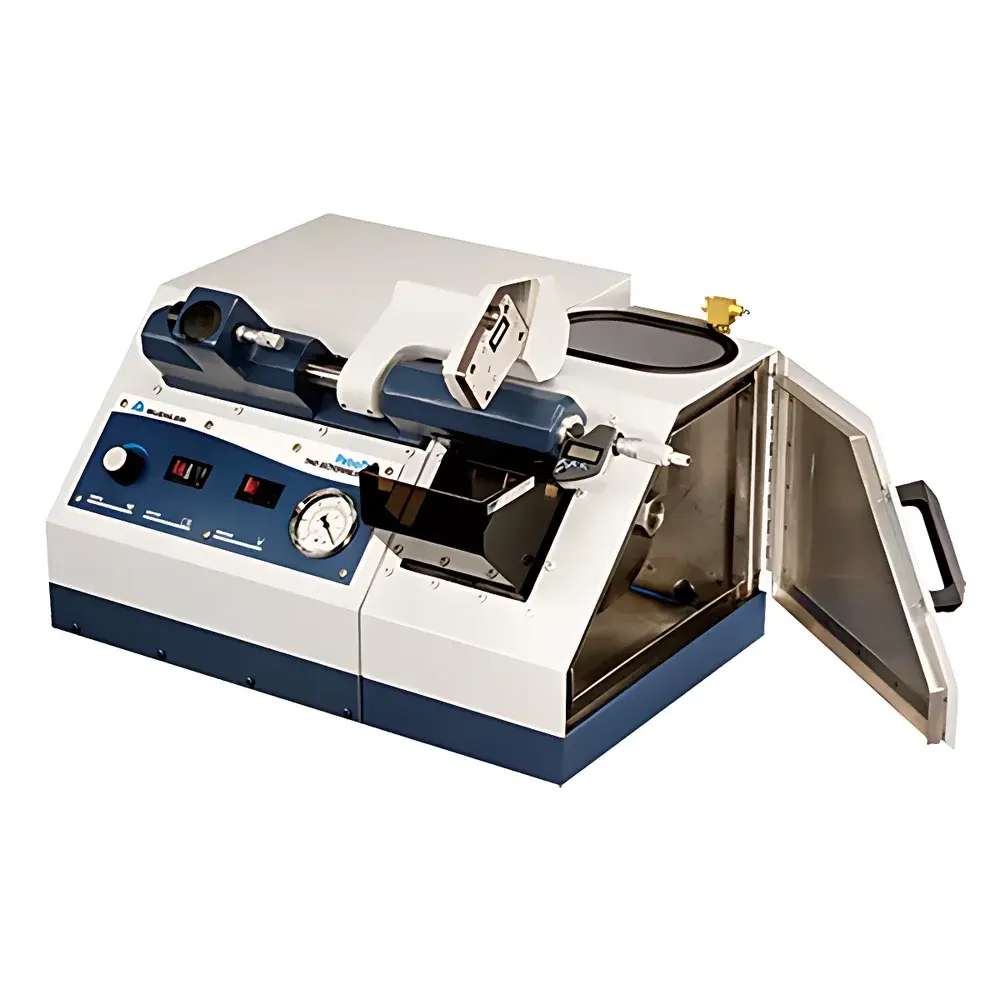
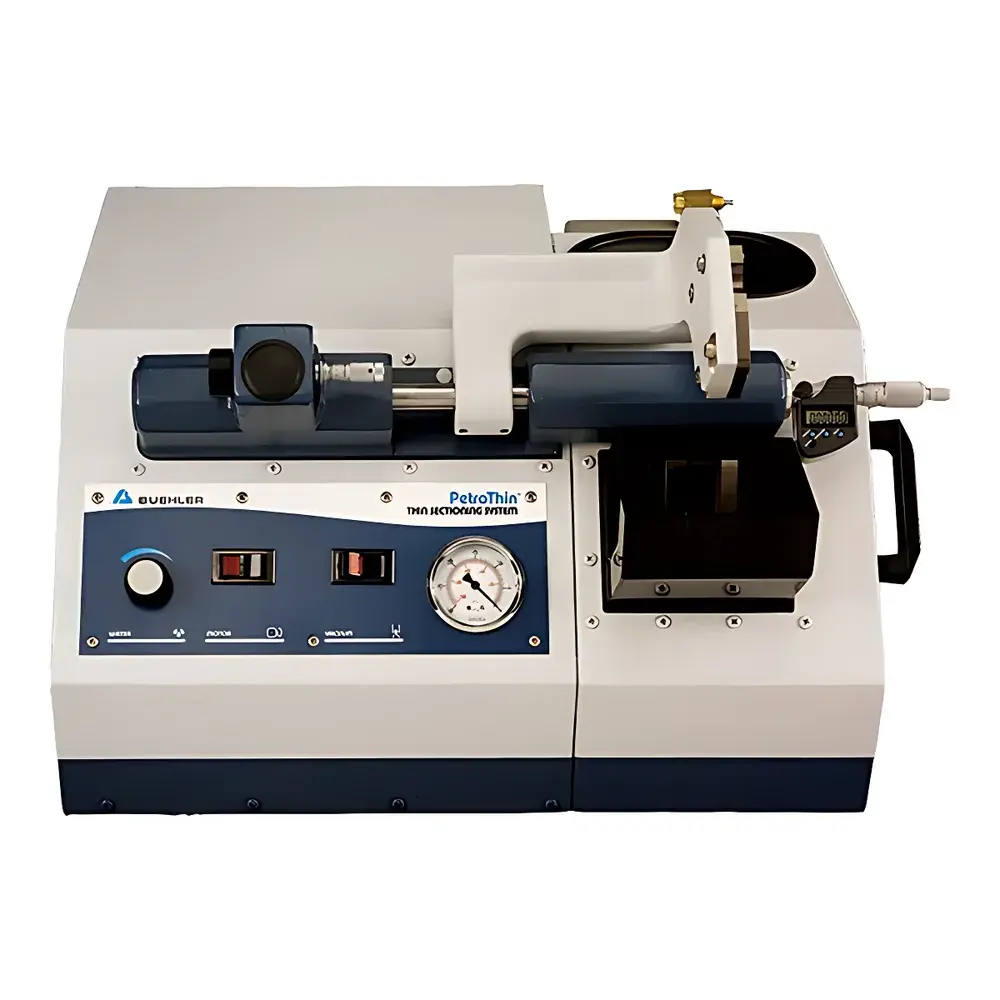
Buehler PetroThin™ Thin Sectioning System
| Brand | Buehler |
|---|---|
| Origin | USA |
| Manufacturer Type | Authorized Distributor |
| Origin Category | Imported |
| Model | PetroThin™ Thin Sectioning System |
| Instrument Type | Precision Cutting Machine |
| Motor Power | 1/3 HP (250 W) |
| Blade Diameter | 8 in (203 mm) |
| Cutting Speed | 220 rpm (38-1450-220 model) / 2100 rpm (38-1450-250 model) |
| Positioning Accuracy | ±5 µm |
| Voltage/Frequency | 115 VAC @ 60 Hz or 220 VAC @ 50 Hz, Single Phase |
| Compliance | CE Marked |
| Vacuum Fixture Capacity | Up to six standard microscope slides (various sizes) |
| Included Fixture | 10-3533 Rock Holder |
Overview
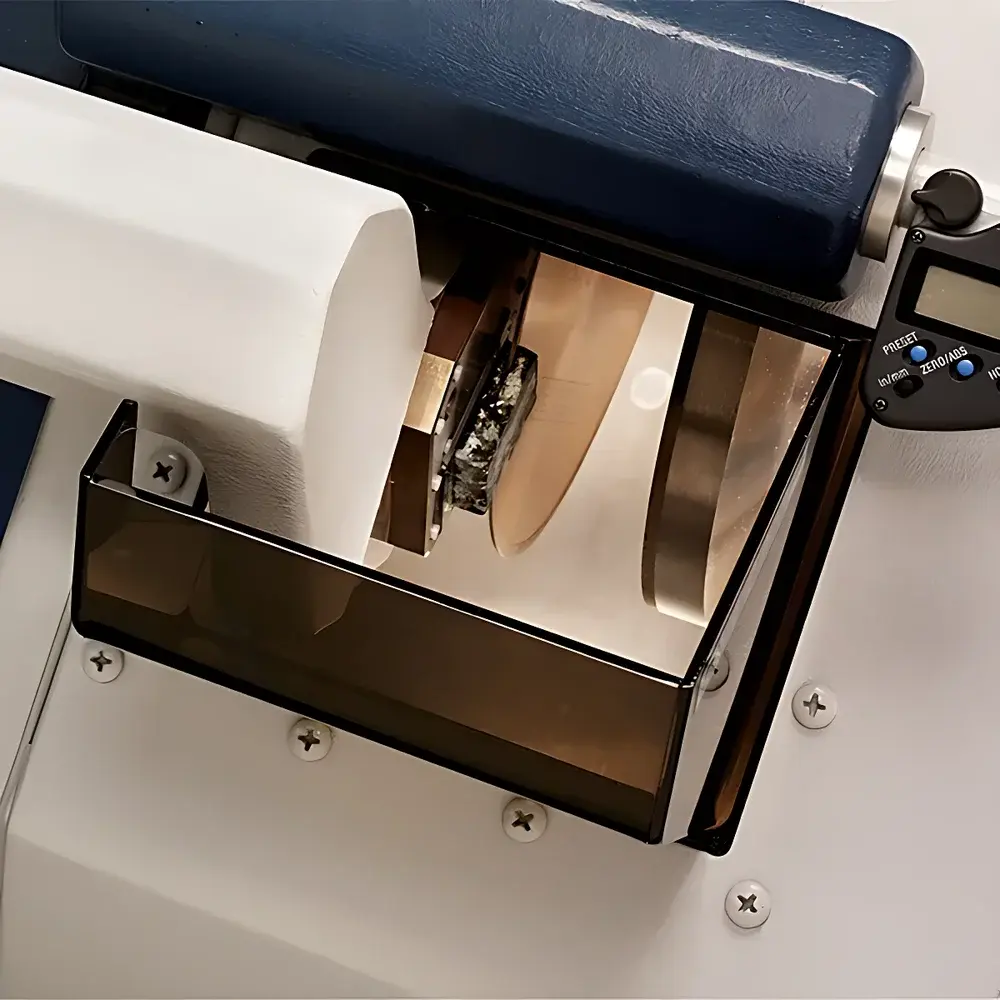
The Buehler PetroThin™ Thin Sectioning System is a manually operated, high-precision thin sectioning instrument engineered for the reproducible preparation of petrographic, geological, and materials science specimens. It employs a single-axis kinematic design combined with vacuum-assisted sample fixation to enable sequential cutting and grinding steps—such as trimming, rough sectioning, final thinning, and surface finishing—without removing the specimen from the glass slide carrier. This architecture ensures exceptional edge parallelism and dimensional fidelity across successive material removal stages. The system operates on the principle of controlled abrasive sectioning using diamond-impregnated blades and cup wheels, delivering consistent material removal rates suitable for brittle, heterogeneous, or highly abrasive substrates including silicate rocks, ceramics, concrete, refractory composites, bone, and dental tissues. Designed for laboratories requiring compliance with ASTM D3418 (standard practice for petrographic analysis), ISO 14798 (geotechnical investigation—sampling of rock), and USP (microscopic evaluation of pharmaceutical excipients), the PetroThin™ integrates mechanical precision with process traceability fundamentals.
Key Features
- Single-axis kinematic geometry maintains continuous alignment between specimen and cutting plane, eliminating repositioning errors and preserving parallelism between opposing specimen faces.
- Dual precision micrometer dials provide independent, calibrated control over both trimming depth (re-cutting) and final thinning thickness—with resolution and repeatability within ±5 µm per pass.
- Vacuum slide holder accommodates up to six standard microscope slides (e.g., 25 × 75 mm, 26 × 76 mm, or custom dimensions) via integrated vacuum pump and self-draining filter assembly; moisture separation prevents condensation-induced vacuum loss during extended operation.
- Modular diamond tooling interface supports interchangeable 8-inch (203 mm) continuous-rim diamond blades (e.g., for coarse sectioning) and diamond cup wheels (for fine grinding and surface leveling), enabling seamless transition between material removal and finish refinement.
- Robust cast-iron base and vibration-damped column ensure mechanical stability during high-torque cutting at variable speeds (220 rpm or 2100 rpm, depending on blade configuration), minimizing chatter and improving edge integrity.
- CE-compliant electrical architecture with dual-voltage input (115 VAC @ 60 Hz / 220 VAC @ 50 Hz) ensures global deployment readiness without external transformers.
Sample Compatibility & Compliance
The PetroThin™ accepts mounted specimens bonded to standard glass microscope slides using epoxy, cyanoacrylate, or low-viscosity acrylic resins. It is validated for use with consolidated and unconsolidated geological matrices—including granite, basalt, shale, limestone, sandstone, and metamorphic schists—as well as synthetic analogs such as sintered alumina, silicon carbide ceramics, cementitious composites, and bio-mineralized tissues. All operational parameters align with ASTM E3 (standard guide for preparation of metallographic specimens), ASTM D5777 (standard guide for rock core sampling), and ISO 14688-1 (geotechnical investigation—identification and classification of soil). When used in regulated environments (e.g., GLP-certified geochemical labs or GMP-aligned biomaterial testing facilities), the system supports audit-ready documentation through manual logbook entries and optional integration with LIMS-compatible digital annotation tools.
Software & Data Management
The PetroThin™ is a standalone mechanical instrument with no embedded firmware or proprietary software. However, its deterministic mechanical behavior enables full procedural documentation using laboratory notebook systems compliant with FDA 21 CFR Part 11 (electronic records and signatures) when paired with validated electronic lab notebooks (ELNs). Users may record micrometer settings, blade serial numbers, vacuum pressure readings, and cycle timestamps to reconstruct each thin sectioning event. Optional accessories—including calibrated thickness gauges, optical interferometers, and digital calipers—facilitate metrological traceability to NIST-traceable standards. Buehler provides comprehensive SOP templates aligned with ISO/IEC 17025 requirements for method validation and equipment qualification.
Applications
- Petrographic thin section production for transmitted light microscopy (TLM), cathodoluminescence (CL), and electron microprobe analysis (EMPA).
- Preparation of polished sections for quantitative mineralogical mapping via SEM-EDS or QEMSCAN® workflows.
- Sectioning of archaeological ceramics and fired clay artifacts for provenance studies and firing temperature reconstruction.
- Thinning of bone and dentin specimens for histomorphometric analysis and collagen fiber orientation assessment.
- Routine quality control of refractory linings in metallurgical furnaces and power generation infrastructure.
- Material failure analysis involving intergranular fracture surfaces in welded joints or thermal barrier coatings.
FAQ
What types of mounting resins are compatible with the PetroThin™ system?
Epoxy-based, acrylic, and cyanoacrylate resins commonly used in metallography and petrography are fully compatible—provided full polymerization is achieved prior to sectioning.
Can the PetroThin™ be used for preparing sections thicker than 30 µm?
Yes. While optimized for standard petrographic thicknesses (25–30 µm), the system supports sectioning down to 5 µm for specialized applications and up to 100 µm for structural evaluation or micro-CT pre-screening.
Is operator training required before first use?
Buehler recommends formal operator qualification per internal SOPs, including hands-on instruction on vacuum integrity verification, micrometer calibration, blade dressing procedures, and safety protocols for diamond tool handling.
Does the system support automated thickness feedback or endpoint detection?
No. Thickness monitoring is performed externally using optical micrometers, interferometry, or spectral reflectance tools; the PetroThin™ itself operates as a manually controlled, open-loop mechanical platform.
What maintenance intervals are recommended for the vacuum pump and filtration system?
The integrated vacuum filter should be inspected after every 20 operating hours and replaced every 100 hours; pump oil must be changed quarterly under continuous use or semiannually under intermittent operation.



