
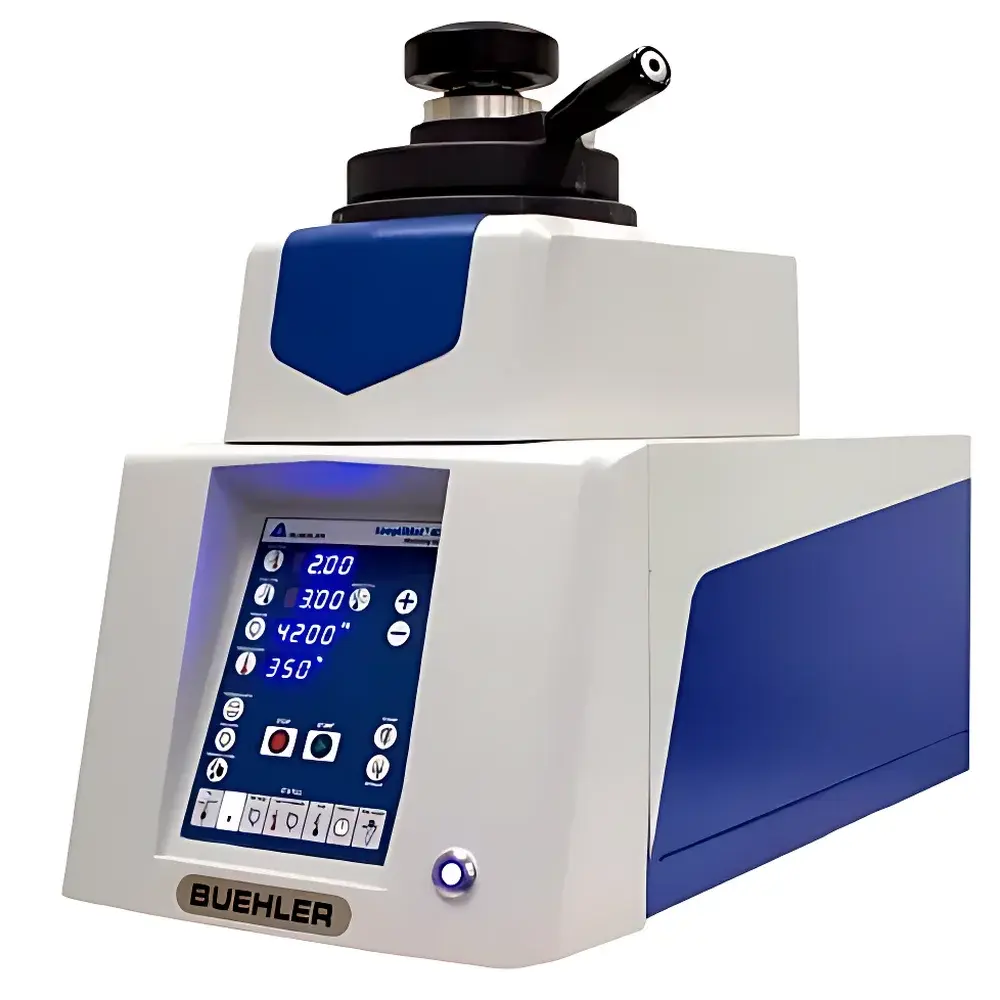
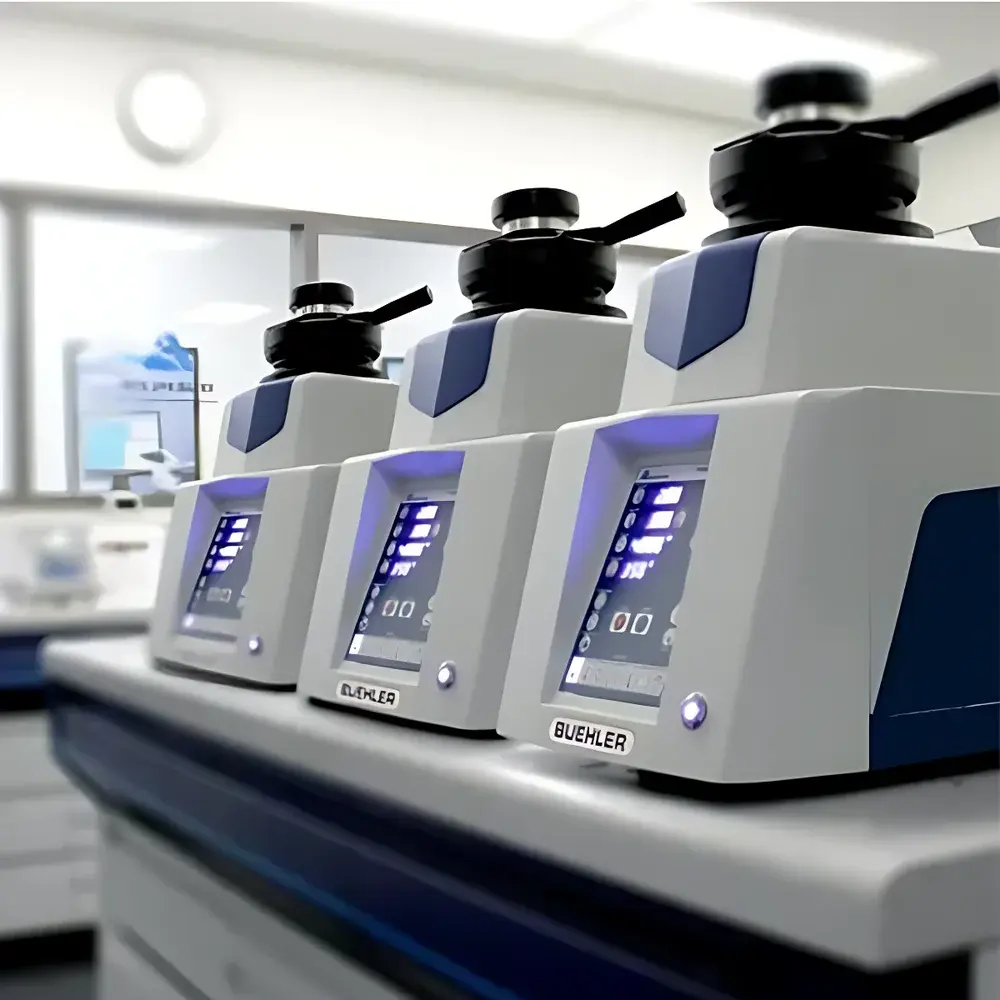
Buehler SimpliMet 4000 Automatic Hot Mounting Press
| Brand | Buehler |
|---|---|
| Origin | USA |
| Model | SimpliMet 4000 |
| Type | Automatic Hot Mounting Press |
| Mounting Force Range | 1000–4400 psi (70–300 bar) |
| Preload Pressure | 350 psi (24 bar) |
| Heating Temperature Range | 50°C–220°C (120°F–420°F), adjustable in 5°C (10°F) increments |
| Heating Time | 1–20 min, adjustable in 10-sec increments |
| Cooling Mode | Manual (1–30 min) or Smart Cool™ automatic cooling to 40°C |
| Mold Sizes | 25 mm, 30 mm, 40 mm, 50 mm (1", 1.25", 1.5") |
| Heating Power | 1500 W @ 115 VAC / 1900 W @ 230 VAC |
| Dimensions (W × D × H, locked) | 311 mm × 540 mm × 498 mm |
| Weight | 54 kg |
| Compliance | CE, PSE, RoHS, WEEE |
| Max Noise Level | 62 dB(A) at 1 m (lid open, piston actuating) |
| Operating Environment | 5–40°C, 30–90% RH non-condensing |
| Input Voltage/Frequency | 85–264 VAC, 50/60 Hz, single-phase |
| Water Inlet/Outlet | 1/4" OD inlet, 1/4" ID × 1/2" OD drain & outlet tubing |
Overview
The Buehler SimpliMet 4000 Automatic Hot Mounting Press is an engineered solution for high-throughput, reproducible specimen encapsulation in metallurgical, materials science, and quality control laboratories. Designed around the principles of thermosetting resin compression molding, the system applies precisely controlled heat and hydraulic pressure to consolidate samples within thermosetting or thermoplastic mounting media—such as phenolic, epoxy, or acrylic resins—producing dimensionally stable, void-free mounts suitable for subsequent grinding, polishing, and microscopic analysis. Its architecture prioritizes operational robustness under continuous duty cycles, validated through accelerated life testing simulating the most demanding global lab environments. Unlike legacy manual or semi-automated presses, the SimpliMet 4000 integrates closed-loop thermal regulation, adaptive pressure ramping, and intelligent cooling logic—eliminating operator-dependent variability while maintaining full compliance with ISO 16015, ASTM E3, and ISO/IEC 17025 documentation requirements for sample preparation traceability.
Key Features
- Smart Cool™ Intelligent Cooling System: Dynamically terminates cooling once the specimen reaches a safe egress temperature of 40°C—reducing average cycle time by up to 35% versus fixed-timer systems and minimizing water consumption without compromising mount integrity.
- Low-Thermal-Mass Mold Design: Optimized aluminum alloy mold bodies with integrated drainage channels evacuate residual coolant prior to heating, enabling rapid thermal ramp-up and consistent cross-sectional curing profiles across all standard diameters (25–50 mm).
- Front-Panel-Only Operation: A dedicated, tactile control interface—free of nested menus or software layers—provides immediate access to all critical parameters: pressure setpoint, temperature target, dwell time, preload activation, and cooling mode selection.
- Preload Functionality: Applies a gentle 350 psi (24 bar) initial force before main compression, protecting brittle or porous specimens—including ceramics, composites, and sintered powders—from fracture or resin infiltration artifacts during early-stage consolidation.
- Space-Efficient Footprint: At only 311 mm wide and 540 mm deep, the unit fits comfortably on standard laboratory benches, freeing adjacent surface area for consumables storage, auxiliary equipment, or future workflow expansion.
- Regulatory-Ready Architecture: Built-in audit trail logging (time-stamped parameter changes, cycle completion events, error flags), password-protected user levels, and hardware-level compliance with CE, PSE, RoHS, and WEEE directives support GLP/GMP-aligned validation protocols.
Sample Compatibility & Compliance
The SimpliMet 4000 accommodates a broad spectrum of specimen geometries and material classes—including metallic alloys, geological cores, electronic components, polymer composites, and biological hard tissues—when paired with compatible thermosetting (e.g., Bakelite, Epoxy) or thermoplastic (e.g., TransOptic™) resins. Its pressure range (70–300 bar) and temperature envelope (50–220°C) align with resin manufacturers’ recommended processing windows, ensuring optimal cross-linking density and optical clarity. All operational parameters are traceable per ISO/IEC 17025 Clause 7.7 (Sampling) and ASTM E3 Annex A1 (Mounting Procedure Documentation). The system’s mechanical safety interlocks, overtemperature cutoffs, and pressure relief mechanisms satisfy EN 61000-6-2 (EMC Immunity) and EN 61000-6-4 (EMC Emission) standards.
Software & Data Management
While operating independently of external computers, the SimpliMet 4000 embeds non-volatile memory capable of storing ≥100 unique method configurations—including multi-step pressure ramps, segmented heating profiles, and Smart Cool™ activation thresholds. Each completed cycle logs timestamp, final pressure/temperature values, total cycle duration, and any fault codes to internal memory; data export is supported via USB-C interface in CSV format for integration into LIMS or ELN platforms. Audit trails comply with FDA 21 CFR Part 11 requirements when used in conjunction with validated third-party electronic signature modules—enabling full electronic record retention for regulatory submissions.
Applications
- Metallurgical Laboratory QA/QC: Routine preparation of metallographic specimens for grain size analysis (ASTM E112), inclusion rating (ASTM E45), and coating thickness measurement (ISO 1463).
- Failure Analysis Labs: Encapsulation of fractured components, solder joints, or PCB cross-sections without thermal distortion or edge rounding.
- Geoscience Core Analysis: Stabilization of friable sedimentary or metamorphic rock samples prior to thin-section fabrication.
- Automotive & Aerospace NDT: Mounting of turbine blade coatings, weld zones, or additive-manufactured parts for porosity and microcrack evaluation.
- Academic Research: High-reproducibility mounting for comparative studies involving novel alloys, nanocomposites, or bioresorbable implants.
FAQ
Does the SimpliMet 4000 support thermoplastic mounting media like TransOptic™?
Yes—the system includes a dedicated thermoplastic mode that automatically configures optimized heating/cooling profiles to ensure linear, stress-free solidification and maximum optical transparency.
Can I validate the pressure and temperature calibration in-house?
Yes—calibration verification is supported using NIST-traceable pressure transducers and Class A PT100 probes; procedure documentation is provided in the IQ/OQ protocol package.
Is remote monitoring or network connectivity available?
No native Ethernet or Wi-Fi interface is included; however, the USB-C data export enables scheduled batch transfers to networked servers via host PC automation scripts.
What maintenance intervals are recommended for continuous operation?
Daily visual inspection of mold surfaces and O-rings; monthly hydraulic oil level check; annual replacement of coolant filter and pressure sensor recalibration—detailed in the Preventive Maintenance Log (PML) supplied with each unit.
How does the preload function protect fragile specimens?
It applies a low-force, slow-ramp compression stage before main pressure engagement—minimizing sudden stress concentration at specimen edges and preventing resin “blow-out” from porous structures.



