
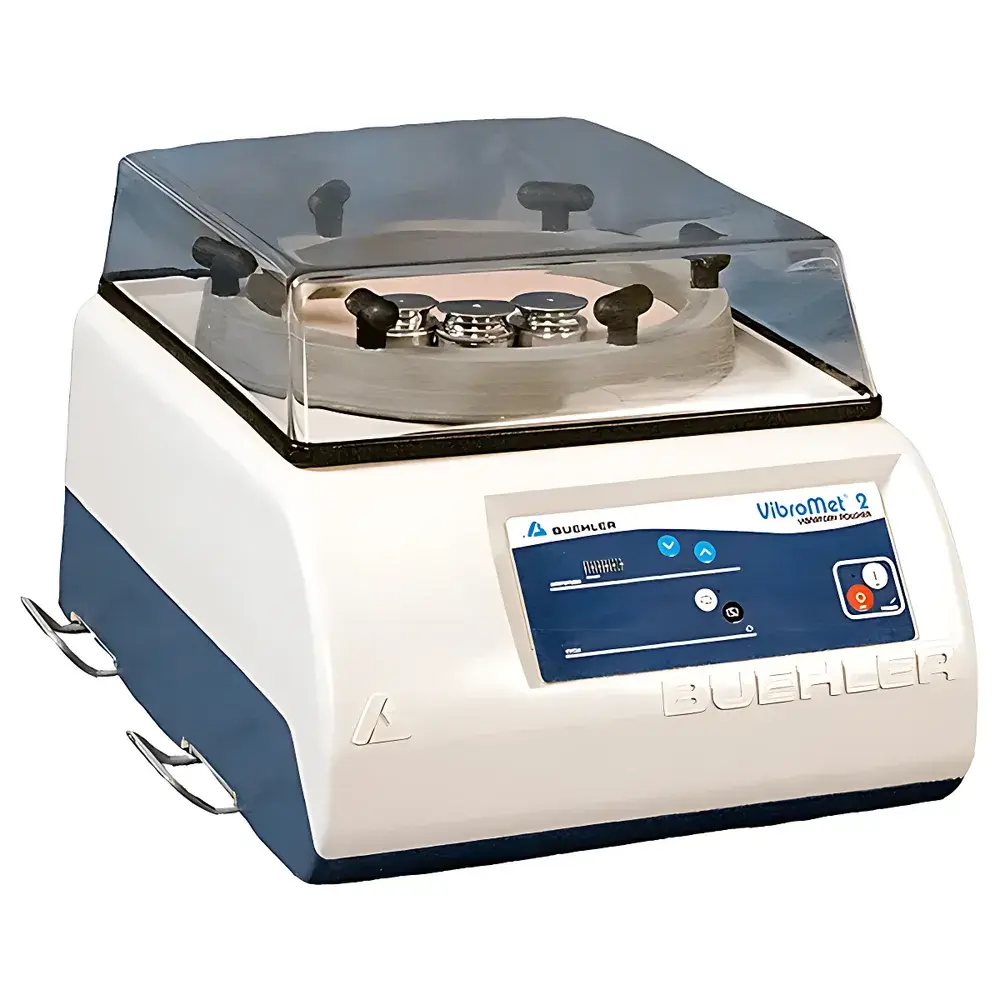
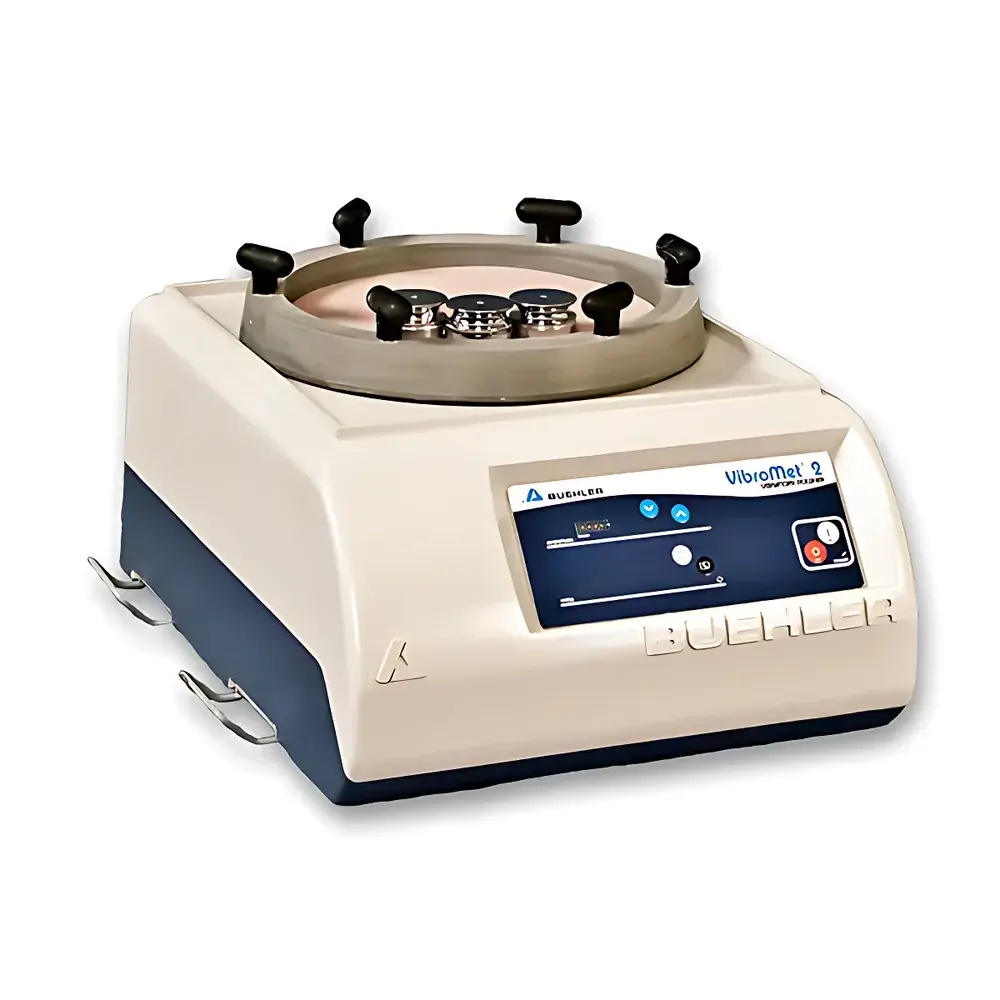
Buehler VibroMet™ 2 Vibratory Polisher
| Brand | Buehler |
|---|---|
| Origin | USA |
| Model | VibroMet™ 2 |
| Dimensions (L×W×D) | 546 × 584 × 368 mm |
| Polishing Plate Count | 1 |
| Polishing Plate Diameter | 305 mm (12 in) |
| Vibration Frequency | Up to 7200 rpm |
| Power Supply | 115/220 V, 50/60 Hz, Single Phase |
Overview
The Buehler VibroMet™ 2 Vibratory Polisher is a second-generation precision surface preparation instrument engineered for high-reproducibility, stress-free final polishing of materials intended for advanced microstructural characterization—particularly Electron Backscatter Diffraction (EBSD), scanning electron microscopy (SEM), and transmission electron microscopy (TEM) sample analysis. Unlike conventional rotary or planetary polishers that introduce mechanical deformation through shear forces, the VibroMet™ 2 employs controlled horizontal orbital vibration—generating low-energy, multi-directional abrasive motion across the specimen surface. This principle minimizes subsurface damage, eliminates preferential orientation artifacts, and preserves crystallographic integrity—critical for EBSD pattern indexing accuracy and phase mapping fidelity. Its design reflects decades of metallurgical expertise aligned with ASTM E3, ISO 14487, and ISO 11270 standards for metallographic specimen preparation.
Key Features
- Robust corrosion-resistant and impact-dampened chassis engineered for laboratory longevity and operational stability.
- Front-mounted capacitive touch LCD interface enabling intuitive control of start/stop functions and real-time adjustment of vibration amplitude (0–100% range).
- Digital current monitoring display visualizing dynamic load variations via bar-chart waveform—allowing immediate detection of polishing progress or abnormal resistance (e.g., embedded abrasives or sample lift-off).
- Transparent polycarbonate dust shield ensuring contamination-free polishing environment while permitting full visual supervision during operation.
- Quick-release mechanism for rapid exchange of 305 mm (12 in) polishing plates—compatible with standard cloth-backed pads, diamond-impregnated films, and colloidal silica suspensions.
- High-capacity platform supporting up to 18 mounted specimens (e.g., 1″, 1¼”, or 1½” epoxy-embedded samples) or single large unmounted specimens (up to 300 mm × 200 mm).
- Fully autonomous cycle execution: once loaded and initiated, no operator intervention is required—ideal for overnight or unattended processing under GLP-compliant workflows.
- Adjustable electromagnetic drive system delivering precise, repeatable vibration frequencies from 0 to 7200 rpm—optimized for both soft metals (Al, Cu, Ni) and ultra-hard alloys (Inconel, Ti-6Al-4V, WC-Co).
Sample Compatibility & Compliance
The VibroMet™ 2 accommodates diverse specimen geometries and material classes without requiring aggressive pre-polishing steps. It excels with soft metals, thin-film coatings, brittle ceramics, geological thin sections (5–10 µm thickness), and delicate electronic components where structural integrity must be preserved. Optional holders include precision-machined aluminum chucks for standard-mounted samples and calibrated counterweights for flat, unmounted specimens. All consumables—including alumina (0.05 µm) and silica (0.02 µm) suspensions—are traceable to ISO 8502-3 certified manufacturing protocols. The system supports audit-ready documentation when integrated into laboratories operating under ISO/IEC 17025, FDA 21 CFR Part 11 (with optional software validation package), and GMP-aligned quality management systems.
Software & Data Management
While the VibroMet™ 2 operates as a standalone electromechanical instrument, its digital interface logs timestamped vibration current profiles per run—exportable via USB for trend analysis in Excel or LIMS environments. Optional Buehler MetaLab™ Connect integration enables remote monitoring, cycle parameter archiving, and automated report generation compliant with GLP data integrity requirements. Audit trails capture user ID, start/stop times, amplitude settings, and anomaly flags—fully traceable for regulatory submissions or internal QA reviews.
Applications
- Final polishing of EBSD-grade specimens—eliminating deformation layers in multiphase alloys, intermetallics, and nanocrystalline materials.
- Preparation of ultra-thin rock thin sections for quantitative petrographic analysis.
- Surface finishing of MEMS devices, semiconductor packaging substrates, and medical implant alloys where surface topography and lattice coherence are critical.
- Routine quality control polishing for hardness testing specimens per ASTM E384 and ISO 6507.
- Stress-relief polishing of additively manufactured (AM) metal parts prior to XRD residual stress analysis.
FAQ
What types of materials are best suited for the VibroMet™ 2?
It is especially effective for soft metals (Al, Cu, Pb), coated systems, brittle phases (carbides, oxides), and high-value components where mechanical damage must be avoided.
Can it replace traditional polishing methods entirely?
No—it is designed as a final-stage polishing tool; coarse grinding and intermediate polishing steps remain necessary per ASTM E3 guidelines.
Is the 7200 rpm specification rotational speed or vibration frequency?
It refers to the equivalent oscillation frequency of the horizontal vibratory motion—not plate rotation—as confirmed by Buehler’s engineering documentation.
Does the system support automated cycle programming?
Yes—via the touch interface, users can save up to 10 custom amplitude/time profiles with password-protected access.
Are replacement polishing plates and holders available globally?
Yes—Buehler maintains an ISO-certified consumables supply chain across 100+ countries, with standard lead times under 5 business days for stocked items.



