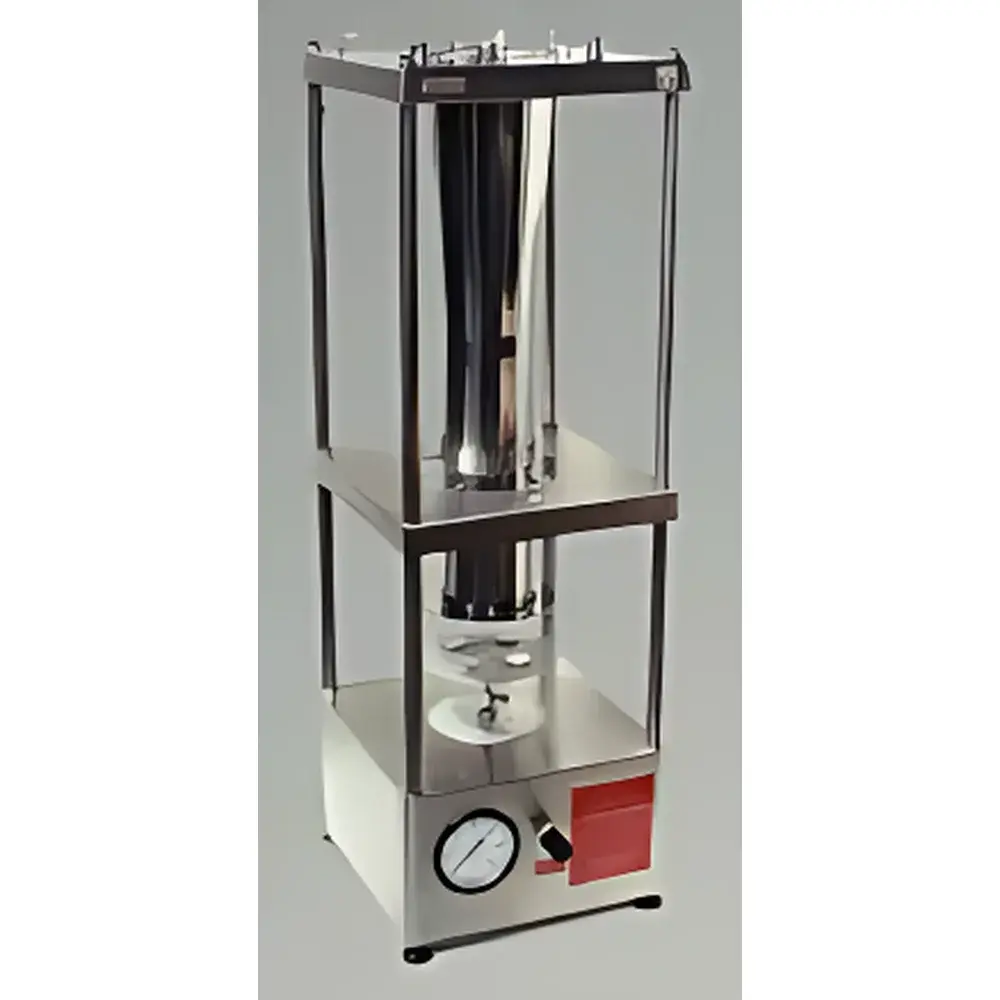
Burkard Porter Spray Tower
| Brand | Burkard |
|---|---|
| Origin | United Kingdom |
| Model | Porter Spray Tower (Standard & Auto-Load Variants) |
| Construction | 316 Stainless Steel Enclosure |
| Spray Area | Uniform 9 cm Diameter Circular Zone |
| 雾化器 | Quick-Release Pneumatic Nebulizer |
| Control Panel | Front-Mounted, Integrated |
| Pressure Gauge | 0–2.5 bar (0–30 psi), 10 cm (4 in) Dial |
| Compliance | Designed to Support GLP/GMP-Compliant Inhalation Toxicology Studies |
| Operating Environment | Compatible with Fume Hood Integration |
Overview
The Burkard Porter Spray Tower is a precision-engineered laboratory aerosol generation system developed in collaboration with Rothamsted Research (UK) for controlled chemical and biological exposure studies. It operates on the principle of pneumatic nebulization—using regulated compressed air to atomize liquid test agents into a reproducible, monodisperse or polydisperse aerosol cloud within a vertically oriented, laminar-flow tower. The device is purpose-built for inhalation toxicology, pesticide residue evaluation, antimicrobial efficacy testing, and respiratory pharmacokinetic research. Its design ensures minimal wall deposition, consistent droplet size distribution across the target zone, and operator safety through full containment and remote actuation. Manufactured in Uxbridge, UK, the tower features a seamless 316 stainless steel housing engineered for corrosion resistance, cleanability, and long-term stability under repeated chemical exposure.
Key Features
- Pneumatically actuated spray platform with smooth vertical lift mechanism—prevents premature aerosol escape by sealing airflow until final position is reached
- Quick-release nebulizer assembly enabling rapid cleaning, calibration, and agent changeover without tools
- Front-mounted control panel with tactile switches, integrated pressure gauge (0–2.5 bar / 0–30 psi), and status indicators for cycle initiation, completion, and fault monitoring
- Dual configuration availability: Standard manual loading variant and Auto-Load variant with external pneumatic controls for loading/unloading Petri dishes outside the fume hood sash
- Uniform spray distribution over a defined 9 cm diameter circular target area—validated per ISO 27427 and ASTM D5657 practices for aerosol deposition consistency
- Fume hood-compatible footprint and exhaust interface; designed for integration into ISO Class 5–7 controlled environments
Sample Compatibility & Compliance
The Porter Spray Tower accommodates aqueous and organic solvent-based formulations—including pesticides, pharmaceutical suspensions, disinfectants, and microbial cultures—within viscosity and surface tension ranges typical of OECD Test Guideline 412 and EPA OPPTS 870.1300 compliant studies. All wetted components are chemically inert (316 SS, PTFE, borosilicate glass). The system supports traceable operation under Good Laboratory Practice (GLP) frameworks: cycle logs, pressure records, and operator ID inputs (via optional LIMS integration) meet FDA 21 CFR Part 11 audit trail requirements when paired with validated software. It conforms to IEC 61000-6-2/6-3 for electromagnetic compatibility and carries UKCA marking for laboratory equipment safety.
Software & Data Management
While the base unit operates via hardware-integrated controls, optional digital modules enable PC-based operation via RS-232 or USB-to-serial interface. Burkard’s proprietary SprayLog™ software (v3.2+) provides real-time pressure monitoring, cycle timing validation, automated pass/fail flagging against user-defined thresholds, and export of CSV-formatted logs for regulatory submission. Audit trails include timestamped operator actions, pressure deviations >±0.1 bar, and door-interlock status—fully aligned with GLP Annex 11 and EU GMP Annex 11 data integrity expectations. Raw data files are SHA-256 hashed and stored with immutable metadata.
Applications
- Inhalation toxicity assessment of agrochemicals per OECD TG 412 and EPA 870.1300
- Bioaerosol challenge testing for respirator filtration efficiency (NIOSH 42 CFR Part 84)
- Antimicrobial spray efficacy evaluation on surfaces and airborne pathogens (ISO 22196, ASTM E1153)
- Pharmaceutical nasal/oral inhalation formulation development and deposition mapping
- Calibration and validation of cascade impactors and aerosol spectrometers
- Environmental fate studies involving pesticide drift simulation under controlled lab conditions
FAQ
Is the Porter Spray Tower compatible with ISO 17025-accredited laboratories?
Yes—the mechanical design, pressure calibration traceability (NIST-traceable gauges), and documentation package support scope accreditation for aerosol generation testing.
Can the nebulizer be calibrated for specific MMAD targets?
Yes—Burkard provides optional calibration kits and SOPs for generating mass median aerodynamic diameters between 1–10 µm using standard polystyrene latex (PSL) suspensions.
What compressed air quality is required?
Oil-free, desiccated air meeting ISO 8573-1 Class 2:2:2 specifications (≤0.1 µm particles, ≤0.1 ppm oil, dew point ≤−40°C) is recommended for consistent nebulization performance.
Does the Auto-Load variant require external PLC integration?
No—it uses Burkard’s proprietary pneumatic manifold and solenoid sequencing; only 6 bar clean air supply and 24 VDC power are needed for full autonomous operation.
Are spare parts and technical support available globally?
Yes—Burkard maintains authorized service centers in the US, Germany, Japan, and Australia; all critical spares (nebulizer tips, O-rings, lift actuators) are stocked with <5-day lead time.