
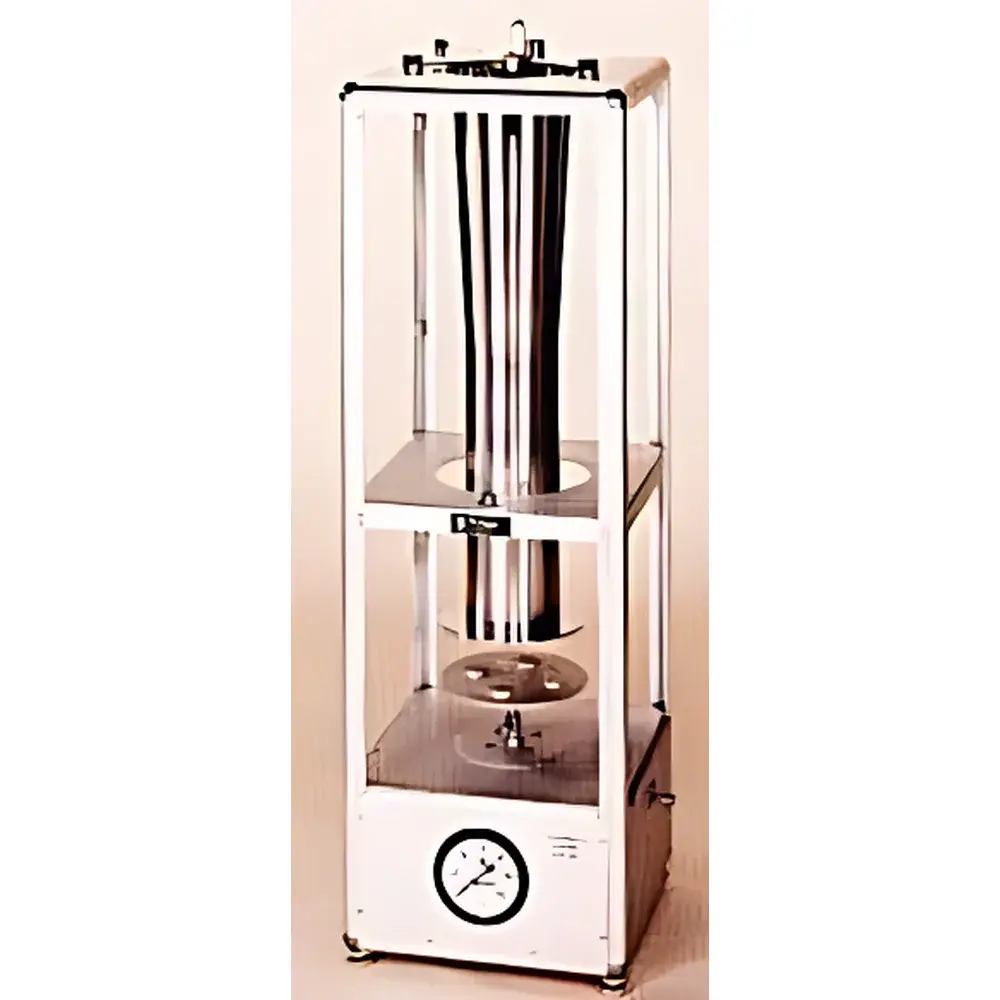
Burkard Potter Precision Laboratory Spray Tower
| Origin | UK |
|---|---|
| Manufacturer Type | Distributor |
| Origin Category | Imported |
| Model | POTTER |
| Price Range | USD 1,400–7,200 (est.) |
| Sample Type | Aqueous solutions only |
| Max. Throughput | 400 samples per day (typical lab workflow) |
| Temperature Range | Ambient to 30 °C (no active heating/cooling) |
| Droplet Size Range | 5 µm (Sauter mean diameter, D₃₂, under standard operating conditions with water at 15 psi) |
Overview
The Burkard Potter Precision Laboratory Spray Tower is a purpose-engineered aerosol delivery system designed for standardized, reproducible application of liquid formulations onto biological or inert substrates in controlled laboratory environments. It implements the classical Potter spray method—first described by Potter (1952) and codified in OECD Test Guideline 212, EPPO Standard PP 1/183, and FAO/WHO pesticide evaluation protocols—as a benchmark technique for contact toxicity bioassays. Unlike thermal spray dryers or centrifugal atomizers, the Potter Tower operates on pneumatic aspiration: compressed air (supplied externally) generates a Venturi-induced vacuum at the nozzle tip, drawing liquid from a reservoir tube and shearing it into a fine, monodisperse mist. The resulting aerosol deposits a highly uniform circular deposit (90 mm diameter) with minimal edge effects, enabling precise dosing control essential for GLP-compliant insecticidal, acaricidal, or fungicidal efficacy studies.
Key Features
- Stainless steel construction (AISI 316 grade) ensures chemical resistance, long-term dimensional stability, and compliance with ISO 14644-1 Class 5 cleanroom-compatible handling protocols.
- Dual configuration options: Manual loading variant (standard) and Safety-Actuated Loading (SAL) variant with pneumatically driven sample stage, eliminating operator exposure during Petri dish placement.
- Integrated pressure regulation system featuring a calibrated 0–2.5 bar (0–30 psi), 100 mm Bourdon-tube manometer with ±0.1 bar accuracy—traceable to NPL (UK) standards.
- Modular spray head assembly allows rapid disassembly, cleaning, and nozzle interchangeability without tools; compatible with standard 12 mL glass vials or custom reservoirs.
- Fixed 90 mm deposition zone geometry ensures spatial consistency across repeated trials—critical for statistical power in dose–response modeling (e.g., probit analysis per EPA OPPTS 850.3100).
- Front-panel mounted controls include master air valve, pressure regulator lock, and visual flow indicator—designed for one-hand operation within fume hood constraints.
Sample Compatibility & Compliance
The Potter Spray Tower is validated exclusively for aqueous-based test solutions (e.g., technical-grade actives dissolved or suspended in distilled water, buffer, or low-viscosity co-solvent blends ≤10 mPa·s). It is not suitable for organic solvents with flash points 25 mPa·s), or suspensions containing particles >5 µm. Regulatory alignment includes full traceability to OECD 212 Annex 2 (Spray Tower Specifications), EPPO PM 7/183 (Standardized Spray Application), and USDA-ARS Bioassay Methodology Handbook Chapter 4. All SAL-model units include audit-trail-capable operation logging (timestamped start/stop, pressure setpoint, cycle count) compliant with FDA 21 CFR Part 11 when interfaced with validated LIMS platforms.
Software & Data Management
The base unit operates as a standalone mechanical system with no embedded firmware or digital interface. However, optional integration kits support analog pressure signal output (0–5 V DC) for connection to data acquisition systems (e.g., LabVIEW, MATLAB, or SCADA). For GLP audits, Burkard provides a certified calibration certificate (NIST-traceable manometer + flow verification report) and a full maintenance log template aligned with ISO/IEC 17025 clause 6.4.2. Digital record retention—including operator ID, ambient RH/T logs, and batch-specific calibration dates—is recommended via external ELN systems such as Benchling or LabArchives.
Applications
- Contact toxicity screening of arthropod pests (e.g., Tetranychus urticae, Harmonia axyridis, Aphidius colemani) per IOBC/WPRS guidelines.
- Residual film bioassays on leaf discs, filter paper, or glass slides for persistence and degradation kinetics studies.
- Formulation development support: comparative atomization efficiency testing of adjuvants, wetting agents, or nano-encapsulated actives.
- Educational use in toxicology, entomology, and agrochemical science curricula—validated for undergraduate and postgraduate laboratory instruction.
- Reference method validation in inter-laboratory ring trials coordinated by EFSA, APVMA, or SANBI.
FAQ
Is the Potter Spray Tower suitable for organic solvent-based formulations?
No. Only aqueous or low-volatility, non-flammable aqueous co-solvent mixtures (e.g., ≤10% ethanol in water) are permitted. Flammable solvents pose explosion risks in pneumatic systems and compromise stainless steel integrity over time.
What is the recommended maintenance interval for the nozzle assembly?
Daily visual inspection and ultrasonic cleaning (acetone or isopropanol) after each use series; full dimensional verification using calibrated micrometers every 500 operational cycles or quarterly—whichever occurs first.
Can the 90 mm deposition pattern be adjusted for smaller substrates?
No. The geometry is fixed per OECD 212 specifications to ensure cross-laboratory comparability. Substrates must conform to the 90 mm zone; partial coverage invalidates regulatory submission data.
Does Burkard provide installation qualification (IQ) documentation?
Yes. Upon request, a complete IQ/OQ package—including site-specific airflow mapping, pressure decay testing, and deposition uniformity verification (via laser diffraction particle sizing of collected deposits)—is available for GMP-regulated facilities.
Is the SAL model compatible with robotic sample handlers?
Yes. The pneumatically actuated stage features ISO 9409-1-50-4-M6 mounting flanges and 24 V DC solenoid trigger inputs, enabling synchronization with third-party automation platforms (e.g., Hamilton STAR, Tecan Fluent) via dry-contact relay signals.



