
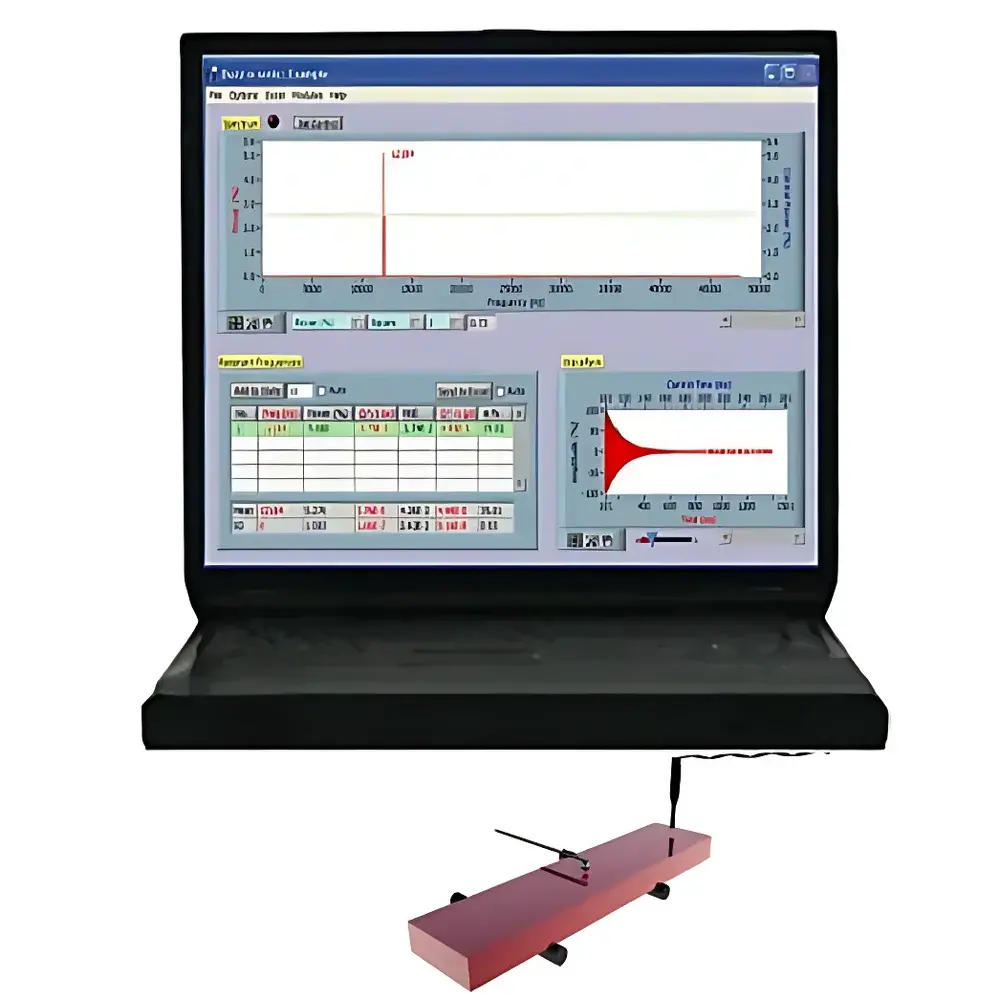
Buzz-Mac Resonant Frequency-Based Dynamic Young’s Modulus Tester
| Brand | 1 mK |
|---|---|
| Origin | USA |
| Manufacturer Type | Authorized Distributor |
| Origin Category | Imported |
| Model | Buzz-Mac |
| Price | USD 1 (FOB) |
Overview
The Buzz-Mac Resonant Frequency-Based Dynamic Young’s Modulus Tester is an advanced non-destructive instrumentation system engineered for the precise determination of dynamic elastic properties—including Young’s modulus, shear modulus, and Poisson’s ratio—via resonant frequency analysis. Operating on the fundamental principle of free-free or supported-beam flexural and longitudinal resonance, the instrument excites a specimen mechanically (e.g., impulse hammer) and captures its natural vibration response using high-sensitivity piezoelectric or acoustic transducers. The measured resonant frequencies are then processed using closed-form analytical models derived from classical beam theory (Euler–Bernoulli and Timoshenko formulations) and plate/cylinder vibration theory, enabling traceable, standards-compliant computation of elastic constants without requiring stress–strain curve fitting or complex calibration artifacts. Designed for laboratory and industrial quality control environments, the Buzz-Mac delivers rapid (<5 s per measurement), operator-independent results with no sample polarization, surface metallization, or dimensional machining beyond basic geometric constraints—making it uniquely suited for brittle, heterogeneous, or temperature-sensitive materials.
Key Features
- Non-contact or low-intrusion excitation and detection via calibrated impulse hammer and broadband vibration/acoustic sensors
- Frequency acquisition range: 1 Hz to 100 kHz with amplitude resolution ≤0.005% full-scale frequency accuracy (traceable to NIST-calibrated reference oscillators)
- Dynamic elastic modulus measurement range: 0.1 GPa to 400 GPa (i.e., spanning soft polymers to tungsten carbide)
- Simultaneous extraction of Young’s modulus (E), shear modulus (G), and Poisson’s ratio (ν) from a single resonance spectrum
- Support for ambient, elevated, and cryogenic temperature testing when integrated with optional environmental chambers (−150 °C to +1200 °C)
- Ruggedized aluminum chassis with EMI-shielded signal conditioning electronics and isolated analog front-end
- Compliance-ready architecture supporting audit trails, user access levels, and electronic signature workflows per FDA 21 CFR Part 11 and ISO/IEC 17025 requirements
Sample Compatibility & Compliance
The Buzz-Mac accommodates solid, isotropic or orthotropic elastic materials in bar, disk, cylinder, or rectangular prism geometries. Minimum recommended dimensions: 1 × 4 × 40 mm (L×W×H) for bars; diameter-to-thickness ratio ≥4 (optimal 10–20) for disks. Compatible material classes include structural ceramics (Al₂O₃, SiC), hydraulic cements and concretes, optical glasses (soda-lime, borosilicate), metallic alloys (Al, Ti, stainless steels), thermoplastics and thermosets (PE, PC, epoxy composites), natural stone, timber, and fiber-reinforced laminates. All measurements conform to ASTM E1876 (Standard Test Method for Dynamic Young’s Modulus, Shear Modulus, and Poisson’s Ratio by Impulse Excitation of Vibration), ASTM C1259, ASTM C1548, ASTM C215, EN 843-2, EN ISO 12680-1, and EN 14146. Instrument validation documentation includes as-delivered uncertainty budgets per GUM (JCGM 100:2008) and interlaboratory comparison reports.
Software & Data Management
The bundled Buzz-Mac Analytical Suite (v5.2+) runs on Windows 10/11 (64-bit) and provides real-time spectral acquisition, modal identification (peak-picking with Gaussian fitting), automatic geometry-based model selection, and iterative parameter inversion. Data files are stored in HDF5 format with embedded metadata (operator ID, timestamp, environmental conditions, sensor calibration IDs). Software supports GLP/GMP workflows: electronic signatures, role-based permissions (admin/operator/auditor), change-controlled versioning, and export to CSV, XML, or PDF reports compliant with ISO 10012 and ASTM E2500. Raw time-series and FFT spectra are retained for retrospective reprocessing. Optional API enables integration with LIMS (e.g., LabWare, Thermo SampleManager) and MES platforms via RESTful endpoints.
Applications
- Quality assurance of sintered ceramic components in aerospace and medical device manufacturing
- In-process monitoring of concrete curing kinetics and early-age modulus development
- Thermoelastic characterization of glass transition behavior in polymer composites
- High-temperature elastic property mapping of refractory linings in metallurgical furnaces
- Non-destructive evaluation of microcracking in nuclear graphite or geological core samples
- Validation of finite element material models used in structural simulation (ANSYS, Abaqus)
- Teaching laboratories for solid mechanics and materials science curricula
FAQ
What physical principle does the Buzz-Mac employ to determine Young’s modulus?
It applies impulse excitation to induce free vibration and measures natural resonant frequencies; elastic moduli are calculated using analytically derived relationships between frequency, geometry, density, and boundary conditions.
Is sample preparation required beyond basic dimensional tolerances?
No machining, polishing, or electrode deposition is needed—only geometric compliance and surface cleanliness to avoid damping artifacts.
Can the system operate under vacuum or controlled atmospheres?
Yes, when coupled with third-party environmental enclosures compatible with standard transducer feedthroughs and thermal isolation mounts.
How is measurement traceability ensured?
Each system ships with NIST-traceable frequency calibration certificates, certified reference materials (e.g., fused quartz, aluminum 6061-T6), and documented uncertainty budgets per ISO/IEC 17025 Clause 6.5.
Does the software support automated batch processing of multiple specimens?
Yes—scriptable workflows allow unattended sequential testing with auto-naming, pass/fail logic based on user-defined modulus thresholds, and summary dashboard generation.



