
B&W Tek DIY Raman System – 785 nm Modular Raman Spectrometer
| Brand | B&W Tek |
|---|---|
| Origin | USA |
| Model | DIY Raman – 785 |
| Spectrometer Type | Grating-based Raman Spectrometer |
| Spectral Range | 788–1067 nm |
| Spectral Resolution | 4.5 cm⁻¹ @ 912 nm |
| Excitation Wavelength | 785 nm |
| Raman Shift Range | 150–3350 cm⁻¹ (dependent on probe selection) |
| Detector | Back-illuminated CCD (2048-pixel), TE-cooled to –25 °C (research-grade) |
| Dimensions (research-grade) | 220 × 180 × 130 mm |
| Weight (research-grade) | 3.4 kg |
| Laser Compliance | FDA 21 CFR 1040 (component-level sale only) |
Overview
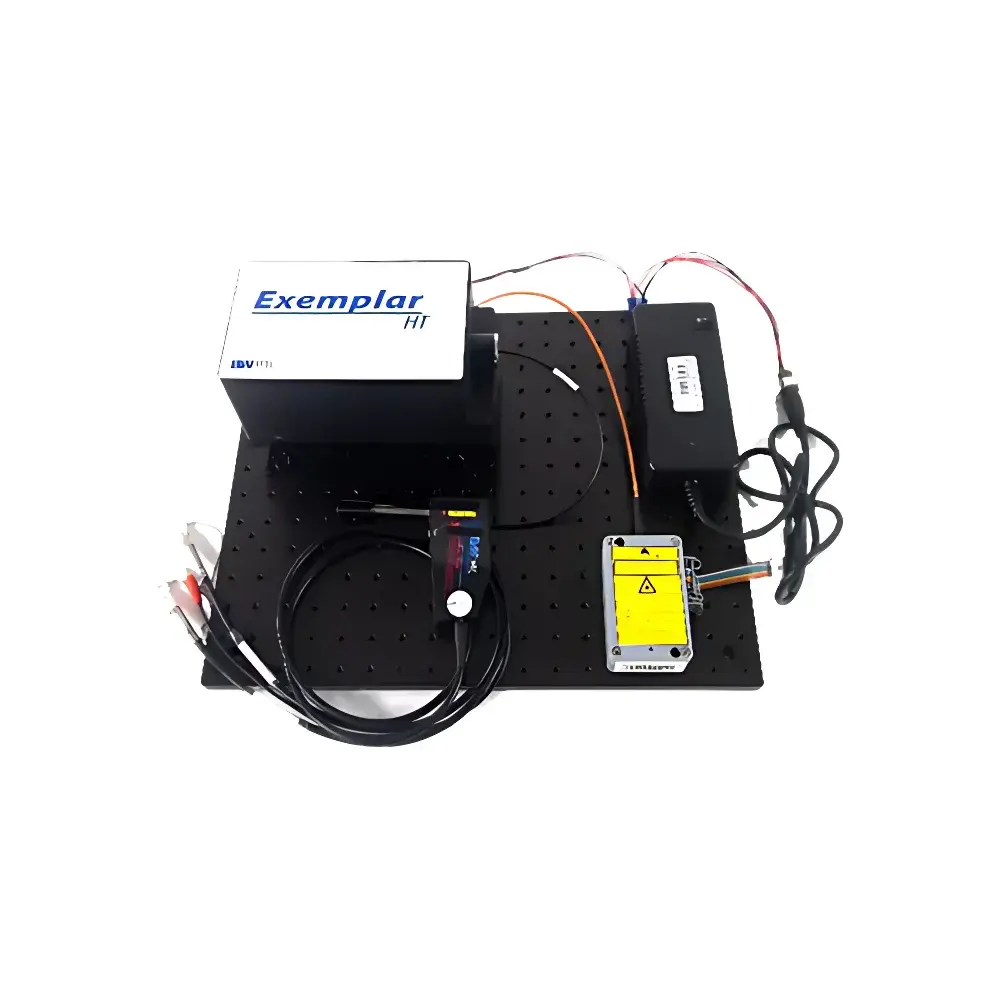
The B&W Tek DIY Raman System – 785 nm is a fully modular, OEM-optimized Raman spectroscopy platform engineered for research laboratories, instrument developers, and industrial R&D teams requiring maximum flexibility in system architecture. Built upon the principles of confocal dispersive Raman spectroscopy, the system employs a stabilized 785 nm diode laser coupled with high-throughput Czerny–Turner spectrometers and thermoelectrically cooled back-illuminated CCD detectors to deliver high signal-to-noise ratio (SNR) spectra across the 150–3350 cm⁻¹ Raman shift range. Unlike turnkey benchtop systems, this platform is explicitly designed as a component-level solution—enabling users to assemble, calibrate, and validate custom optical layouts on optical breadboards or within embedded instrumentation housings. Its architecture supports rigorous scientific validation workflows while meeting foundational requirements for traceable calibration, spectral reproducibility, and long-term thermal stability—critical for method development under GLP, ISO/IEC 17025, or internal QA/QC protocols.
Key Features
- Modular OEM-grade architecture: Interchangeable spectrometers (Glacier®, Exemplar®), 785 nm lasers (BRM series), and fiber-coupled probes (BAC100/BAC101) allow full mechanical and optical reconfiguration.
- CleanLaze™ laser stabilization technology (U.S. Patent No. 7,245,369 B2): Actively suppresses mode-hopping and power drift, ensuring <±0.5% RMS intensity stability over 8-hour acquisitions—essential for quantitative kinetic studies and multivariate modeling.
- Three-tier spectrometer options: Glacier® (entry-level), Exemplar® (standard), and Exemplar® HT (high-throughput, deep-cooled) — differing in detector QE, cooling depth (–2°C to –25°C), and optical throughput.
- Configurable sampling interfaces: Industrial-grade stainless-steel probes (BAC101-SS) rated to 200 °C and laboratory-grade probes (BAC100B) with adjustable working distance (5.4 mm) and OD6 laser attenuation.
- External trigger support (TTL-compatible): Enables synchronization with external events (e.g., reaction initiation, stage motion, or process control signals) for time-resolved or spatially resolved Raman mapping.
Sample Compatibility & Compliance
The DIY Raman – 785 accommodates solid, liquid, and powder samples via interchangeable fiber-optic probes, cuvette holders, or custom sample stages. Its 785 nm excitation minimizes fluorescence interference from organic matrices—making it suitable for pharmaceutical APIs, polymer additives, food contaminants (e.g., melamine, Sudan dyes), and semiconductor wafer surface characterization. All laser modules are supplied as Class 3B components per IEC 60825-1:2014 and comply with FDA 21 CFR 1040.10/1040.11 when integrated into final equipment by the end-user. The system supports NIST-traceable wavelength calibration using built-in neon or mercury-argon lamp references. Spectral data acquisition meets audit trail requirements under FDA 21 CFR Part 11 when used with validated BWSpec® configurations and appropriate SOPs.
Software & Data Management
BWSpec® is a native Windows application supporting real-time spectral acquisition, dark current subtraction, interactive baseline correction (Rubberband, Asymmetric Least Squares), peak fitting (Gaussian/Lorentzian), and export in CSV, JCAMP-DX, and HDF5 formats. It includes hardware-level control of integration time (1 ms–60 s), laser power (0–100% in 1% steps), and detector gain. The B&W Tek Software Development Kit (SDK) provides documented C/C++, Python, and LabVIEW APIs for full instrument orchestration—including simultaneous laser enable/disable, spectrometer triggering, and raw frame readout. SDK-integrated chemometric engines (derived from BWIQ®) support PLS regression, PCA, and spectral library matching—enabling deployment of validated predictive models directly within user-defined applications. All software binaries undergo static code analysis and are compatible with Windows 10/11 (x64/x86).
Applications
- Materials Science: Polymorph identification in crystalline APIs, stress/strain mapping in composites, carbon nanotube chirality analysis.
- Food Safety & Quality: Detection of adulterants (e.g., milk dilution, olive oil blending), pesticide residue screening, and shelf-life monitoring via oxidation marker tracking.
- Semiconductor Manufacturing: In-line wafer metrology for SiGe layer thickness, strain quantification, and defect density estimation.
- Medical Device R&D: Raw material verification (e.g., PEEK, UHMWPE), coating uniformity assessment, and leachable compound screening.
- Custom Instrument Development: Integration into portable analyzers, process analytical technology (PAT) platforms, or automated lab-on-chip systems requiring spectral fingerprinting capability.
FAQ
Is the DIY Raman – 785 suitable for regulatory submissions (e.g., FDA, EMA)?
Yes—when deployed with documented calibration procedures, version-controlled BWSpec® settings, and audit-trail-enabled data capture, the system supports method validation under ICH Q2(R2) and USP . Full 21 CFR Part 11 compliance requires site-specific validation of software configuration and electronic signature workflows.
Can I integrate third-party lasers or detectors?
The platform is optimized for B&W Tek’s BRM-series lasers and proprietary spectrometers. While mechanical and electrical interfaces (SMA905, USB 2.0, TTL I/O) are industry-standard, optical alignment and firmware-level synchronization are only guaranteed with OEM components.
What level of technical support is provided for system integration?
B&W Tek offers engineering consultation packages—including optical layout review, spectral calibration services, and SDK integration support—for customers developing custom instruments or deploying at scale.
Are NIST-traceable calibration standards included?
A factory-installed neon calibration lamp is standard. Optional NIST-traceable Raman shift standards (e.g., silicon, cyclohexane) and certified wavelength calibration kits are available separately.
Does the system support real-time spectral processing?
Yes—via the SDK’s embedded prediction engine, users can execute trained chemometric models on-device with sub-second latency, enabling closed-loop process control or rapid pass/fail decision logic.





