
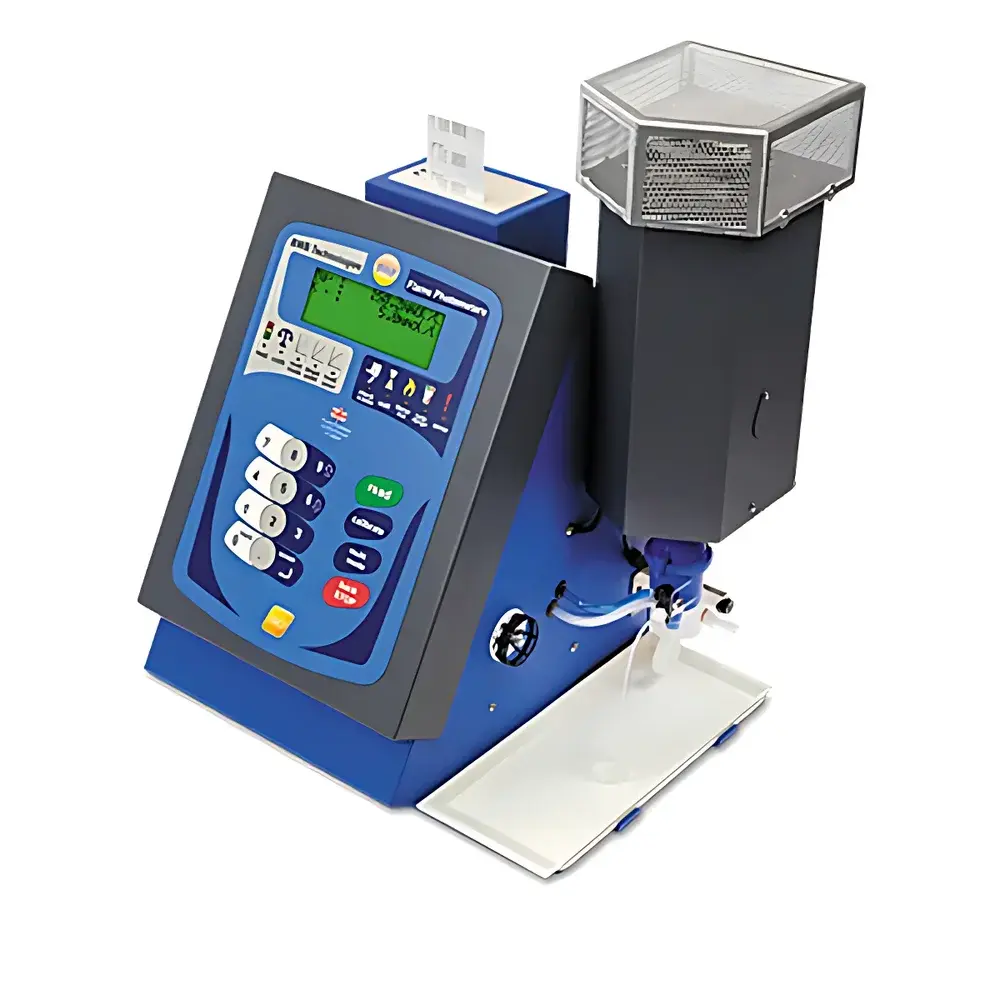
BWB FL Multi-Element Flame Photometer
| Brand | BWB |
|---|---|
| Origin | United Kingdom |
| Model | BWB FL |
| Detection Range | Na: 0.05–1000 ppm, K: 0.05–1000 ppm, Li: 0.1–1000 ppm, Ca: 2.5–1000 ppm, Ba: 5–1000 ppm |
| Detection Limit | Na/K: 0.02 ppm, Li: 0.05 ppm, Ca: 1.0 ppm, Ba: 2.0 ppm |
| Response Time | <15 s |
| Repeatability | CV <1% at 100 ppm (n=20, >10 min post-stabilization) |
| Sample Uptake Rate | 3.0–5.5 mL/min |
| Air Supply | Integrated silent air compressor (switchable to external source) |
| Compliance | CE-marked, GLP-compliant architecture, FDA 21 CFR Part 11-ready software support |
Overview
The BWB FL Multi-Element Flame Photometer is a high-precision, benchtop atomic emission spectrometer engineered for quantitative analysis of alkali and alkaline earth metals—including sodium (Na), potassium (K), lithium (Li), calcium (Ca), and barium (Ba)—in aqueous and digested liquid samples. Based on the fundamental principle of flame atomic emission spectroscopy (FAES), the instrument atomizes sample solutions in a stable, premixed air–fuel flame (propane, butane, LPG, or natural gas), where thermally excited metal ions emit characteristic wavelengths. These emissions are isolated via interference filters and measured by photodiodes with temperature-stabilized electronics, ensuring long-term signal integrity and minimal spectral overlap. Unlike single-channel or sequential systems, the BWB FL employs a modular optical path design that supports up to five independently selectable filter positions—enabling flexible multi-element configuration without hardware modification. Its integrated silent air compressor eliminates dependency on external compressed air infrastructure, while its robust burner head and optimized nebulizer system deliver consistent aerosol generation across the full dynamic range.
Key Features
- Five-position filter wheel supporting simultaneous or sequential measurement of Na, K, Li, Ca, and Ba—with user-selectable display order and real-time concentration ranking
- Multi-point calibration capability (2–5 points) with automatic curve fitting; calibration data stored internally with timestamp, operator ID, and standard lot traceability
- Configurable concentration units: ppm, mg/L, mmol/L, meq/L; adjustable resolution (0.001–100 units)
- Automated safety protocols: flame-out detection with immediate gas cutoff, auto-shutdown after 30 min idle, and power-on self-diagnostic sequence
- Dual air supply mode: built-in oil-free silent compressor (6 bar, 4.5 L/min) + rear-panel port for external air source switching
- Analog output (0–1 V DC) compatible with strip chart recorders, PLCs, or SCADA interfaces
- Digital connectivity via RS232 and USB-B ports; firmware-upgradable architecture with remote diagnostics and maintenance alert logging
- Thermal drift compensation: ≤1% signal deviation after 30 min warm-up under ambient temperature fluctuations ±2 °C
Sample Compatibility & Compliance
The BWB FL accepts clarified, low-viscosity aqueous solutions—commonly derived from acid digestion (e.g., HNO₃/HCl), ion exchange eluates, or direct dilution of biological fluids (serum, milk, plant extracts). It is validated for use with ASTM D1317 (sodium in gasoline), ISO 9297 (potassium in fertilizers), USP (calcium in pharmaceutical excipients), and EN 16171 (alkalis in cement). All internal wetted components are chemically resistant (PTFE, borosilicate glass, stainless steel 316), minimizing memory effects and enabling rapid rinse cycles between high- and low-concentration samples. The system meets CE Directive 2014/30/EU (EMC) and 2014/35/EU (LVD); its mechanical and electrical design conforms to IEC 61010-1:2010 for laboratory equipment safety. Data handling workflows align with GLP requirements, including electronic signature support, audit trail generation, and secure user access levels (admin/operator/guest).
Software & Data Management
The included FP-PC software provides a Windows-based interface for instrument control, method development, and regulatory-grade reporting. It supports graphical real-time monitoring of all active channels, customizable report templates (including GLP header fields: analyst, date/time, instrument ID, calibration status), and batch export of up to 10 sample results per report in PDF or CSV. Raw intensity values, background-corrected net signals, and calibration residuals are archived with metadata (sample ID, dilution factor, filter used, flame stability index). Data files are digitally signed and time-stamped using SHA-256 hashing; optional integration with laboratory information management systems (LIMS) is supported via ODBC drivers. Software updates preserve historical calibration libraries and user-defined methods, ensuring continuity during instrument lifecycle management.
Applications
- Geochemical analysis: Na/K ratios in silicates, feldspars, and soil exchangeable cations (ASTM D512)
- Cement and construction materials: Alkali content screening per ASTM C1777 and EN 196-2
- Agricultural science: K⁺ in fertilizers, plant tissue digests, and animal feed extracts
- Foods & beverages: Ca²⁺ in dairy products, Na⁺/K⁺ balance in juices and beer (AOAC 985.27)
- Pharmaceutical QC: Calcium quantification in antacids and IV formulations (USP )
- Petroleum testing: Sodium contamination in crude oil and refined fuels (ASTM D3229)
- Environmental monitoring: Exchangeable Na⁺ in sodic soils (SAE method), Li⁺ in geothermal brines
- Industrial process control: Ba²⁺ in catalyst slurries, Li⁺ in battery electrolyte recycling streams
FAQ
What fuel gases are compatible with the BWB FL?
Propane, butane, liquefied petroleum gas (LPG), and natural gas—all regulated via integrated pressure-reducing valves and flow controllers calibrated for optimal flame stoichiometry.
Can the BWB FL perform simultaneous multi-element analysis?
No—it does not acquire all five elements concurrently. However, its five-filter wheel enables rapid sequential measurement (<15 s per element) with synchronized sample aspiration, effectively delivering quasi-simultaneous results for routine QA/QC workflows.
Is the instrument suitable for high-salinity samples such as seawater or brines?
Yes, provided samples undergo appropriate dilution and matrix-matching with standards; optional internal standard addition (e.g., Cs for K correction) mitigates ionization interference in complex matrices.
How is calibration verification performed between runs?
A dedicated “Cal Check” function re-measures one primary standard at user-defined intervals (e.g., every 10 samples), triggering an alert if deviation exceeds ±3% of expected value—logging both raw and corrected response.
Does the FP-PC software comply with 21 CFR Part 11?
The software includes foundational controls (electronic signatures, audit trails, role-based access), and can be configured to meet Part 11 requirements when deployed on validated IT infrastructure with documented SOPs and change control procedures.





